Imagine being a visibly Jewish person in the Netherlands today. Or imagine being an Israeli living, working, or traveling here. One day you need urgent medical care. You need a doctor. You need someone whose profession is built on trust, neutrality, and the commitment to save lives.
Would you feel completely safe?
That question may sound shocking. It should. Yet recent events have made it impossible for many Jews and Israelis to ignore.
Every doctor takes an oath. It is not merely a formality. It is a promise to society.
Doctors swear that they will practice medicine to the best of their ability in service of their fellow human beings. They promise to care for the sick, promote health, relieve suffering, place the interests of patients first, do no harm, respect different beliefs, keep confidences, and provide equal medical care to everyone.
Equal medical care to everyone.
Those words matter.
Now imagine two countries at war.
One country values life above all else. Its people build, innovate, and repeatedly seek compromise in the hope of peace. Let us call that country Sion.
The other side has a culture in which martyrdom is often glorified. Martyrdom is the act of suffering persecution, injury, imprisonment, or death because of one’s beliefs or cause. In many societies, the willingness to die for a cause is considered noble and heroic. Let us call that land Hanam.
As conflict rages between these two fictional nations, people from Hanam settle in Europe. Some integrate peacefully. Others bring their political passions with them. Among them is a doctor who openly supports Hanam and deeply hates Sion.
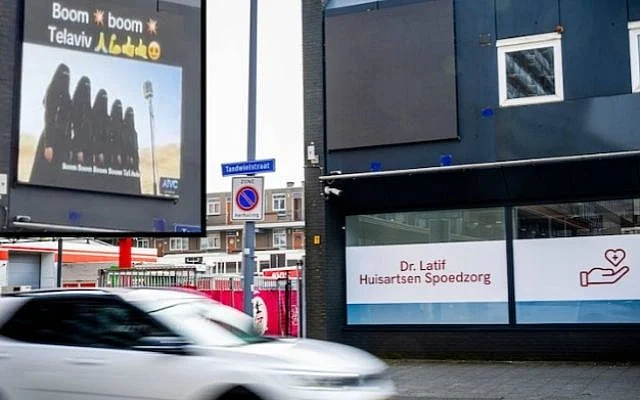
Then imagine that this doctor displays videos outside his clinic that celebrate violence against the people of Sion and call for their deaths.
Would you trust that doctor with your life?
Would you trust him with your child’s life?
Most people would hesitate.
The issue is not political disagreement. Doctors are human beings and are entitled to personal opinions. The issue arises when those opinions cross the line into advocating violence against a group of people who may one day become patients.
This is why the recent controversy in Rotterdam was so disturbing. Reports emerged about an out of hours medical clinic near Zuidplein where videos were displayed on a large screen. The lyrics reportedly included phrases such as “Boom boom Tel Aviv”, “Humanity expects no good behavior from you Jews”, and “It is your time to bleed.”
Whether one supports Israel, Palestine, or neither side should be irrelevant. A medical facility should never be associated with messages that glorify violence against civilians or target people because they are Jews.
Yet this incident did not happen in isolation.
Across the Netherlands there is a growing sense among many Jews that hostility toward Israel is increasingly spilling over into hostility toward Jews themselves. Public figures can make extreme statements with little consequence. Demonstrations regularly feature rhetoric that would be unacceptable if directed at almost any other minority group.
At the same time, many Jewish patients find themselves wondering about the views of the professionals responsible for their care.
I admit that I check. I have looked at the social media profiles of medical professionals I might one day visit. I have seen doctors enthusiastically supporting accusations against Israel and sharing highly partisan political content. Perhaps they would still treat every patient fairly. Perhaps they would remain completely professional.
But should patients have to wonder?
Trust is the foundation of medicine. Once trust is damaged, the relationship between doctor and patient suffers.
What makes this even more troubling is that medicine is one of the professions that should remain above political conflict. Alongside teachers and journalists, doctors have a special responsibility. Society depends on them being able to treat people equally regardless of nationality, religion, ethnicity, or political belief.
The ideal is not impossible.
Israeli hospitals have treated Palestinian patients for decades. Israeli doctors have treated terrorists and enemy combatants because medical ethics demanded it. The duty of a physician is to treat the human being in front of them, not to judge whether they agree with that person’s politics.
The idea that doctors always remain neutral during war has also been challenged by deeply disturbing allegations from the Israel Hamas conflict. Israeli hostage Noa Marciano was recovered near Al Shifa Hospital in Gaza after being taken captive on October 7. In December 2025, her father, Avi Marciano, revealed that he had received and viewed a video which, according to him, showed a doctor injecting air into her veins while she pleaded for her life. According to the family, she had been wounded but was not suffering from life threatening injuries when she arrived at the hospital. If the account is accurate, it would represent one of the most shocking violations of medical ethics imaginable. It stands in stark contrast to the conduct expected from physicians who swear to preserve life, relieve suffering, and treat every patient equally regardless of nationality, religion, or political affiliation.
That principle must be universal.
When medical professionals openly celebrate violence, call for the destruction of groups of people, or create reasonable doubt about their ability to treat all patients equally, there must be consequences.
Freedom of speech is important. Professional responsibility is also important.
A doctor who publicly advocates violence against potential patients undermines confidence in the entire medical profession. Regulatory bodies should take such behavior seriously. Investigations should be conducted. Ethical standards should be enforced. Where those standards are clearly violated, disciplinary measures should follow.
The question is not whether someone supports Israel or Palestine.
The real question is much simpler.
Can a patient trust that a doctor will see a human being rather than a political enemy?
If the answer to that question is uncertain, then something has gone deeply wrong.
And if society tolerates that uncertainty in the medical profession, we should all be concerned.