Values, Culture, and the Search for Peace
Most of us grow up with a basic understanding of right and wrong. We are taught to tell the truth, not to steal, to respect others even when we disagree with them, and to judge people as individuals rather than as members of a group. We learn about responsibility, loyalty, honesty, and compassion.
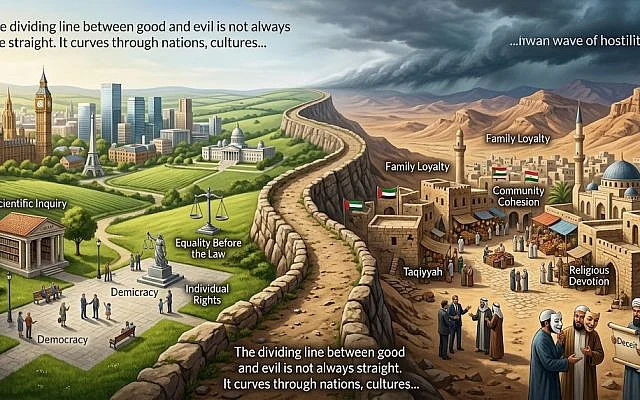
Western societies are often built upon principles such as freedom of speech, freedom of religion, equality before the law, democracy, individual rights, protection of minorities, gender equality, and scientific inquiry. Countries such as the Netherlands, the United Kingdom, Canada, and Australia each have their own political debates and imperfections, yet these ideals remain influential in public life.
Other cultures may place greater emphasis on values such as family loyalty, respect for elders, community cohesion, religious devotion, social stability, collective responsibility, honor, and reputation. These values are not necessarily incompatible with Western ideals, but differences in emphasis can sometimes create misunderstandings when people from different backgrounds interact.
For many years, I believed that goodwill, understanding, and dialogue could overcome almost any cultural difference. Then I had an experience that challenged some of my assumptions.
Years ago, I entered into a brief relationship with an Iraqi refugee who presented himself as a moderate Muslim. He described himself as supportive of Israel and claimed to have assisted American forces in Iraq.
Over time, I discovered that much of what he had told me was untrue.
Our differences went beyond personal dishonesty. We appeared to have very different expectations regarding relationships, gender roles, emotional expression, and personal responsibility. Behaviors that I considered normal were often viewed very differently by him.
Eventually I ended the relationship and later learned that he was already married and had children.
The experience was painful, but it also forced me to think more deeply about the role culture, values, and upbringing play in shaping people’s expectations and behavior.
This is not an argument about race or ethnicity. Nor do I believe that any culture, religion, or nationality can be reduced to a single set of characteristics. Individuals vary enormously. Nevertheless, cultural norms can influence how people view authority, family, gender roles, religion, and individual freedom.
That realization led me to a broader question: can societies with significantly different values and priorities always coexist easily, or do some differences create lasting tensions that must be acknowledged honestly?
Today I see a similar challenge in the public debate surrounding Israel.
Across social media, information and misinformation spread at extraordinary speed. Complex historical events are often reduced to simplistic narratives. Facts are sometimes ignored, context is lost, and emotional reactions frequently overshadow careful analysis.
What concerns me most is not that misinformation exists. It is that many people, including those in democratic societies, can be influenced by narratives that appeal more to emotion than to evidence.
As someone who supports Israel, I have watched with growing concern the increase in hostility toward Israel and, in some cases, toward Jewish communities around the world. I find many of these developments deeply troubling.
The conflict surrounding Israel is often presented primarily as a dispute over territory. While territory is certainly part of the issue, I believe the conflict also involves competing historical narratives, political visions, security concerns, religious beliefs, and differing ideas about governance and society.
Ideas matter. Values matter. Cultural attitudes matter. Understanding those differences does not require hostility toward others, but it does require honesty about the challenges they can create.
One encouraging development has been the Abraham Accords, which demonstrated that cooperation and normalization are possible even in a region marked by decades of conflict.
Yet lasting peace requires more than diplomatic agreements. It requires trust, security, and a willingness among all parties to recognize one another’s legitimacy and humanity.
The dream of peace remains worth pursuing.
But peace cannot be built on wishful thinking alone. It requires a clear-eyed understanding of reality, including the disagreements, fears, and cultural differences that continue to shape the region.
The dividing line between good and evil is not always straight. It runs through nations, communities, ideologies, and individuals—including ourselves.
Recognizing that complexity may be one of the first steps toward building a safer and more peaceful future for everyone involved.