There are moments when a single word is enough. Not a slogan, not a political statement, not a defense but a reaction from the heart. For me, that word is WOW. Not because Israel is perfect, not because the IDF is without flaws, but because sometimes Israel reveals something so deeply human, so morally clear, that all the noise, lies, and hatred collapse under the weight of truth.
This blog is about one of those moments. It is about Judaism, human dignity, disability, and an extraordinary Israeli program called “Special in Uniform.” It is also, unavoidably, a pro-Israel story because values matter, and actions matter even more.
Human Dignity as a First Principle
In Judaism, people with disabilities, including those with Down syndrome, are viewed through a fundamentally different moral and spiritual lens than in many societies throughout history. The core idea is simple but radical: human dignity is intrinsic. It does not depend on intelligence, physical ability, productivity, independence, or usefulness.
Judaism teaches that every human being is created b’tzelem Elokim, in the image of God (Genesis 1:27). This is not poetic language. It is a legal, ethical, and spiritual foundation. There are no degrees of divine image. A person with Down syndrome does not possess less humanity, less holiness, or less worth. Respect is not something you earn. It is something you are owed by virtue of being human.
This stands in sharp contrast to ideologies, ancient and modern, that rank people based on perceived value, efficiency, or perfection. Judaism rejects that hierarchy outright.
Value Is Not Measured by Utility
Many cultures, especially in the modern West, quietly measure human worth by productivity and independence. Judaism refuses this metric. The Talmud teaches that one who saves a single life is considered as if they saved an entire world (Sanhedrin 37a). No footnotes. No categories. No exceptions.
A person’s value lies not in what they produce, but in the fact that they exist.
This belief shapes Jewish ethics profoundly. It explains why humiliating or shaming another person, especially someone vulnerable, is considered a grave moral offense. The sages compare public humiliation to shedding blood. Words can kill dignity, and dignity is sacred.
Compassion Is Not Optional
The Torah repeatedly commands special care for the vulnerable: the orphan, the widow, the stranger, the poor, and those who depend on others. Jewish society is judged not by how it treats its strongest members, but by how it treats its weakest.
Caring for people with disabilities is not viewed as charity alone; it is a religious obligation. Acts of kindness (chesed) are central to Jewish life, not as optional virtues but as commandments. Inclusion is not a modern trend imported from progressive ideology. It is deeply Jewish.
That is why, in many Jewish communities, people with Down syndrome and other disabilities are actively included in schools, synagogues, religious ceremonies, community events, and even employment frameworks. Not as mascots. Not as symbols. But as full participants in communal life.
A Different Understanding of “Perfection”
Judaism does not idolize physical or intellectual perfection. Some of the greatest figures in Jewish history had limitations. Moses struggled with speech. Isaac became blind. Jacob walked with a limp. None of this diminished their greatness.
Greatness in Judaism is measured by moral character, effort, responsibility, and the soul, not by flawless bodies or superior intellect. This worldview stands in direct opposition to dehumanizing ideologies such as eugenics, forced sterilization, or the idea that some lives are “less worth living.”
Jewish history has taught, at an unbearable cost, what happens when societies decide that certain people are expendable.
Then Comes Israel and the IDF
And then there is Israel.
The Israel Defense Forces are often portrayed as the embodiment of cold power: masculine, macho, unemotional. Critics describe the IDF as ruthless, brutal, even inhuman. But those narratives collapse the moment you look honestly at programs like Special in Uniform.
A few years ago, I attended an event about this remarkable initiative, featuring Lt. Col. Tiran Attia and journalist Eli Mandelbaum. I expected an interesting presentation. I did not expect to be emotionally shaken.
Lt. Col. Tiran Attia’s Turning Point
Tiran Attia is not a sentimental man. He is a career officer. During the Second Lebanon War, he was severely injured in an explosion and left paralyzed from the neck down. In that moment, stripped of strength, identity, and control, he did not want to live. He tried to stop treatment. He refused food and water.
Then something unexpected happened.
A group of people with special needs came to visit him. One of them, a young woman, gently took his arm. She touched him, trying to make him feel something. He could not respond. But he felt her presence, her effort, her humanity, her energy.
When she left, she turned back and said, simply: “All will be okay.”
Shortly afterward, Tiran began to feel sensation returning, slowly, painfully. After months of intense rehabilitation, he stood on his feet again. With medical help, yes, but also, in his words, with the help of Hashem.
That experience shattered his assumptions. Who was he to judge who was “whole” and who was not? Who was he to rank human beings, when every person is created in the image of God?
Special in Uniform: Values in Action
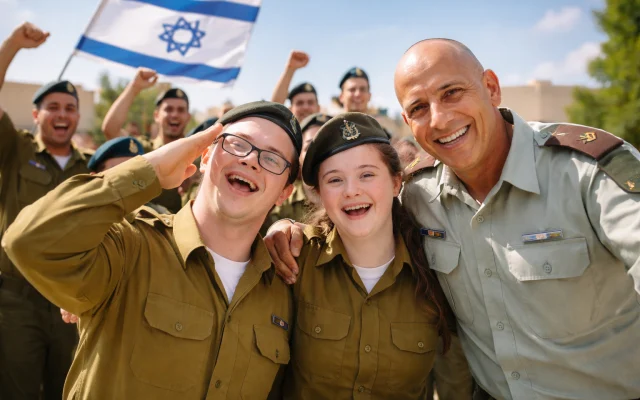
From that moment, Tiran Attia dedicated his life to Special in Uniform, a program that integrates people with special needs into the IDF in meaningful, tailored roles.
Today, more than 400 soldiers with special needs serve in the Israeli army through this program, with many on the waiting list. These are not symbolic positions. Soldiers are trained according to their abilities and talents. They contribute. They grow. They serve their country with pride.
The benefits are profound. Individuals develop skills, independence, and self-esteem. Families witness capabilities they were told not to expect. Fellow soldiers learn humility, responsibility, and gratitude. After their service, many participants successfully enter the Israeli labor market.
This is not charity. This is dignity in action.
Imagine the Pride
Imagine the pride of that young soldier in uniform. Imagine the pride of their parents. Imagine the pride of a country that refuses to discard its most vulnerable.
And then ask yourself: how can people hate Israel? How can they demonize the IDF while ignoring programs like this, programs that reveal not brutality, but moral courage?
I felt proud. Deeply proud. And at the same time, deeply shaken by the scale of Israel-hatred and Jew-hatred in the world. Because when facts like these are ignored, hatred is no longer ignorance, it is willful blindness.
If you want to judge Israel, judge it honestly. Look at its values. Look at its actions. Look at how it treats those who cannot defend themselves.
Then look into your own heart and see the truth.
Am Yisrael Chai.