I grew up in the Netherlands in a secular family, shaped more by observation than belief. We had a deep respect for Jewish culture and religion, and, if I am honest, a quiet skepticism toward Christianity. That may sound unusual given that I attended Catholic and later Christian schools, including a military pre school when we lived in Germany. Yet I never felt a sense of belonging there. Faith, as practiced around me, often felt closed rather than welcoming.
Everything changed in 1978, when my father was sent to Syria under the old Assad regime. I was young, but old enough to absorb what I saw and to recognize, even then, that something was deeply off. We had just settled into life in Damascus when elections were announced. That word, elections, carried a certain meaning in my Dutch upbringing. It implied choice, debate, and freedom. What I witnessed instead was something else entirely.
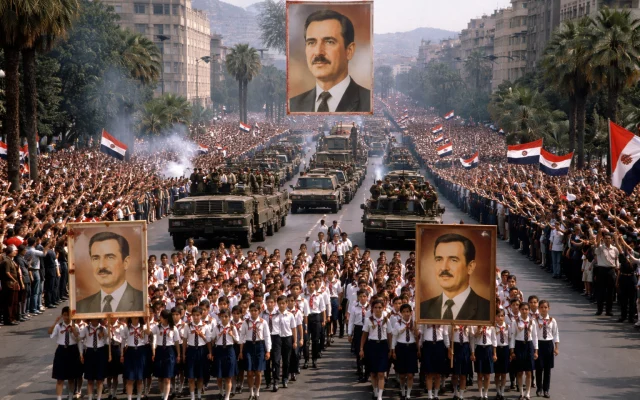
My father was invited by a Syrian woman whose husband had died in the Yom Kippur war. From her home, we could look out over the street. What unfolded felt like a performance rather than a civic process. Massive parades filled the roads. Schoolchildren marched in formation. Military vehicles rolled by. Men fired guns wildly into the air. Everywhere there were portraits of Assad, carried by children who looked too young to understand what they were participating in.
This was presented as democracy. The candidates, as we were told, were Assad, Assad, and Assad.
We asked the woman why so many children were involved. Her answer was calm, almost resigned. Attendance was mandatory. Her own daughter had been sick that day, but even then, they had received a warning that absence would bring consequences. That moment stayed with me. It was my first real encounter with a system built not on freedom, but on fear. The word democracy had been hollowed out and repurposed as a tool of control.
There was another moment that left an equally deep impression. Our landlady had a daughter my age, Lumah. She was eleven. One day she told me about an upcoming school trip. I imagined something familiar, perhaps a zoo or a park, something lighthearted. Instead, they were going to Quneitra, a city destroyed during the war.
The trip was not about curiosity or learning in any open sense. It was framed as a lesson in hatred. The children would travel by bus, accompanied by armed soldiers who were there, she said, to protect them from “dirty Jews” who might attack. This was 1978. Lumah repeated these words as if they were simple facts. She had been taught this from the beginning, and there was no space in her world to question it.
What struck me then, and still troubles me now, is how early and how systematically these ideas were planted, from cradle to grave, children were being fed a narrative of fear and hostility. It was not incidental. It was organized, deliberate, and reinforced at every level of society.
Looking back, I cannot ignore the parallels I see today. The mechanisms of indoctrination may differ in form, but the essence remains. Take the UNWRA schools in Gaza, where books of Mein Kamf and other anti-Jewish material are found or were terrorists with portraits on the walls of the schools are idolized like they are heroes instead of terrorists. When education becomes a vehicle for propaganda, when history is twisted to serve ideology, the result is generations raised not to think, but to react.
This is not a problem confined to one region. It forces an uncomfortable question. How often do we allow distorted narratives to take root in our own societies. Even in the Netherlands, I have seen debates about limiting Holocaust education out of fear of offending certain groups. That, to me, is not sensitivity. It is a failure of responsibility. When we avoid truth to maintain comfort, we create space for ignorance to grow.
The world is more connected than ever, yet misinformation spreads faster than knowledge. Old prejudices, especially antisemitism, do not disappear. They adapt, sometimes hidden, sometimes openly expressed, often amplified by digital platforms that reward outrage over understanding.
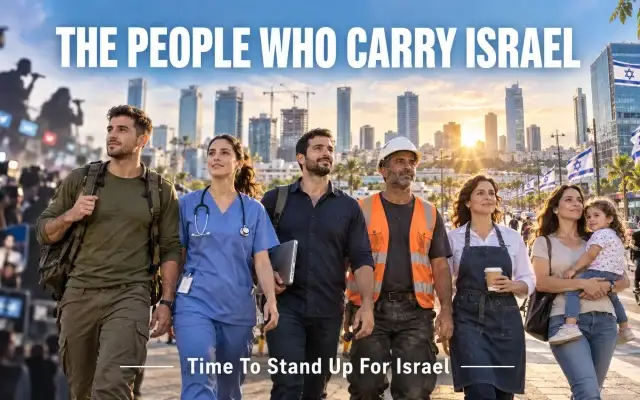
If there is one lesson I take from all of this, it is the importance of clarity and resilience. I have seen what happens when a society abandons truth. I have seen how easily children can be shaped by fear. And I have also seen the contrast in a place like Israel, where despite constant pressure, there remains a commitment to life, to learning, and to moving forward.
Knowledge is not just power. It is protection. Without it, and without a willingness to confront uncomfortable realities, any society is vulnerable. Positivity, too, is not naive optimism. It is a conscious choice to build rather than to destroy.
That is why I hold on to a simple conviction. Survival, both cultural and moral, depends on truth, on education, and on the courage to stand by both.
Am Yisrael chai.