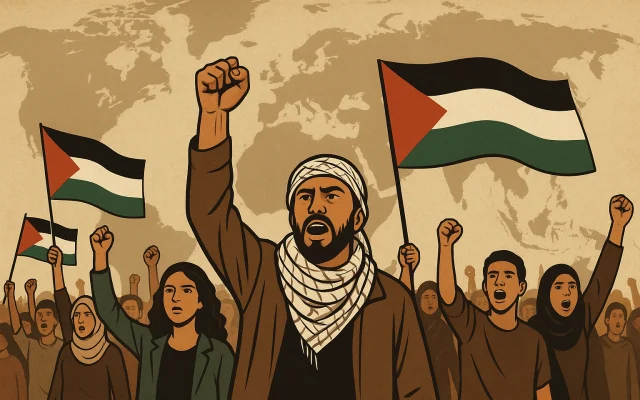
“Globalize the Intifada” Is the Globalization of Moral Collapse
The slogan “Globalize the Intifada” is often defended as rhetoric, metaphor, or radical speech. That defense collapses the moment we look at history and at the real-world consequences unfolding before our eyes.
This is not a slogan about justice.
It is a call to normalize terror, export it, and morally disinfect it for a global audience.
The historical truth activists refuse to name
An intifada was not a peaceful civil rights movement. The Second Intifada (2000–2005) in particular was defined by:
Suicide bombings on buses and in cafés
Mass shootings of civilians
Lynching attempts
Targeted attacks on children, families, and the elderly
Israeli civilians were not collateral damage; they were the target. That is an historical fact, documented by international media, human rights organizations, and court rulings.
To call for an intifada—anywhere—is to invoke that model of violence.
To call to globalize it is to say: take these tactics, this worldview, and this moral logic to the rest of the world.
From localized terror to global permission
“Globalize the Intifada” does something more dangerous than incite individual attacks. It rewires moral perception.
Through endless repetition on social media, the slogan:
Rebrands murder as “resistance”
Frames civilians as legitimate targets
Erases the difference between a soldier and a child
Removes individual responsibility by blaming an entire people
This is how terror movements have always operated, not only through weapons, but through language that numbs conscience.
When violence is renamed justice often enough, people stop asking who is bleeding.
The Bondi Hanukkah attack: ideology made flesh
In December 2025, Jews celebrating Hanukkah in Bondi were attacked while marking a holiday centered on light, survival, and religious freedom. They were not protesting. They were not political actors. They were families.
That attack did not emerge from nowhere. It emerged from an environment where:
Jews are portrayed as symbols, not humans
Violence against them is contextualized, excused, or minimized
Slogans like “Globalize the Intifada” are chanted without shame
This is how ideology becomes action. Not overnight—but inevitably.
A pattern, not an anomaly
Bondi is not an exception. It is part of a global pattern:
Synagogues vandalized or attacked
Jewish schools requiring armed protection
Jews assaulted in Europe and North America for visibly existing
Terror attacks followed by rationalizations instead of condemnation
Each time, the same language appears afterward: anger, context, resistance.
Rarely do we hear the word that actually fits: terror.
Social media as a radicalization engine
What makes this moment uniquely dangerous is scale.
In past decades, radicalization took place in closed circles. Today, it happens algorithmically. Violent slogans are packaged into memes, chants, and viral clips. Nuance dies. History is flattened. Emotion replaces ethics.
Young people are taught:
That violence is authenticity
That empathy is betrayal
That moral clarity is “colonial”
That Jews are a concept, not a people
This is not political education.
It is moral poisoning.
When good and evil become interchangeable, when murder is reframed as courage, society does not become more just—it becomes more brutal.
This is not about Israel alone
“Globalize the Intifada” does not threaten only Israelis. It threatens the moral foundations of pluralistic societies everywhere.
A worldview that celebrates violence against civilians will not stop at one group. History is unambiguous on this point.
Every time societies tolerated the dehumanization of Jews “for a cause,” they eventually paid the price themselves.
Words still matter
History also teaches us something else:
Violence is always preceded by language that makes it feel necessary.
If we still care about human rights, if we still believe civilians should never be targets, then we must say this clearly and without apology:
Globalizing terror is not liberation.
It is the abandonment of morality itself.
And once that line is crossed, no society remains safe.