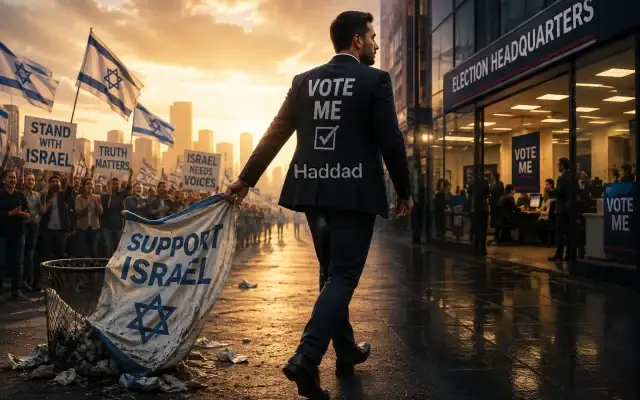
The world claims to care about human rights. It marches, boycotts, petitions, and floods social media with slogans about justice. Yet when you step back and look at where this energy is directed and where it is not, the pattern is impossible to ignore. What we are witnessing is not universal humanitarianism, but selective outrage. And once again, Israel sits at the center of it, while far greater atrocities unfold in near silence.
Gaza dominates headlines, protests, UN debates, NGO campaigns, and Western political pressure. Sudan barely registers. Afghanistan has faded into the background. And now Iran, where hundreds of thousands of civilians are risking their lives in open defiance of a brutal regime, is met with a deafening global silence.
This is not coincidence. It is a moral failure.
A World Obsessed With One Small Strip of Land
Gaza covers roughly 365 square kilometers. It is one of the most densely populated areas on earth, and suffering there is real and tragic. But compare that obsessive focus with the scale of other crises.
Sudan is engulfed in a civil war that has displaced more than 10 million people, caused mass starvation, ethnic cleansing, and systematic sexual violence. Entire regions have collapsed into chaos. Aid convoys are blocked. Journalists are absent. Social media barely notices.
Afghanistan has erased women from public life. Girls are banned from secondary education. Forced marriages, hunger, and fear define daily existence. The Taliban governs through executions and repression. Yet there are no global marches, no campus occupations, no endless UN resolutions.
And now Iran.
Iran Burns and the World Looks Away
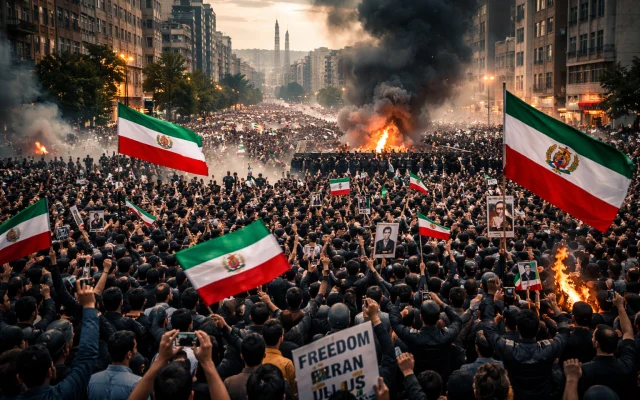
Across Iran, civilians are taking to the streets in unprecedented numbers. Men and women, young and old, are openly challenging a regime built on fear. They know the cost. They march anyway.
The response of the Islamic Republic is predictable and brutal: live ammunition, mass arrests, torture, disappearances, and executions. Civilians are being murdered by their own government for demanding basic dignity and freedom.
This is what real oppression looks like.
Yet where are the outrage campaigns? Where are the daily headlines, the emergency UN sessions, the flood of NGO reports, the university protests, the celebrities posting black squares? They are largely absent, because Iran is a dictatorship, because it does not listen, and because there are no Jews to blame.
NGOs: Overconcentration and Absence
Gaza hosts one of the highest per-capita concentrations of international NGOs in the world: UNRWA, Amnesty International, Human Rights Watch, Oxfam, Doctors Without Borders, Save the Children, and many more.
In Sudan, NGOs struggle to operate at all. In Afghanistan, aid is constrained by Taliban control. In Iran, activists are hunted down and silenced.
This disparity exposes an uncomfortable truth: NGOs gravitate toward places where Western pressure can be applied and reputations can be built. Israel, a democratic, open, legally accountable state, is targeted precisely because it can be pressured. Dictatorships are ignored because they cannot.
Israel is attacked because it listens. Tyrannies are spared because they don’t.
The Israel Exception
Israel is expected to fight a genocidal terrorist organization, Hamas, that embeds itself in civilian areas, uses hospitals and schools as military infrastructure, and deliberately targets civilians, while behaving as if it were fighting a conventional army on an empty battlefield.
No other country is held to this standard.
When the United States fought ISIS, civilian casualties were tragic but accepted as the reality of war. When Arab regimes flatten cities, the world shrugs. When Iran arms proxies that destabilize entire regions, it is treated as a “complex actor.”
When Israel defends itself, it is accused of genocide, often by people who cannot define the word.
This double standard is not humanitarian. It is political. And in its effect, it is increasingly antisemitic.
Western Projection and Moral Laundering
Western countries, including my own in Europe, feel uniquely entitled to lecture Israel. This moral posturing is deeply ironic.
Many of these societies have histories of colonial violence, slavery, and catastrophic moral failure. The Netherlands, for example, lost over 75% of its Jewish population during the Holocaust, one of the highest rates in Western Europe. That did not happen in a vacuum.
Condemning Israel has become a way to cleanse collective conscience without confronting past or present failures. Israel functions as the world’s moral laundering machine. By fixating on the Jewish state, Western elites avoid dealing with Sudan, Afghanistan, Iran, or their own complicity in global injustice.
This is not justice. It is projection.
What Real Solidarity Looks Like
If the world truly cares about civilians, it must care consistently.
That means speaking about Sudan when there are no Jews involved.
That means defending Afghan women even when hashtags are no longer trending.
That means standing with Iranian civilians who are being shot in the streets without calculating geopolitical convenience.
And it means telling the truth about Israel: a small democracy fighting for survival against forces that openly seek its destruction, while being judged by standards no other nation is expected to meet.
Stop Being Loud, Start Being Honest
A better world is not one that shouts at Israel.
It is one that confronts real evil.
One that condemns jihadist terror without apology.
One that holds dictators accountable, not just democracies.
One that listens to Iranians, Sudanese, Afghans, and Israelis alike.
Israel is not the problem.
Israel is the mirror.
And what much of the world sees reflected back is its own selective conscience, moral confusion, and fear of facing where the real horrors are unfolding.
It is time to stop obsessing over 365 square kilometers and start caring about the millions suffering far beyond it.