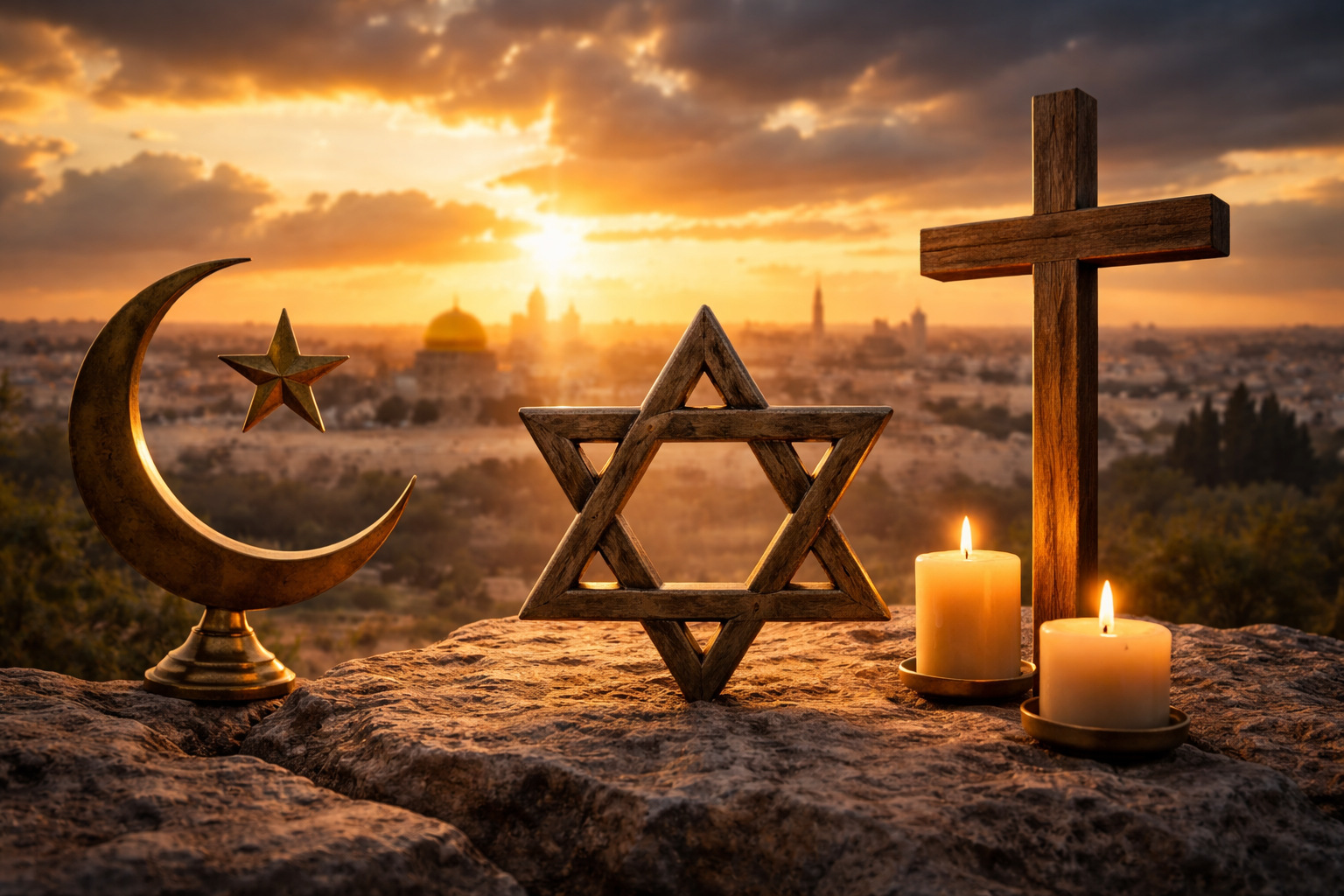
War, Peace, and Life in Three Faiths
If you look at Judaism, Christianity, and Islam, the three traditions most often pulled into debate, you find something striking. At their core, all three begin from the same uncomfortable truth. The world is not peaceful, and human beings are capable of both great compassion and terrible harm. The real question each religion wrestles with is not whether violence exists, but when it can be justified. More importantly, what is the value of a human life when those moments arise.
Judaism takes perhaps the most grounded approach. It does not romanticize war, nor does it build identity around it. Instead, it places an almost radical emphasis on preserving life here and now. The principle of pikuach nefesh holds that saving a life overrides nearly every other religious obligation. This is not abstract theology. It is law and moral priority. If a rule endangers life, the rule bends.
War, in this framework, is not glorified. It is permitted in cases like self defense, but tightly restricted and surrounded by ethical boundaries. It is treated as a tragic necessity, never as a righteous calling. The message is unmistakable. Before ideology, before territory, before even certain religious duties, there is life.
That moral clarity matters today. In a region where survival is not theoretical, Israel reflects this same principle in practice. The duty to protect life is not optional. It is the foundation. When a nation faces threats to its existence, restraint is not weakness, but responsibility. The right to defend life is inseparable from the obligation to value it.
Christianity begins in a different place. Its central teachings emphasize nonviolence in direct terms. Love your enemies. Turn the other cheek. Forgive without limit. It is not just moral advice. It is a redefinition of power itself. Yet history forced confrontation with reality.
As Christianity moved from persecuted minority to political authority, it had to govern, defend, and at times fight. Out of that tension came the idea of just war, an attempt to reconcile peace with resistance to injustice. War is never good in this view, but it may be tolerated under strict conditions. As a last resort, for a just cause, with restraint and protection for civilians.
The tension remains. Christianity carries a divide between its pacifist ideal and the demands of history.
Islam approaches the issue with a more explicit legal structure. It recognizes conflict as part of human society and builds detailed rules around it. The concept of jihad is reduced to violence in public discourse, but it also refers to internal struggle, the effort to live rightly. Armed struggle exists within that framework as well.
Fighting is permitted in self defense, against oppression, or to protect the community. It comes with firm prohibitions. Civilians cannot be targeted. Force must be proportional. Peace must be accepted if offered. Islam does not deny war. It attempts to discipline it.
Yet the gap between principle and reality can be wide. In the English speaking world, the emphasis is on peace and resilience. In other contexts, interpretations shift. Language hardens. Meaning becomes more severe. In places like Afghanistan, the difference is impossible to ignore.
There, extremist interpretations dominate. Groups like the Taliban impose a rigid, literalist, and deeply patriarchal version of Islam, enforced through harsh punishment. Afghan society, shaped by tribal structures and local authority, blends culture, tradition, and religion into a system that can become profoundly oppressive.
This contrast reveals something important. Religion alone does not explain violence. Interpretation, power, and social structure shape outcomes.
For a long time, it was easy to blame religion, especially Islam, for war. That explanation is too simple.
Wars do not begin with a single spark. They are built slowly, layer upon layer, from human fears, ambitions, and failures. By the time the first shot is fired, the conditions have often existed for years.
Power remains one of the oldest drivers. States seek influence, control, and dominance. This is not always about necessity. It is often about pride and the belief that strength must be demonstrated. When multiple actors pursue power at once, conflict becomes likely.
Fear is just as powerful. Nations fight not only to gain, but to avoid losing. Suspicion turns neighbors into threats. Defensive actions are seen as aggression. Each side prepares for the worst, and the spiral tightens.
Resources add pressure. Land, water, energy, and trade routes have fueled countless conflicts. Scarcity sharpens competition. When survival appears tied to control, compromise becomes difficult.
Ideas deepen the divide. Religion, ideology, and nationalism can turn political disputes into moral battles. When people believe they are fighting for their way of life, wars intensify. Opponents become existential enemies.
Economic interests operate in the background. War can benefit industries and individuals. Economic instability can push leaders toward conflict as distraction or opportunity.
Diplomatic failure seals the outcome. Miscommunication, arrogance, and refusal to negotiate close the door on peace. Institutions meant to prevent conflict can lack trust or authority. When dialogue fails, force takes over.
Human nature cannot be ignored. Leaders miscalculate. Crowds are driven by emotion. History is filled with moments where better choices were possible but not taken.
Understanding these causes does not eliminate war. It reveals a pattern. Conflict is not accidental. It is the result of decisions and beliefs that can be changed. The real challenge is whether societies are willing to confront those forces before they turn tension into tragedy.
Perhaps it is time to stop looking outward for salvation. God, in many forms, becomes a projection. For some it is faith. For others it is money, power, or political authority. Each person is driven by something.
What remains is responsibility. The need to build an internal moral compass. Not imposed, not outsourced, but chosen.
If enough individuals choose that path, the world does not become perfect. But it becomes better. And in a world where life must come first, that is where everything begins.