An honest analysis of Israel-hatred
The world’s obsession with Israel is, to me, nothing short of mind-blowing. I say this not as someone who learned about the Middle East through headlines or hashtags, but as someone who has lived among radically different worlds. I lived among (radical) Muslims in Syria. I lived among (Orthodox) Jews in Israel. I read the Qur’an, the Bible, the Torah, and many other books. I traveled the world not to sit comfortably with a glass of wine watching sunsets, but to engage deeply with cultures, beliefs, fears, and hopes. I am also a highly sensitive person, someone who feels atmospheres, tensions, and contradictions intensely.
And from that place, personal, intellectual, emotional, I truly cannot comprehend how anyone can turn against Israel, let alone millions of people, entire countries, people from all social classes, educational levels, and cultural backgrounds. The scale of hostility feels irrational. Incomprehensible. Almost obsessive.
So instead of stopping at the easy explanation, “it’s just Jew-hatred”, I want to go deeper. Not because Antisemitism isn’t real (it very much is), but because the phenomenon is larger, more complex, and more revealing about our world today.
Let us try to understand what is really going on.
Living Reality Versus Observing Narratives
When you live in Israel, reality looks very different from how it is portrayed abroad. Israel is not a cartoon villain or a simplistic colonial caricature. It is loud, diverse, anxious, argumentative, creative, wounded, resilient, and deeply human. Jews from Yemen, Ethiopia, Russia, Morocco, Poland, Iran, Iraq, and Argentina argue politics in cafés while Arab doctors save Jewish lives in hospitals. Religious and secular coexist uneasily but persistently. Fear is present, not imagined fear, but learned fear, shaped by suicide bombings, rockets, and massacres.
When I lived among radical Muslims in Syria, I saw something else too: how deeply antisemitic narratives were normalized, taught, and repeated as unquestioned truths. Jews were not described as individuals, but as an abstract, malevolent force. Israel was not discussed as a state with borders, citizens, and dilemmas, but as an evil entity whose existence itself was illegitimate.
What struck me later, painfully, was how similar some Western activist language had become to what I once heard in the Middle East, just dressed in progressive vocabulary.
The Unprecedented Obsession With One Small Country
Israel is one of the smallest countries on earth. It is not responsible for the world’s largest wars, greatest humanitarian disasters, or most authoritarian regimes. And yet, it receives a level of scrutiny, condemnation, and moral outrage that dwarfs that directed at far worse conflicts.
This obsession is not proportional. It is not rational. And it demands explanation.
Age and the Generational Shift
One of the clearest patterns is generational. Younger people, particularly in Western Europe and the United States, are far more likely to hold unfavorable views of Israel than older generations.
This is not because younger people are inherently immoral or antisemitic. It is because they grew up in a radically different information environment. They were raised on social media, on visual narratives, on emotionally charged clips rather than historical context. They encountered Israel primarily through conflict footage, slogans, and activist framing, not through lived experience or long-form learning.
For many young people, Israel is not a real place. It is a symbol. And symbols are easy to hate.
Education, Ideology, and the Illusion of Moral Clarity
Education alone does not explain attitudes toward Israel. In fact, higher education often correlates not with deeper understanding, but with stronger ideological positioning.
University environments today emphasize power dynamics, oppression frameworks, and identity hierarchies. These frameworks can be useful but when applied mechanically, they flatten reality. Israel is placed into the role of “powerful oppressor,” Palestinians into “absolute victim,” and all nuance disappears.
The fact that Jews are an indigenous people to the land, a persecuted minority globally, and a people who returned after near-annihilation does not fit neatly into these models. So it is ignored.
Geography and Distance From Consequences
Public opinion varies dramatically by region. Western Europe, distant from the daily consequences of Middle Eastern instability, often exhibits the harshest criticism of Israel. Distance allows moral absolutism. When you do not live under rocket fire, it is easy to demand perfect restraint. When your children do not run to bomb shelters, it is easy to judge.
In contrast, people in regions facing real security threats often understand Israel’s dilemmas far better even if they do not agree with all its policies.
Travel, or the Lack of It
One of the most revealing facts is how few of Israel’s loudest critics have ever been there. Many have never spoken to Israelis. Never met Israeli Arabs. Never seen the diversity, the fear, the contradictions.
Research shows that structured travel to Israel, such as Birthright, significantly increases emotional connection and understanding. But casual travel, or no travel at all, leaves people dependent on media narratives.
And once those narratives harden, travel alone often cannot undo them.
Social Media and the Collapse of Shared Reality
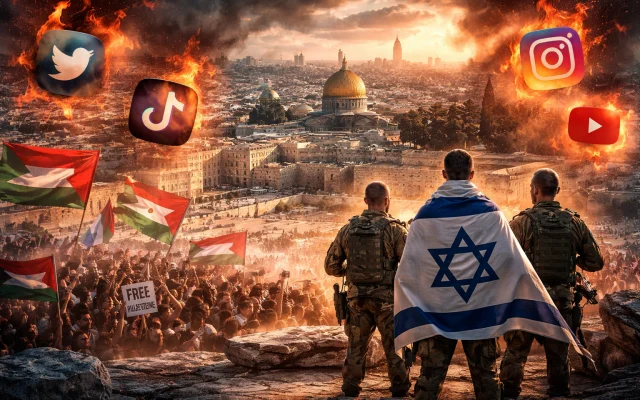
This brings us to the most important factor of all: social media.
Social media did not just change how we communicate. It changed how people perceive reality, truth, and authority.
We used to live in a shared informational world. There were disagreements, yes, but there was a common factual baseline. Today, that baseline is gone.
Algorithms curate personalized realities. Two people can live in the same country and inhabit entirely different moral universes. Emotional engagement matters more than accuracy. Outrage spreads faster than truth.
Israel suffers enormously in this environment because its reality is complex, slow, and morally ambiguous, everything social media hates.
Emotion Over Accuracy
Platforms reward content that is emotional, simplified, and polarizing. A burning building spreads faster than a legal explanation. A crying child spreads faster than a historical timeline. Nuance dies in algorithms.
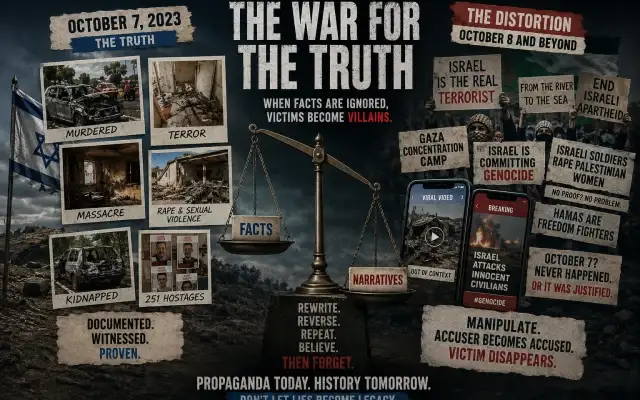
Israel’s enemies understand this very well. Simplified images, stripped of context, become weapons. And millions consume them daily without questioning sources, motives, or omissions.
The Illusion of Knowledge
We live in an age of information abundance and context scarcity. People read headlines, not articles. Watch clips, not debates. Absorb conclusions without foundations.
This produces confidence without competence, the illusion of knowledge. Many who speak most loudly about Israel know the least about its history, security reality, or regional context.
The Death of Expertise
Authority has been replaced by popularity. A viral influencer can outweigh a historian. A trending hashtag can overpower decades of scholarship.
This undermines journalism, academia, and historical accuracy. Truth becomes whatever feels morally satisfying to share.
Moral Simplification and Tribalism
Social media thrives on binary thinking: good versus evil, oppressor versus oppressed. There is no room for tragic complexity.
People are rewarded not for thinking critically, but for signaling loyalty to a tribe. Questioning dominant narratives is punished. Conformity is safe.
Supporting Israel today often requires social courage. Many choose silence. Others choose alignment with the loudest crowd.
Emotional Exhaustion and Cognitive Decline
Constant exposure to outrage, crisis, and violence exhausts the human mind. Attention spans shrink. Emotional reasoning replaces analytical thought.
People are not less intelligent than before, they are overstimulated. And overstimulation makes deep thinking difficult.
So Why Israel?
Israel sits at the intersection of everything modern culture struggles with: colonial narratives, religion, identity politics, Western guilt, post-truth media, and unresolved antisemitism.
It is easier to project moral anxieties onto Israel than to confront complexity elsewhere. Israel becomes the symbolic battleground for a world that has lost patience for nuance.
Final Thought
Israelis themselves argue endlessly about their own government. That, too, is part of Israel’s democracy.
But the hatred directed at Israel today is not proportional, not informed, and not honest.
Social media did not make people stupid. It made superficial thinking easier, faster, and socially rewarded.
Those who still think critically, who read deeply, travel honestly, and resist slogans, are not louder. They are simply harder to find.
And perhaps that is the real tragedy of our time.