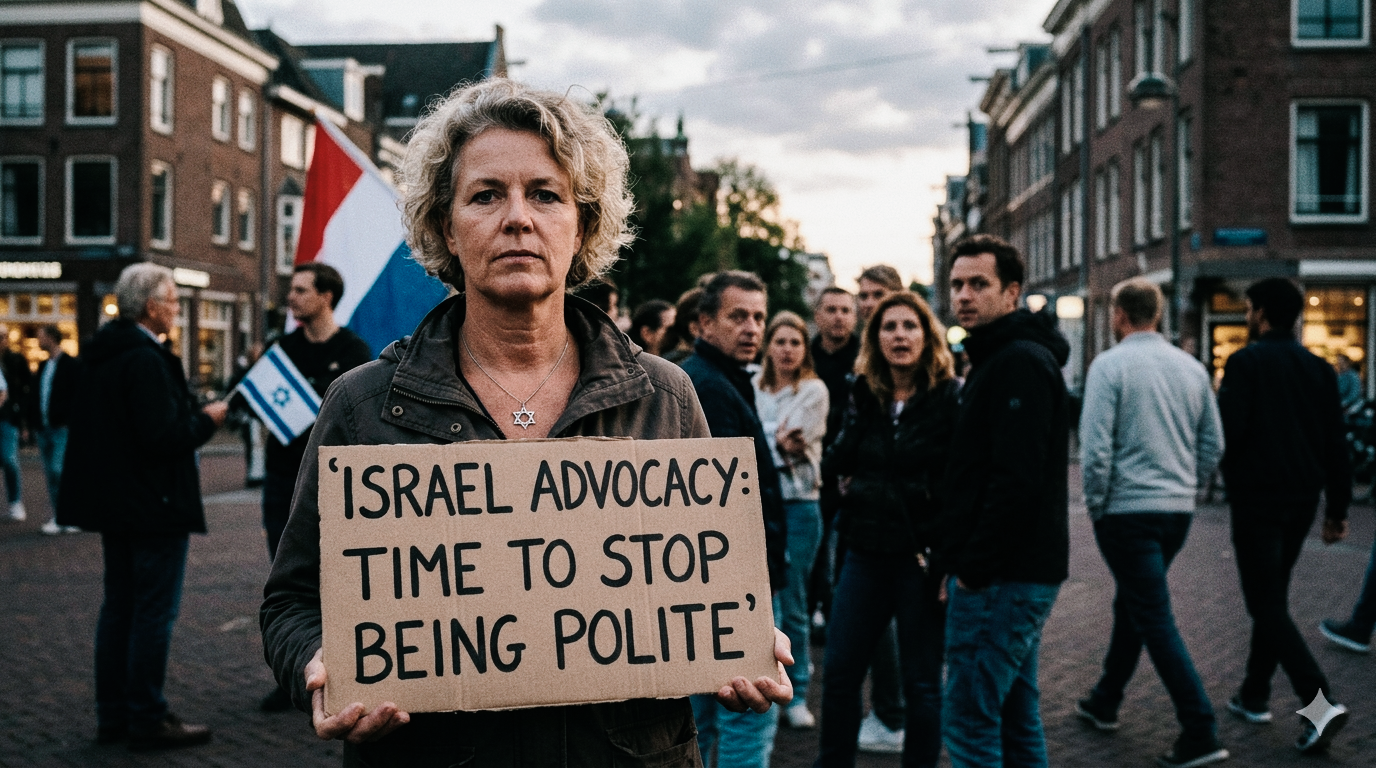
Truth Over Politeness on Israel
How long can we stay politically correct when it comes to Israel’s existence?
I ask this seriously.
I grew up in the Netherlands, and I am direct by nature. Very direct. Very blunt. I have never had much of a filter between my brain and my mouth. Even in a country that prides itself on tolerance, that kind of honesty is often unwelcome.
A personal example says enough. If my daughter asks whether I like her new dress, and I do not like it, I ask first, “Do you want the real answer?” If she says yes, I tell her plainly. Awful. But the moment I ask the question, she already knows honesty is coming. The advantage is simple. When I praise something, people know I mean it from the bottom of my heart.
I am like this with everything. Politics. Religion. Israel.
My children know me well, but they do not always support how outspoken I am. They worry.
“Mum, be careful.”
“Mum, hide your necklace.”
“Mum, are you really going to organize another pro Israel event?”
“One day this will cost your life.”
They know I can be stubborn. Once I believe something is right, I act.
People who know me understand this. People who do not often struggle with it. The Dutch may look tolerant on paper, but real life is more complicated. I have lost jobs, friendships, and relationships because of my views.
If you write blogs, speak publicly, or defend Israel openly, you quickly learn that society rewards silence more than courage.
There is another problem.
Many educated people who support Israel are intelligent, articulate, and thoughtful. They communicate carefully. They choose every word with precision. Sometimes it is almost an art form.
But the average person in the street does not live in that world.
Most people do not analyze complex arguments. They respond to what they hear clearly, repeatedly, and emotionally. That is simply reality.
Now look at the activism from the other side.
It is harsh. Loud. Unapologetic. It often ignores facts, history, and context. Yet it repeats powerful accusations again and again. Genocide. Colonialism. Starvation. Apartheid.
These words are emotionally charged. They spread fast. They require no nuance. They are designed to provoke reaction, not understanding.
So who will billions of ordinary people believe?
The careful paragraph full of diplomatic language?
Or the slogan shouted with certainty?
We know the answer.
That is why political correctness in Israel advocacy may be well intentioned, but too often it fails. It can sound weak against aggressive falsehoods.
This does not mean becoming hateful. It does not mean abandoning truth. It means speaking clearly and directly.
Do not say someone “passed away during an incident.”
Say they were murdered in cold blood.
Do not say rockets “were exchanged.”
Say terrorists fired rockets at civilians.
Do not say Israel is “facing tensions.”
Say Israel is defending its people against groups openly calling for its destruction.
Words matter.
Soft language can hide hard realities. Honest language can expose them.
If supporters of Israel continue whispering facts while opponents shout lies, the lies will keep winning.
Maybe the time has come to stop being afraid of sounding impolite and start being committed to sounding truthful.