For more than seventy five years, the Middle East has been marked by conflict, war, terrorism, and missed opportunities for peace. Yet despite the challenges, Israel has repeatedly shown that peace is possible. The real question is not whether peace can exist in the Middle East. The question is why some nations and groups have chosen peace while others continue to reject it.
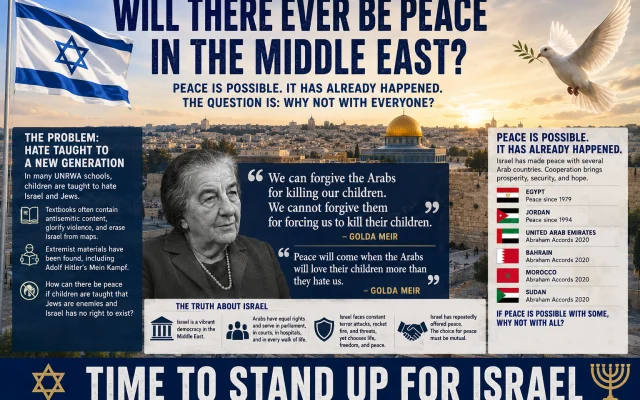
Israel has demonstrated time and again that it is willing to make painful compromises for peace. The country signed peace treaties with Egypt in 1979 and Jordan in 1994. More recently, the Abraham Accords brought normalization agreements with the United Arab Emirates, Bahrain, Morocco, and Sudan. These agreements proved that former enemies can become partners when they choose cooperation over hatred.
The success of these agreements raises an important question. If peace is possible with several Arab countries, why not with others?
Part of the answer lies in education and leadership. Peace requires people to teach their children to build a future rather than continue old conflicts. Unfortunately, in many places, hatred of Israel has been allowed to flourish for generations.
One of the most controversial examples involves schools operated by UNRWA, the United Nations Relief and Works Agency. Numerous reports over the years have documented cases in which educational materials used in some UNRWA schools contained antisemitic content, glorified violence, or erased Israel from maps. Researchers and watchdog organizations have repeatedly raised concerns about textbooks that promote hostility instead of coexistence.
Even more disturbing are reports that extremist materials have appeared in educational settings connected to Gaza. There have been documented cases where books such as Adolf Hitler’s Mein Kampf have been available and discussed. Whether officially approved or not, the very presence of such material highlights a serious problem. No society can prepare children for peace while exposing them to literature that promotes hatred and intolerance.
Education matters because today’s students become tomorrow’s leaders. If children are taught that Jews are enemies and that Israel has no right to exist, then peace becomes almost impossible to achieve. By contrast, when children learn about mutual respect and shared humanity, the foundations for peace can be built.
Israel itself is often judged by standards not applied to any other nation. Despite facing constant security threats, terrorist attacks, rocket fire, and hostile neighbors, Israel remains a vibrant democracy with freedom of speech, freedom of religion, and equal voting rights for all citizens. Arabs serve in Israel’s parliament, on its courts, and in its hospitals. This reality is often ignored by those who portray Israel as the sole obstacle to peace.
The late Israeli Prime Minister Golda Meir understood the tragedy of the conflict better than most. She famously said:
“We can forgive the Arabs for killing our children. We cannot forgive them for forcing us to kill their children.”
This quote reflects a painful reality. Israel does not seek war. Every military operation carries a terrible human cost. Yet when terrorist organizations embed themselves among civilian populations, launch rockets from residential neighborhoods, and use civilians as human shields, innocent people suffer. Golda Meir’s words highlight the moral tragedy of a conflict in which terrorists often place their own civilians in danger while blaming Israel for the consequences.
Another famous quote from Golda Meir remains equally relevant today:
“Peace will come when the Arabs will love their children more than they hate us.”
Whether one agrees fully with this statement or not, it captures a fundamental truth. Peace requires a commitment to life, prosperity, and the future. It cannot grow in an environment where hatred is constantly nurtured.
The history of the Middle East contains many examples of rejected peace opportunities. Israel accepted the United Nations partition plan in 1947. Arab leaders rejected it and launched a war. Subsequent peace proposals have often met a similar fate. While no side is without mistakes, the pattern of rejectionism has played a significant role in prolonging the conflict.
The Abraham Accords offer a different vision. Countries that once viewed Israel as an enemy now cooperate in trade, technology, tourism, and security. These relationships have benefited millions of people. They demonstrate that when leaders focus on practical cooperation rather than ideological hostility, peace becomes possible.
The future of peace in the Middle East depends on several factors. First, there must be an end to incitement and hatred in educational systems. Second, leaders must be willing to recognize Israel’s right to exist as the national homeland of the Jewish people. Third, regional cooperation must continue to expand. Economic partnerships, cultural exchanges, and people to people connections create incentives for stability and mutual respect.
Most importantly, peace requires courage. It is often easier to continue a conflict than to end one. Politicians can gain support by exploiting grievances and fears. True leadership requires choosing reconciliation over revenge.
Will there ever be peace in the Middle East?
The answer is yes, but only if more nations and communities follow the example of those who have already chosen peace. Egypt, Jordan, the United Arab Emirates, Bahrain, Morocco, and others have shown that coexistence is possible. Their experience proves that peace is not a dream. It is a choice.
Israel has repeatedly extended its hand in peace. The challenge now is whether others will be willing to take it. The day hatred is replaced with acceptance, the day children are taught hope instead of hostility, and the day leaders choose cooperation over conflict, lasting peace in the Middle East will no longer be an aspiration. It will become a reality.