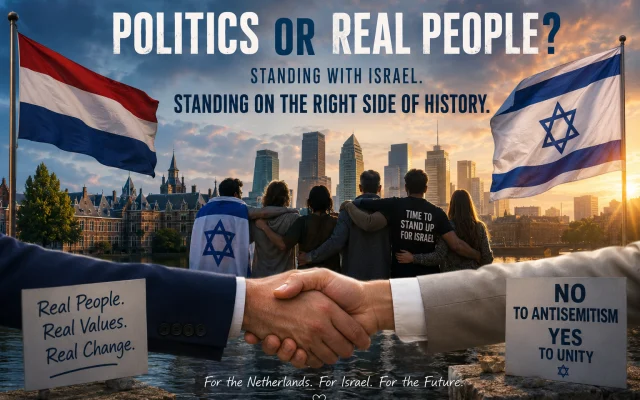
This week I attended two pro-Israel events and participated in a meeting about antisemitism in the Netherlands and the role politics plays in addressing it. After these experiences, one question kept returning to my mind: Are we dealing with politics, or are we dealing with real people?
The first event was a delayed celebration of Israel’s Independence Day hosted by the Israeli Embassy in The Hague. An embassy is not merely an office building. In many ways it represents the territory, interests, and voice of the country it serves. The Israeli Embassy exists to represent Israel in the Netherlands and to maintain relations between the two nations. When disagreements arise, governments communicate through ambassadors. The ambassador explains the policies and actions of Israel to the Dutch government, and vice versa.
As far as I know, Israel is still an ally of the Netherlands. Yet I cannot ignore the changing atmosphere. More and more, it seems that if you are not part of a certain political narrative, your concerns are considered less important. And whenever the name Israel is connected to an event, it often faces criticism, resistance, or even cancellation, regardless of how valuable or significant that event may be.
I would have expected to see the Dutch prime minister present at such an occasion, even if only to shake hands with the most important representative of Israel in the Netherlands, the ambassador. Of course, that did not happen. There were two or three politicians known for their support of Israel, and I appreciate their presence. Still, the respect and recognition that Israel deserves are rarely given. Israel is a democratic ally, a technological powerhouse, and a nation that has contributed enormously to innovation, medicine, agriculture, and security. Yet too often it is treated differently from other countries.
The second event was a benefit dinner for Soroka Medical Center in Urk. Once again, we saw the ambassador. Also present were representatives of various pro-Israel organizations, including Christians for Israel, other supporters of Israel, and my own organization, Time To Stand Up For Israel. There were also politicians from two different Dutch political parties.
One of these politicians is someone very close to my heart. In a political world where many people carefully weigh every word until their message becomes vague or dishonest, he stands out. He does not hide behind politically correct language. He says what he thinks. He speaks openly about Israel, about antisemitism, and about the challenges facing Dutch society.
That honesty is refreshing. I admire him for it, and he will always have my vote. Unfortunately, there seems to be little room in the Netherlands for honest opinions regarding Israel when those opinions differ from the mainstream narrative. People are criticized for every word. Passion is discouraged. Emotion is viewed as a weakness. Directness is punished.
Politics often demands that people wear a mask. Instead of speaking honestly, they are expected to follow the crowd. I sincerely hope my friend continues to stand strong. I hope to see him become Prime Minister one day. That would be a blessing not only for the Netherlands but also for the relationship between the Netherlands and Israel. He is intelligent, and intelligent people understand that standing with Israel means standing on the right side of history.
At the benefit dinner, the chairman of Christians for Israel was also present. I want to give credit where credit is due. Christians for Israel does tremendous work for Israel, and I respect that. However, my own experiences with the organization have not always been positive.
Back in 2014, when I was trying to establish cooperation between various pro-Israel initiatives, I approached them. As a new organization, I hoped we could work together for the benefit of Israel advocacy. Unfortunately, that cooperation never materialized. My impression was that support was generally reserved for activities organized by their own network. Cooperation with independent initiatives proved difficult.
When Time To Stand Up For Israel officially became an NGO in January 2023, I had not forgotten the obstacles we had encountered. Instead of competing for attention, we should be working together. Today there are countless pro-Israel groups. There are Christians for Israel, Muslims for Israel, Jews for Israel, organizations that support Benjamin Netanyahu, organizations that oppose him, organizations with significant funding, organizations with almost none, influencers, activists, and advocacy groups. Everyone believes their own contribution is the most important.
But the real question remains: is pro-Israel advocacy about politics, or is it about real people?
My disappointment with the lack of cooperation among pro-Israel organizations was one of the reasons why Time To Stand Up For Israel was founded without any political or religious affiliation. We wanted to be as neutral as possible. Our focus is simple: support Israel, combat misinformation, and stand against antisemitism.
Finally, I met with someone who is extremely active in the fight against antisemitism in the Netherlands. He organized a petition urging political parties to place the growing insecurity faced by Jewish people in Amsterdam and throughout the Netherlands on the political agenda.
What struck me most was that among the parties willing to receive the petition, not a single one came from the left side of the political spectrum.
It is important to understand that this initiative was not about Israel. It was about Dutch citizens who happen to be Jewish. It was about their safety and their right to live without fear. Yet despite that, this gentleman is frequently labeled a Zionist by critics. Some even accuse him of serving Mossad. Personally, I consider being called a Zionist a compliment. Zionism simply means supporting the right of the Jewish people to have their own homeland in Israel.
Once again, the question arises: politics or real people?
Like me, this man wants to establish one strong front against antisemitism. I fear that achieving such unity will be difficult, but it is desperately needed. Antisemitism is growing. Jewish people increasingly feel unsafe. The problem cannot be ignored.
My conclusion after this week is that politics and Israel have become impossible to separate. Every discussion about Jewish safety, every discussion about Israel, and every discussion about antisemitism quickly becomes political. Yet behind these political debates are real people whose lives are affected every day.
The Netherlands needs leadership that is honest, intelligent, and courageous. It needs leaders who are willing to speak the truth even when it is unpopular. It needs leaders who understand that supporting Israel and protecting Jewish citizens are not controversial positions but moral responsibilities.
And if I were asked to recommend a future Prime Minister, I already know exactly who I would choose.
Time To Stand Up For Israel