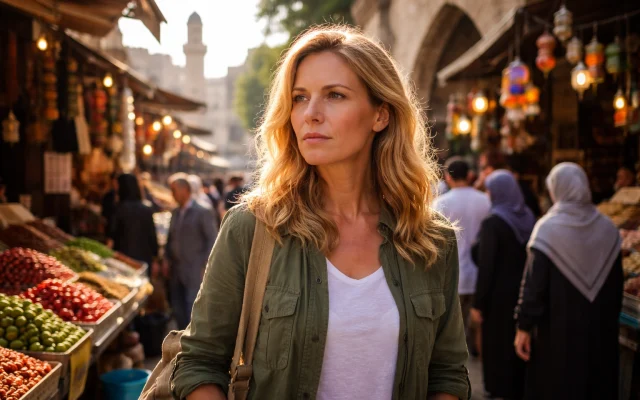
I sometimes stop and realize how radically my life was shaped by growing up in the Middle East. Not through theory, headlines, or ideology but through lived experience. I saw both sides of the coin long before the world reduced the region to hashtags and slogans. I had friends in Israel and friends in Syria. Life was never abstract. It was immediate, human, and often lived on the edge.
Because of my parents’ activities connected to Israel, we existed in a constant state of quiet alertness. Nothing was ever explained to us in full, but as a highly sensitive child, I always knew when something was wrong or important. I felt it in the air, in the silences, in the way my parents moved.
There are moments etched into my memory forever. Being dropped off with my brother in a museum in the middle of Damascus, with clear instructions: If we are not back by a certain time, go straight to the embassy. Don’t talk to anyone. No drama. No panic. Just certainty. In Palmyra, my mother needed to go to the toilet every ten minutes, to hide something. My brother, three years older, believed every explanation without question. I didn’t. I was already skeptical, already reading between the lines.
At an Egyptian airport, I was suddenly carrying a shopping bag for my mother. What should have been nothing turned into everything. It almost became a crime. A heated argument erupted between my mother and me, one I won, not because I was right, but because she couldn’t afford a scene in front of airport personnel. By pure chance or fate, I pushed the button and got the green light. I walked through holding that bag. My mother got red light and had to unpack her other bag. A close call. Terrifying. And strangely, exhilarating.
We could write entire books about those years. Yet my parents remained mostly silent. They didn’t need to explain. I knew something important was happening. Something bigger than us. Life was simple then. Life was alive.
There was no internet. No social media mobs. No performative outrage. No people claiming moral superiority from the safety of their couches. No industrial-scale misinformation. And certainly no fashionable hatred of Israel disguised as virtue.
The world has changed dramatically since then. Yes, Israel has changed too, but nowhere have I felt the shift more painfully than in the Netherlands.
For decades, the Netherlands cultivated an image of moral clarity: shaped by World War II memory, by Holocaust education, by a self-image of tolerance and justice. From Israel’s perspective, the Netherlands was considered a reliable, if sometimes critical, friend. Disagreements existed, but they lived within boundaries.
Since October 7, 2023, those boundaries have collapsed.
What we are witnessing is not merely criticism of Israeli government policy. That has always existed and always should. What we are seeing now is something else entirely: a surge in antisemitic incidents, physical attacks on Israelis, intimidation of Jewish communities, and a public atmosphere where hostility toward Israel increasingly bleeds into hostility toward Jews.
Football matches turning into manhunts. Jewish institutions vandalized. Protest slogans that erase context, history, and humanity. And all of it justified as “activism.”
The Netherlands prides itself on free speech, but free speech without responsibility becomes a weapon. A society that confuses moral posturing with moral courage creates space for hatred to grow—especially when Jews are few in number, highly visible, and historically vulnerable.
What shocks Israel is not criticism. It is the loss of moral proportion. The inability or unwillingness to draw a hard line between political debate and racial or religious hatred. The silence, hesitation, or relativism when Jews are threatened in public spaces.
For someone like me, this feels deeply personal. I remember a world where complexity was lived, not shouted. Where danger existed, but meaning did too. Where Israel was not a caricature but a reality, flawed, resilient, human.
Today, narratives move faster than facts. Emotion outpaces truth. And societies like the Netherlands, so confident in their moral self-image, struggle to see their own blind spots.
This is not about demanding blind support for Israel. It is about honesty. About recognizing when criticism turns into demonization, and when activism mutates into intimidation. It is about protecting Jewish life not as a favor, but as a moral obligation.
I grew up between worlds. I know what complexity looks like. And that is precisely why I refuse to accept the simplified hatred we are seeing today.
Some illusions, once broken, can never be restored. But clarity, if we choose it, still can be.