A Strong Army Is Built on Will, Not Force
Anger about military service in Israel is understandable. When you watch your son or daughter put on a uniform, stand guard at night, enter combat zones, or carry the emotional weight of defending the Jewish state, it hurts to see others seemingly “get away” without sharing that burden. Many Israelis and supporters of Israel abroad, feel this frustration deeply when it comes to the Haredi (ultra-Orthodox) community and military service.
That anger is human. It is also legitimate.
But legitimacy of emotion does not automatically mean correctness of policy. If Israel wants to remain strong, not just morally, but militarily and socially, it must think beyond slogans, resentment, and forced solutions. The real question is not whether service matters. It does. The real question is what actually makes an army strong and whether forcing unwilling populations into uniform truly strengthens the Israel Defense Forces.
Understanding the Reality, Not the Myth
For decades, most Haredi men did not perform military service or an alternative civilian service. This was not because they were secretly enjoying benefits, but because of a long-standing arrangement known as “Torato Umanuto”, “Torah study is his profession.” Under this system, full-time yeshiva students repeatedly deferred service and eventually became exempt.
This arrangement was controversial even inside Israel, but it was also rooted in history. After the Holocaust, the Jewish people had lost much of their Torah scholarship. Israel’s founders, many of them secular, agreed to preserve that spiritual backbone. What began as a small exemption expanded over time into a large social issue.
That era is now ending. In 2024, Israel’s Supreme Court ruled the blanket exemption unconstitutional. Draft notices have begun going out to Haredi men. The state is trying to rebalance responsibility.
But law alone does not create cohesion. And coercion alone does not create strength.
What Happens When You Force the Unwilling?
An army is not a factory line where bodies automatically become assets. Military effectiveness depends on motivation, discipline, trust, and unity. Forced conscription of people who fundamentally reject military service, religiously, culturally, or ideologically, comes with real risks.
A soldier who does not believe in the mission, who feels his identity is under attack, and who serves only under threat of punishment is not a force multiplier. He is, at best, neutral and at worst, a liability.
Israel does not suffer from a lack of raw manpower. It suffers from overstretched reserves, prolonged service cycles, and the emotional toll of continuous war. The answer to this is not adding unwilling soldiers with zero motivation. The answer is smart integration and meaningful contribution.
What a Strong Army Actually Looks Like
History, Israeli and global, shows that armies win not by numbers alone, but by quality. A strong army rests on several pillars:
First, moral clarity. Soldiers fight better when they know why they are fighting. The IDF is a defensive army protecting civilians, borders, and the existence of the Jewish state. That moral legitimacy is one of its greatest strengths.
Second, motivated and trained soldiers. Motivation is not optional. Highly motivated units consistently outperform larger, less committed forces. This is why elite IDF units matter far more than raw troop counts.
Third, leadership at every level. From junior officers to NCOs, leadership turns chaos into coordination. Forced service undermines leadership by breeding resentment rather than responsibility.
Fourth, social cohesion. An army reflects its society. When different groups feel alienated or humiliated, cohesion weakens. Internal division damages military strength more effectively than enemy fire.
Fifth, adaptability and innovation. Israel’s security edge comes from learning faster than its enemies. That requires soldiers who think, care, and engage, not those who are simply present.
The Reality of Haredi Service Options
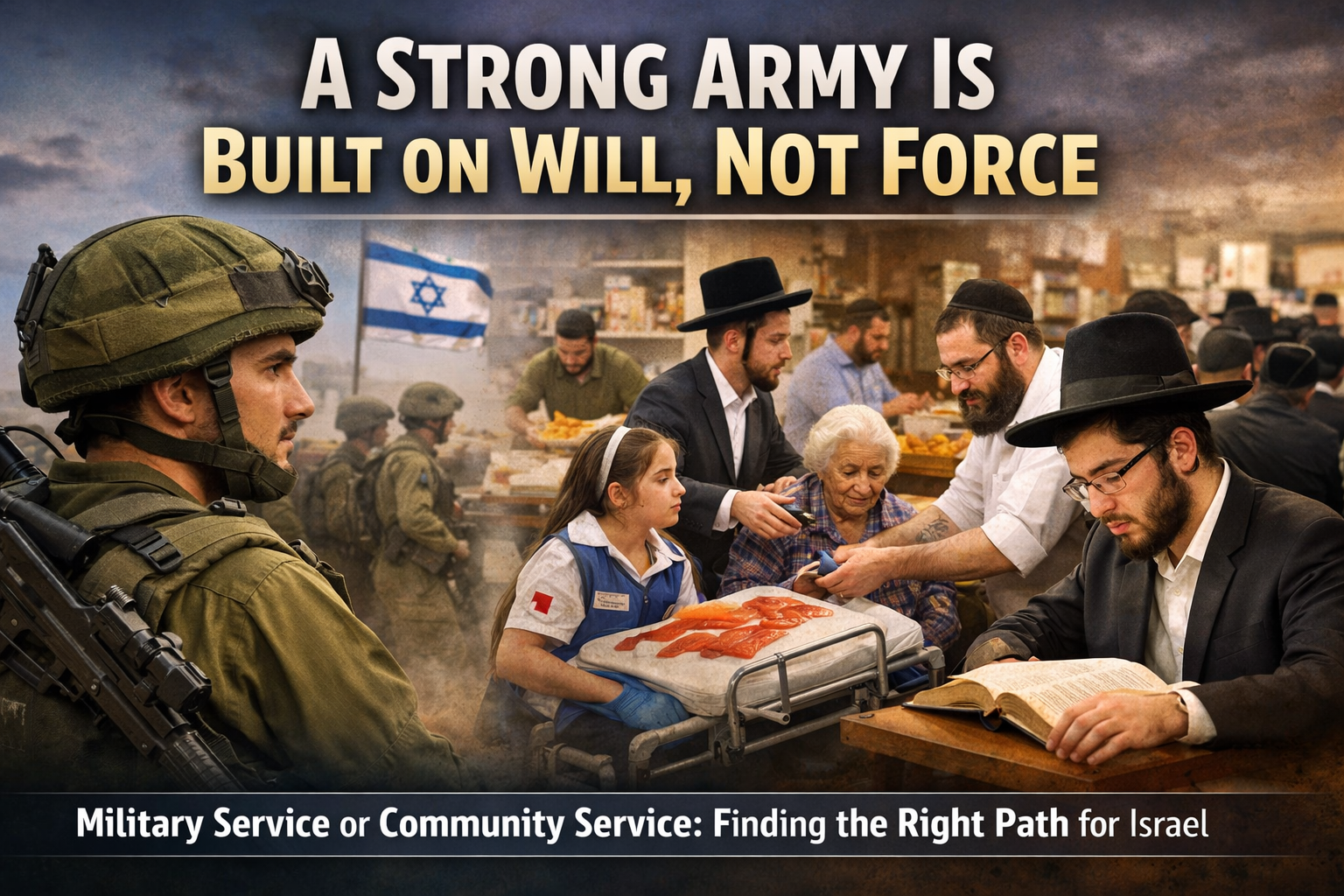
Contrary to popular belief, there are Haredi men who serve. Units like Netzah Yehuda, the Hasmonean Brigade, and adapted service tracks exist. They respect religious requirements such as strict kashrut, prayer times, and gender separation. These frameworks work for some and should be expanded thoughtfully.
But they remain military service. They are not suitable for everyone.
What does not meaningfully exist is a broad, structured civilian national service framework tailored for Haredi men, comparable in status, obligation, and contribution to military service.
And this is where Israel has an opportunity.
Community Service Is Not “Getting Away With It”
A formal, mandatory community or national service track, designed with seriousness, supervision, and equal duration, would allow Haredi men to serve the state without violating their core beliefs.
Imagine thousands contributing to:
Emergency medical services
Elder and disability care
Education and tutoring
Civil defense, logistics, and disaster response
Municipal and social infrastructure
This is not avoidance. This is contribution.
A society under constant threat needs resilience not only at the front lines, but in hospitals, schools, and communities. During war, these systems matter just as much as tanks and aircraft.
Strength Is Built on Wisdom, Not Punishment
Israel is fighting enemies who want to tear it apart from the outside. It cannot afford to fracture itself from within. Turning one group into a permanent symbol of resentment weakens the very unity that keeps Israel alive.
Fairness matters. Shared responsibility matters. But smart responsibility matters even more.
Forcing Haredi men en masse into the IDF will not suddenly create stronger brigades. It risks creating weaker cohesion, lower morale, and deeper societal wounds. A structured alternative, serious, demanding, and respected, can increase contribution without destroying identity.
A strong army is not defined by how many people you force into uniform.
A strong army is defined by soldiers who believe in their mission, a society that supports them, and a state wise enough to know the difference between equality and effectiveness.
Israel has always survived by thinking differently. This challenge deserves the same courage not emotional shortcuts, but strategic maturity.