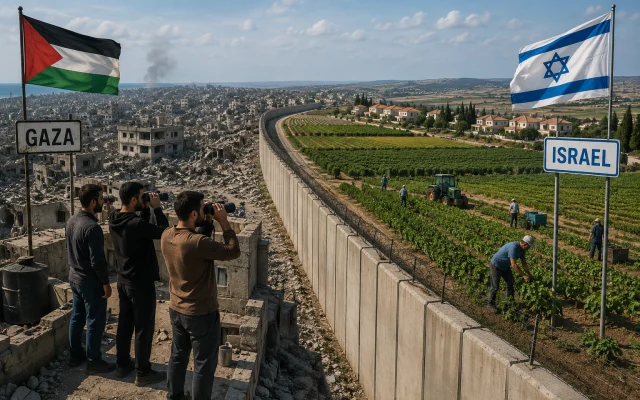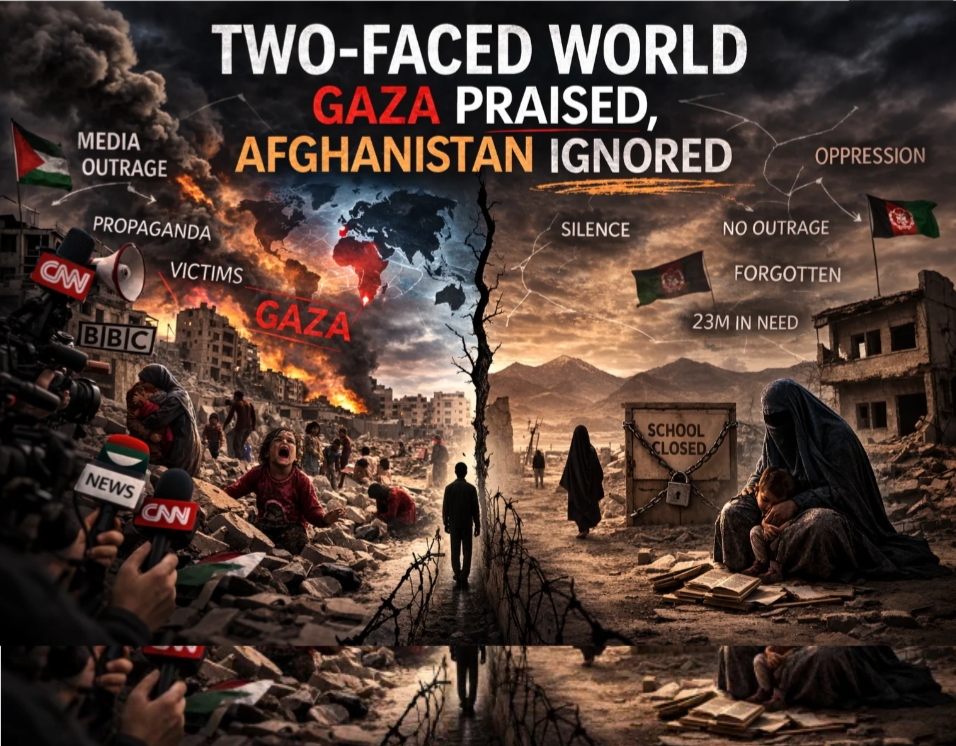
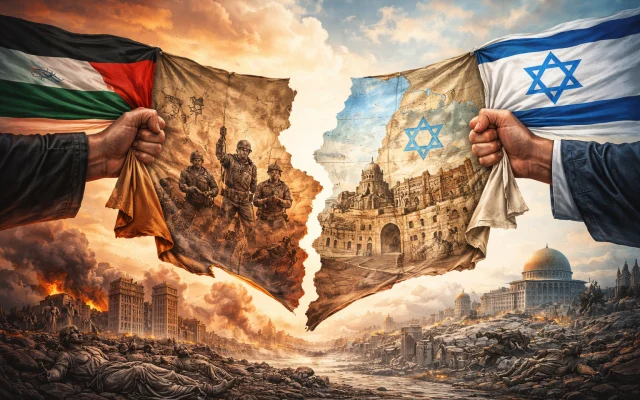
There is a persistent temptation to measure conflicts in missiles, troop movements, and territorial gains. But in the long struggle surrounding Israel and Gaza, that lens misses the deeper and more consequential battlefield. The most significant victory achieved by Hamas is not military. It is psychological. It is the quiet but powerful rewriting of how millions of people understand history itself.
Hamas did not arise as a spontaneous expression of grassroots Palestinian nationalism. Its ideological roots run through the Muslim Brotherhood and the broader currents of 20th century pan Islamist and pan Arab thought. From its earliest formulations, the movement was not focused on building a modern nation state alongside Israel. Its ambition was far more expansive and far less compatible with Western notions of sovereignty: the restoration of a religious political order across lands once under Muslim rule.
Yet this ideological foundation alone does not explain Hamas’s global resonance. Its real breakthrough came in reframing the conflict through a narrative that is both simple and deeply misleading. By adopting the language of anti colonial struggle, Hamas and its allies managed to invert the historical context of the region. A civilization that arrived through conquest and ruled for centuries repositioned itself as an indigenous population resisting foreign occupation.
This reframing did not happen overnight. It required the construction of a modern Palestinian identity that could be presented as ancient and continuous. In reality, the distinct national identity we now call “Palestinian” largely took shape in the mid 20th century, particularly in the 1960s. Before that, the Arab inhabitants of the region generally identified in broader terms, as part of the Arab world or as Syrians. National identities across the Middle East were fluid, often shaped more by imperial boundaries than by longstanding ethnic distinctions.
But narrative is not about archival precision. It is about emotional resonance. And the story that has taken hold is one of an indigenous people displaced by outsiders. Once that frame is accepted, every event is interpreted through it. History becomes secondary to perception.
This transformation relies on three powerful psychological mechanisms. The first is inversion. The roles of aggressor and victim are flipped, creating a moral clarity that appeals to global audiences conditioned to support the underdog. The second is displaced trauma. The broader history of military defeats and political failures across the Arab world is condensed into a single, highly visible grievance. The third is binary morality. Complex historical and political realities are reduced to a simple dichotomy of oppressed versus oppressor.
These mechanisms do not just shape opinions. They erase context. The centuries of Arab and Islamic dominance in the region, including the marginalization and at times persecution of Jewish and Christian communities, fade from view. The long history of Jewish presence in the land is recast as an anomaly rather than a continuity. What remains is a flattened narrative that is easy to communicate and difficult to challenge.
Understanding this dynamic is essential, especially in light of recent developments that underscore how dangerous narrative distortions can become when paired with hard power. The ongoing confrontation with Iran has revealed capabilities that were once dismissed or underestimated. It is now increasingly clear that Iran possesses missile systems capable of reaching parts of Europe. This is not a theoretical concern. It is a strategic reality that reshapes the security landscape far beyond the Middle East.
At the same time, diplomatic efforts that were once hailed as breakthroughs have shown their limits. Despite agreements brokered under the Trump administration aimed at stabilizing Gaza, Hamas remains armed and operational. The expectation that economic incentives or political arrangements alone would lead to disarmament has proven unfounded. The organization’s core objectives have not changed, because they are rooted not in immediate material conditions but in a long term ideological vision.
This is where the psychological and the military dimensions converge. A movement that sees itself as engaged in a historical and religious struggle is unlikely to abandon its goals in exchange for short term concessions. And a global audience that views that movement through the lens of anti colonial resistance is less likely to hold it accountable for actions that would otherwise be condemned.
The result is a conflict that is sustained not only by weapons but by ideas. Narratives shape legitimacy, and legitimacy shapes the boundaries of acceptable action. When history is inverted, accountability becomes elusive.
None of this is to deny the human dimensions of the conflict or the real suffering experienced by civilians on all sides. But acknowledging suffering should not require accepting a distorted version of history. If anything, a clearer understanding of the past is necessary to avoid perpetuating cycles of violence driven by misunderstanding.
The challenge, then, is not only to address immediate security threats but also to engage in a more honest conversation about the origins and nature of the conflict. That means questioning narratives that have become widely accepted but are historically tenuous. It means recognizing that not every movement that adopts the language of liberation is pursuing freedom in the sense that liberal democracies understand it.
In the end, the struggle over Israel and Gaza is as much about perception as it is about territory. Hamas’s most enduring success has been its ability to reshape that perception. Reversing that achievement will not be easy. But without doing so, any attempt at lasting resolution will rest on a foundation that is fundamentally unstable.