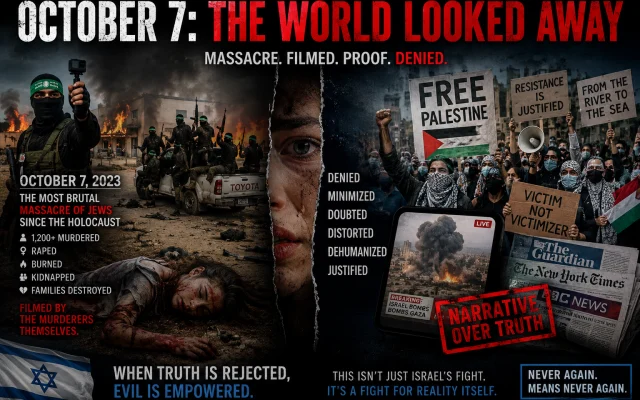
When Truth Becomes Optional: Israel, October 7, and the Collapse of Moral Clarity
Something has shifted in the world, and not in a subtle way. It is not just about Israel. It is about truth itself, about whether reality still matters when it becomes inconvenient, emotional, or politically unfashionable.
For decades, Israel was seen, particularly in the West, as a small, embattled democracy surrounded by enemies. That perception did not emerge from propaganda but from observable reality. The wars of 1967 and 1973 were existential. Israel’s survival was not guaranteed, and the world largely understood that.
Over time, that image changed. Israel became stronger, more prosperous, and more secure. Meanwhile, Palestinians came to be seen as stateless and vulnerable. In a world that instinctively sympathizes with the perceived underdog, the emotional balance shifted. That shift alone explains part of the transformation in global opinion, but not what we are witnessing today.
Because what happened on October 7 was not a “shift in narrative.” It was a rupture in moral reality.
Within a single day, the most brutal massacre of Jews since the Holocaust was carried out by Hamas. Entire families were slaughtered. Children were burned. Women were raped. Civilians were hunted house by house. This was not collateral damage, not crossfire, not a tragic byproduct of war. It was deliberate, intimate, filmed violence.
And that is the part that should have ended all debate.
Hamas documented its own crimes. The perpetrators wore GoPro cameras. They broadcast the killings. They were proud of what they were doing. This was not a matter of disputed facts or unclear evidence. It was recorded by the murderers themselves.
Yet within days, something astonishing happened.
The facts were not just questioned. They were diluted, reframed, minimized, and in some cases outright denied.
How is that possible?
How does a world that says “Never Again” look at the most documented mass killing of Jews in modern history and respond not with clarity, but with hesitation?
The answer lies in deeper transformations that have been building for years.
First, the conflict itself has been reframed. What was once understood as a struggle for Israel’s survival is now often reduced to a story about power imbalance and occupation. That lens is not entirely baseless, but it is dangerously incomplete. When every event is forced into that framework, even atrocities are interpreted through it. Violence against Israelis becomes contextualized before it is condemned.
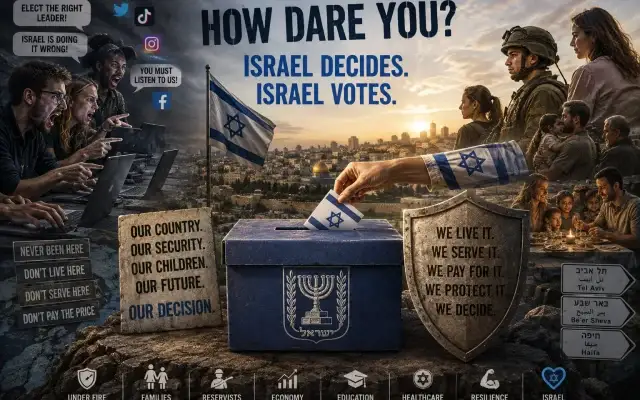
Second, media has changed. In the past, information passed through filters. Today, it floods the world instantly, emotionally, and without context. Social media does not reward accuracy. It rewards intensity. The more shocking an image, the faster it spreads. The more it confirms existing beliefs, the more it is believed.
This creates a paradox.
When Israelis present verified footage, documented evidence, forensic reality, it is often met with skepticism. It is seen as “official,” therefore suspect. But when unverified or staged content emerges from Palestinian sources, it is immediately embraced because it fits the prevailing narrative.
This phenomenon even has a name in Israeli discourse: Pallywood. It reflects a growing frustration that emotional storytelling, regardless of accuracy, often overrides documented truth.
Third, we are living through a collapse of shared reality.
Before the internet, people argued about values within a broadly agreed set of facts. Today, even the facts are contested. Entire communities exist in parallel information worlds. In one world, October 7 is a massacre. In another, it is exaggerated, justified, or reframed as resistance.
This fragmentation makes moral clarity almost impossible.
And then there is something more uncomfortable to acknowledge.
There is a persistent double standard when it comes to Jews and Israel. When Israel defends itself, it is scrutinized in ways that no other country is. When Jews are attacked, the reaction is often filtered through political context before empathy is allowed.
This does not mean that criticism of Israeli policy is illegitimate. Of course it is legitimate. Israel is a democracy, and its actions should be debated. But there is a difference between criticism and distortion, between scrutiny and denial.
What we are seeing now goes beyond criticism.
It is a willingness to doubt Jewish suffering even when it is documented by the perpetrators themselves.
It is a readiness to believe narratives that align with ideological frameworks, even when they contradict evidence.
It is, ultimately, a moral failure.
The deeper issue is not Israel versus Palestinians. It is whether truth still holds authority in a world driven by narrative, identity, and viral emotion.
Because if a massacre of this scale, this brutality, and this level of documentation can be questioned, minimized, or denied, then the phrase “Never Again” has lost its meaning.
And if truth becomes optional, then justice becomes impossible.
Israel is not just fighting a military battle. It is fighting a battle over reality itself.
And that is a far more dangerous war.