When Peace Replaced Trust With Fear
In the late 1970s, my parents had Israeli friends who represented something deeply human and often forgotten in today’s narratives. They were ordinary people. They had friendships that crossed every line the world now insists are unbridgeable. Jews, Christians, Arabs, Muslims. It did not matter. They visited each other, celebrated together, and supported one another in ways that reflected genuine coexistence rather than political slogans.
Among those friendships were people living in Ramallah. Visits were frequent, warm, and natural. When one of their Arab friends needed help building a small home in the garden for a son, my parents’ Israeli friends contributed financially. Not out of obligation, but out of kindness. A mitzvah. A simple act of generosity between friends.
Then came 1980. A wedding invitation in Ramallah. A joyful occasion, or at least it was supposed to be.
But something had shifted.
The atmosphere in the room was no longer what it had been. There was tension, subtle at first, but unmistakable. The same people who had once welcomed this Jewish family now looked at them differently. Suspicion replaced warmth. Silence replaced familiarity. And then, without warning, hostility erupted. They were attacked. The message was clear and brutal. Jews were no longer welcome.
This was not the result of a personal conflict. It was not about anything that had happened between friends. It was the result of something larger, something toxic that had begun to spread. Narratives that reframed neighbors as enemies. Narratives that poisoned relationships that had once been real and meaningful.
To understand this moment, one must also understand the reality of that time. After the Six-Day War in 1967, Israel took control of Judea and Samaria, including Ramallah. Throughout the 1970s, Israelis could and did enter cities like Ramallah. There were no divisions into Areas A, B, and C. There was no Palestinian Authority governing the city. Movement, while not without tension, was relatively open. Human relationships still had space to exist.
Everything changed with the Oslo Accords in the 1990s.
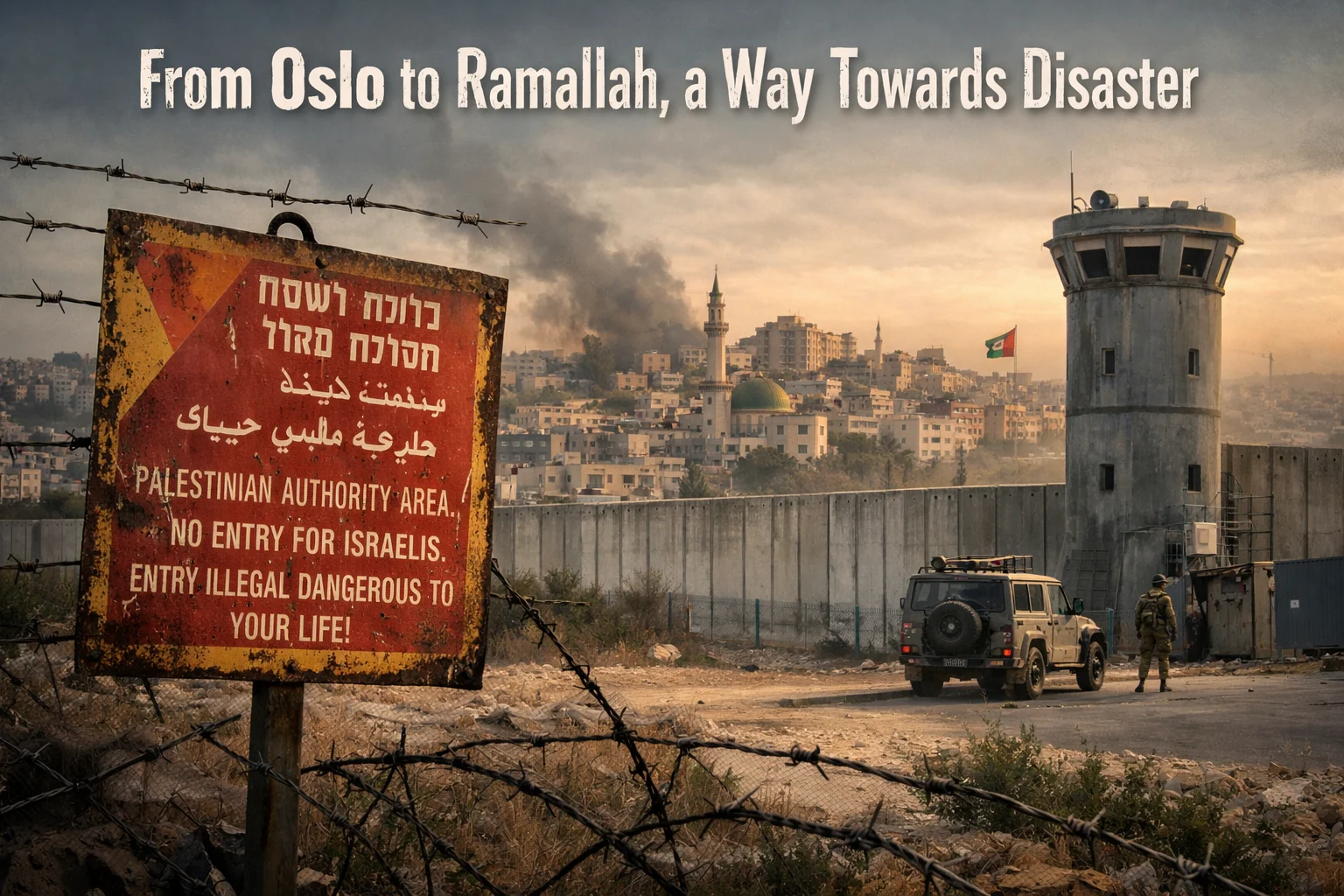
These agreements were presented as a path to peace. Israel and the PLO recognized each other for the first time. A new governing body, the Palestinian Authority, was created to manage daily life in Palestinian areas. Judea&Samaria was divided into Areas A, B, and C, each with different levels of control. Ramallah became part of Area A, meaning full Palestinian civil and security control. Israel withdrew.
On paper, it sounded like progress.
In reality, it created separation.
Where people once visited each other, barrier, legal, psychological, and eventually physical, began to rise. Israelis are now legally prohibited from entering Ramallah. The city is considered a high-risk area. Israeli vehicles are easily identifiable, increasing danger. The Israeli military enforces these restrictions, not as a political statement, but as a security necessity shaped by years of violence, especially during events like the Second Intifada.
Today, it is technically possible to drive into Ramallah, but for most Israelis, especially Jews, it is illegal and widely understood to be dangerous.
The tragedy is not only in the present reality, but in what was lost.
Instead of fostering coexistence, instead of confronting those who spread hatred and incitement, instead of strengthening the fragile but real human connections that existed, the process institutionalized division. Communities that once interacted were separated. Trust eroded. Fear took its place.
And over time, that fear hardened into something far worse.
Looking back from today, especially after the horrors of October 7, 2023, it is impossible not to ask difficult questions. Could things have been different? Could those early relationships have been protected instead of abandoned to political forces and propaganda?
What I carry from this story is not just anger or disappointment, but a deep sense of loss. Loss of a reality that once existed, however imperfect. Loss of the idea that people who shared meals, celebrations, and acts of kindness could remain connected despite everything.
I often find myself wishing that history had taken a different turn. That the decisions made in the name of peace had truly built peace, instead of walls.
Because once, not so long ago, people drove to Ramallah for a wedding, not knowing it would be the last time trust would feel so natural.
https://youtu.be/DgOS6ZOvcJs?list=RDDgOS6ZOvcJs