
You Cannot Build Peace on a Deleted Past
Peace is impossible when one side’s history is treated as an inconvenience that must be erased. In the Israeli–Palestinian conflict, this is not a marginal issue, it sits at the very heart of the problem. A growing political narrative insists that Jewish history in Judea, Samaria, and Jerusalem is either exaggerated, fabricated, or irrelevant. That claim is not merely wrong. It is destructive.
History does not belong to the powerful. It belongs to the factual.
In the first century CE, the Roman Empire ruled the land known to the world as Judea. Jerusalem was not a vague spiritual idea; it was the political and religious center of Jewish life. This was not recorded by Jewish sources alone. It was acknowledged, often grudgingly, by Rome itself.
One of Rome’s most important historians, Publius Cornelius Tacitus, wrote about Judea around the year 100 CE. Tacitus was a Roman senator, deeply critical of Jewish customs and beliefs. He had no sympathy for the people he described, which is precisely why his testimony carries weight.
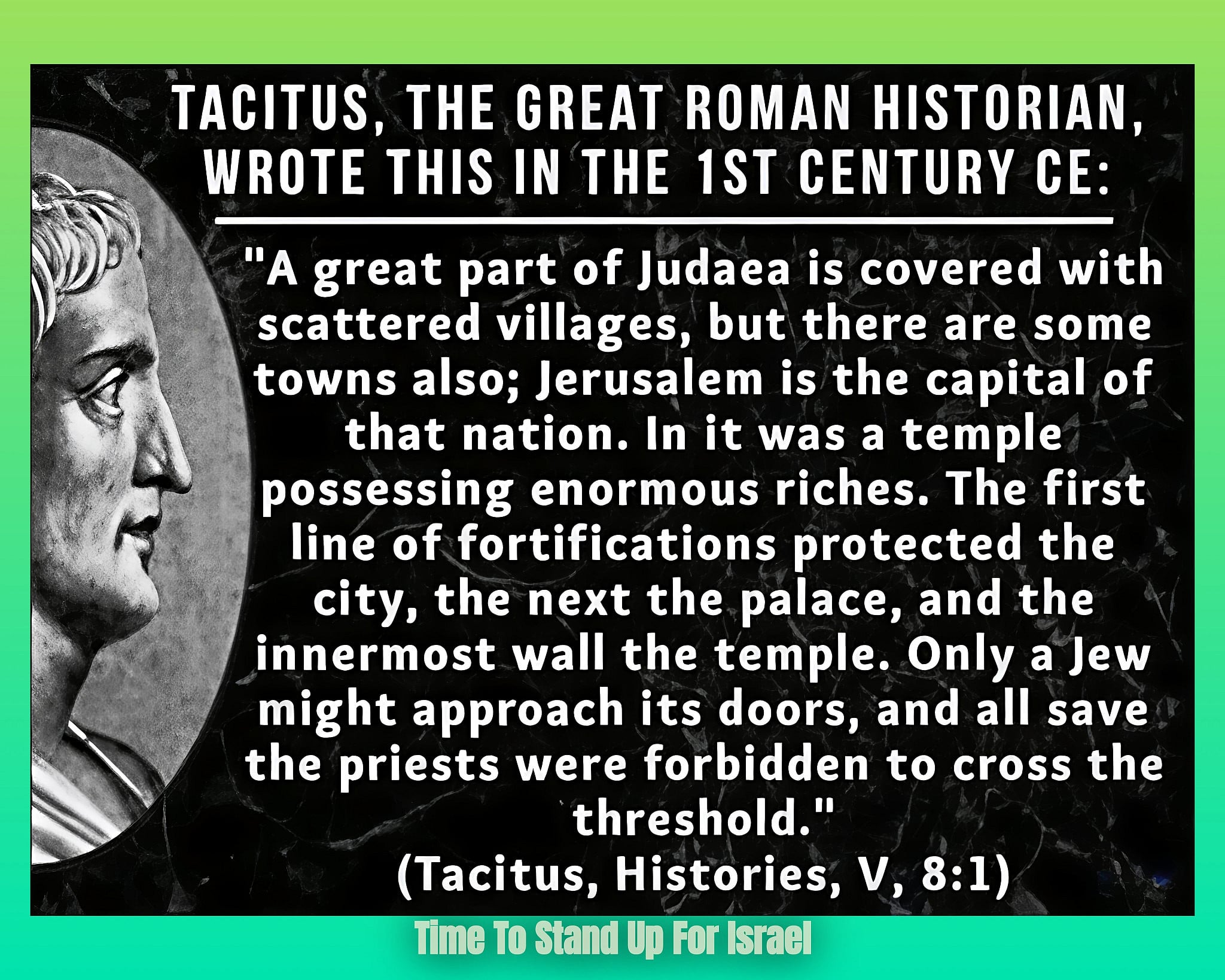
Midway through his account, Tacitus states plainly:
“Jerusalem is the capital of the Jews.”
— Histories, Book V
That single sentence collapses an entire modern narrative. A hostile Roman historian confirms that Jerusalem was Jewish, functionally and nationally, centuries before Islam and long before modern political disputes. This is not ideology. It is documentation.
What Tacitus also shows, by omission, is just as important. In his detailed descriptions of the region’s peoples, customs, and conflicts, there is no mention of an Arab people calling themselves Palestinians. None. There was no Palestinian nation, no Palestinian ethnicity, no Palestinian political identity during his lifetime. The term did not exist in that sense.
The name “Palestina” itself would only be imposed later by Rome, after crushing Jewish revolts, as an act of humiliation meant to sever the Jewish connection to the land. It was borrowed from the long-extinct Philistines, not from an existing Arab population. To retroactively turn this Roman punishment into proof of ancient Palestinian nationhood is not history—it is revisionism.
Arab presence in the land is real and historically documented, but it begins centuries later, following the Islamic conquests of the 7th century. That history deserves recognition and respect. What it does not justify is the erasure of what came before.
And yet, erasure has become a political strategy. Jewish archaeological finds are dismissed. Ancient place names are relabeled. The Jewish Temple, acknowledged by Romans, Christians, and early Islamic sources alike, are sometimes denied outright. This is not reconciliation. It is historical vandalism.
Peace cannot grow in a vacuum of truth.
Recognizing Jewish indigeneity does not deny Palestinian humanity. Acknowledging Jewish history does not invalidate Palestinian aspirations today. Two things can be true at once but only if we allow facts to exist without fear.
The refusal to accept Jewish roots in the land does more than distort the past. It radicalizes the present. If Jews are portrayed as foreign impostors with no historical legitimacy, then violence against them can be framed as “resistance” rather than rejectionism. That mindset does not lead to peace. It leads to perpetual conflict.
True peace requires mutual recognition. Jews must recognize Palestinians as a living people with real grievances and a future that deserves dignity. Palestinians must recognize that Jews are not colonial inventions but an ancient people returning to a documented homeland.
You do not achieve justice by deleting someone else’s past.
History is not a weapon to be wielded selectively. It is a foundation. And when that foundation is cracked by denial, everything built on it will eventually collapse.
Peace does not begin with slogans.
It begins with truth even when that truth is uncomfortable.