Truth Loses When Propaganda Wins
There was a time when defending Israel in the international arena was built on documentation, evidence, and historical clarity. Facts mattered. Archives mattered. Original documents mattered. People did not simply repeat slogans they picked up from activists or social media influencers. They studied history. They examined evidence. They understood the context of the conflict before forming an opinion.
Today that culture has almost disappeared.
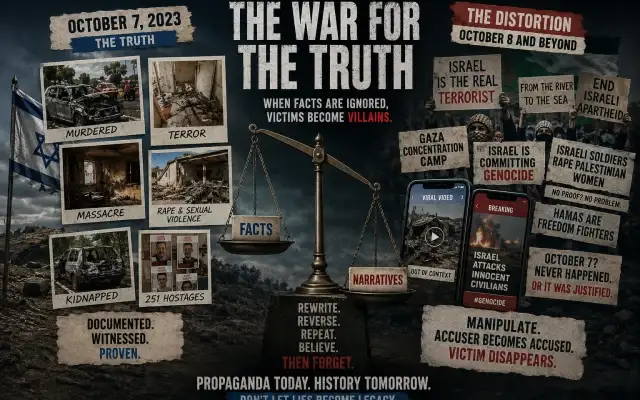
At Time To Stand Up For Israel we see the consequences every single day. Conversations about Israel are increasingly dominated by emotion, selective outrage, manipulated imagery, misinformation, and political activism disguised as journalism. In many Western countries, especially online, the anti-Israel narrative has become so dominant that historical reality is often pushed aside completely.
What is perhaps most alarming is not the hostility itself. Israel has faced hostility since the day the Jewish state was founded in 1948. The truly dangerous development is the collapse of historical awareness and critical thinking. Entire generations are growing up with almost no understanding of the wars against Israel, the terror campaigns against civilians, the repeated rejection of peace proposals, or the ideological foundations of organizations that openly called for Israel’s destruction long before the current conflict ever existed.
The result is a dangerous imbalance.
Israel is judged in isolation while the surrounding history is erased.
And once history disappears, propaganda fills the vacuum.
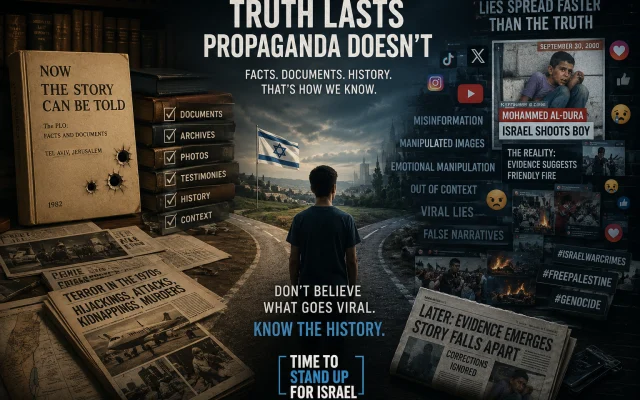
One of the clearest and most damaging examples of this phenomenon was the case of Mohammed al-Dura.
In September 2000, the world saw shocking footage from Gaza showing a Palestinian father and son caught in crossfire during violent clashes at the start of the Second Intifada. International media outlets rapidly blamed Israel for the death of the child. The images spread across television screens and newspaper front pages around the world within hours.
Israel was immediately condemned.
The footage became one of the most powerful propaganda symbols ever used against the Jewish state. Demonstrators carried the image in protests throughout Europe and the Middle East. The story fueled hatred, outrage, and antisemitism internationally. For millions of people, the accusation became absolute truth almost overnight.
But over time, serious questions emerged.
Ballistic analyses, investigative reports, independent experts, and later examinations increasingly challenged the original narrative. Evidence raised the possibility that the fatal shots may not have come from the Israeli position at all and may instead have resulted from Palestinian friendly fire during the chaotic gun battle.
Yet by then the damage was irreversible.
The emotional image had already entered global consciousness.
The accusation remained.
The correction barely traveled.
That is exactly how modern propaganda functions.
A dramatic accusation against Israel spreads globally within minutes. Emotional reactions explode online. Celebrities, activists, journalists, and politicians repeat the claim before facts are verified. Then days, weeks, or months later, evidence emerges showing that the situation was far more complicated or entirely different from what people originally believed.
But by that point almost nobody pays attention anymore.
The lie already won the headlines.
This pattern has become increasingly common in the digital age. Social media rewards outrage rather than accuracy. Algorithms amplify emotional content because anger generates clicks and engagement. Carefully researched historical analysis cannot compete with emotionally manipulated videos designed to go viral within seconds.
As a result, millions of people now consume the Middle East conflict almost entirely through fragments of misinformation stripped of context.
This concerns me deeply because I remember a very different atmosphere during my childhood.
In the late nineteen seventies my family lived in the Middle East. My parents were deeply committed supporters of Israel. They were not motivated by trends, ideology, or political fashion. They were motivated by conviction rooted in historical knowledge. They believed with absolute certainty that supporting Israel was morally and historically justified.
As a child I often wondered how they could be so certain.
Years later I understood why.
Our home was filled with books, archives, reports, newspaper collections, maps, and historical publications about the Middle East conflict. My parents did not form their opinions through slogans. They studied evidence. They examined original documents. They spent years researching the history surrounding Israel and the Arab Israeli conflict.
One publication left a permanent impression on me.
It was a book published in Jerusalem in 1982 by the World Zionist Organization titled Now the Story Can Be Told. The publication focused on the history and activities of the Palestine Liberation Organization during the nineteen sixties and seventies.
The book was not propaganda.
It was documentation.
Page after page contained evidence about aircraft hijackings, hostage crises, terror attacks against civilians, assassinations, and the expansion of militant Palestinian factions throughout the Middle East. It explained how these groups operated from bases in Jordan and later Lebanon, where armed organizations effectively created a state within a state in southern Lebanon.
Most importantly, the publication clearly documented something that many people today either ignore or deliberately erase.
Long before modern debates about settlements or borders dominated international discussions, organizations such as the PLO openly declared that their objective was the elimination of Israel itself. This was publicly stated. The conflict was never only about territory. At its core it concerned the existence of a Jewish state in the Middle East.
That reality is increasingly hidden from younger generations.
Today many students and activists encounter the conflict only through social media clips, slogans, and selective narratives. They are rarely exposed to the decades of terrorism against Israeli civilians, the repeated rejection of peace initiatives, or the extremist ideologies that fueled violence long before current events.
History is presented selectively.
And selective history is manipulation.
Even worse, many Western institutions now amplify this distortion instead of correcting it. Universities that once valued critical scholarship increasingly tolerate ideological activism presented as academic analysis. Media organizations sometimes publish accusations before verification. Influencers with little historical knowledge reach millions while serious historians are ignored because nuance is less emotionally satisfying than outrage.
Meanwhile Israel often appears absent from the battlefield of information.
This is one of modern Israel’s greatest strategic failures.
The country that excels in intelligence, military innovation, medicine, cyber security, and technology should also dominate the field of historical documentation and public diplomacy. Israel possesses overwhelming historical evidence supporting its case, yet too often fails to communicate that evidence effectively to younger global audiences.
Where are the massive multilingual digital archives accessible to students worldwide?
Where are the international campaigns exposing decades of terrorism against Israeli civilians?
Where are the public historical databases documenting the repeated Arab rejection of coexistence and peace proposals?
Where are the restored testimonies from survivors of terror attacks during the nineteen seventies, eighties, and nineties?
The material exists.
The archives exist.
The evidence exists.
But in the modern information war, possessing the truth is no longer enough.
The truth must also be communicated relentlessly.
Anti-Israel activists understand this extremely well. They repeat the same narratives continuously across universities, activist organizations, entertainment platforms, and social media networks. Repetition creates perception, even when the claims themselves are weak, misleading, or entirely false.
That is why factual advocacy matters more than ever.
Not blind loyalty.
Not slogans.
Not emotional manipulation.
Facts.
Documents.
Historical context.
Evidence.
Because the tragedy is that many people spreading anti-Israel propaganda genuinely believe they are supporting justice. They do not realize how heavily their worldview has been shaped by selective information and emotionally charged misinformation.
The reality is that Israel’s story is not weak. On the contrary, it is one of the strongest stories of national survival in modern history. A people that survived centuries of exile, persecution, pogroms, and genocide rebuilt their homeland while facing repeated invasions, terror campaigns, diplomatic isolation, and endless delegitimization.
That story deserves to be told clearly and unapologetically.
Because despite the noise dominating social media today, one principle remains true.
Truth has endurance.
Propaganda may dominate headlines temporarily. Lies may spread faster than facts. False accusations may go viral within minutes.
But eventually archives reopen.
Documents resurface.
Witnesses speak.
Evidence accumulates.
And reality becomes harder to suppress.
That is why organizations like Time To Stand Up For Israel continue this work despite hostility and resistance. Not because it is easy. Not because it is popular. But because historical truth matters.
Future generations deserve facts instead of propaganda.
They deserve evidence instead of manipulation.
And they deserve to understand that the conflict surrounding Israel cannot be reduced to slogans shouted on university campuses or emotional clips shared online.
History is far more complicated than activists want people to believe.
But one thing remains certain.
The side that preserves facts, protects historical memory, and continues defending the truth will ultimately outlast the side built on distortion, propaganda, and emotional manipulation.