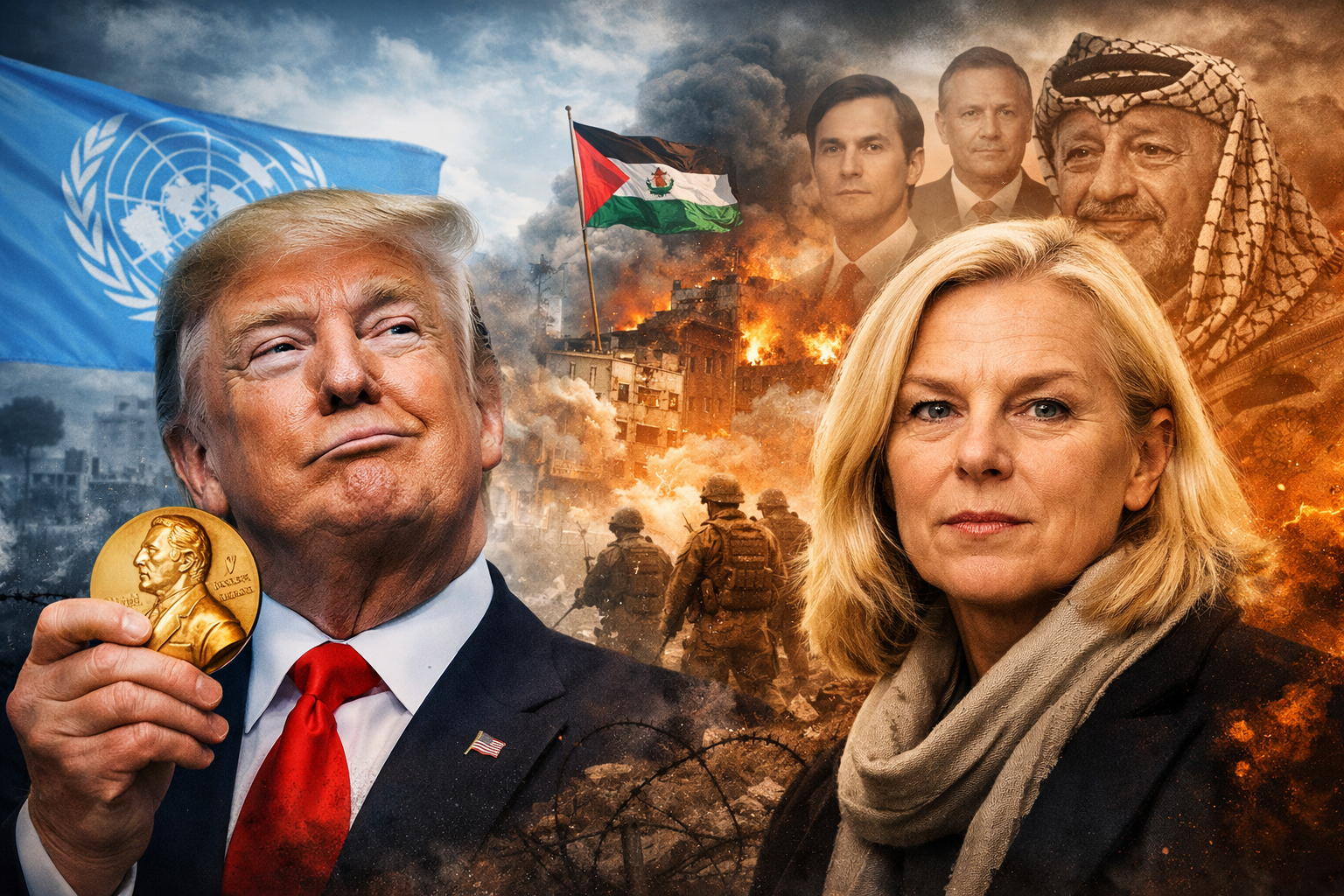
Donald Trump wants the world to believe he is building peace in Gaza. He wants headlines that frame him as a historic dealmaker, a global statesman, perhaps even a future Nobel Peace Prize laureate. But behind the carefully staged announcements and the grand language of “stability” and “prosperity,” Trump’s newly assembled Gaza peace structure reveals something far more troubling: a dangerous mix of vanity, misplaced trust in failed diplomatic elites, and a reckless disregard for Israel’s security realities.
The appointment of Sigrid Kaag to Trump’s Gaza advisory framework is emblematic of this problem.
Kaag is frequently portrayed as an experienced, neutral technocrat. Her defenders point to decades of United Nations service and her time as a Dutch minister as proof of professionalism. Yet in the Middle East, neutrality is not an abstract virtue, it has concrete consequences. And the institutional culture in which Kaag built her career has consistently failed Israel while empowering those who undermine it.
This is not a personal attack. It is a political assessment.
The UN worldview that failed Gaza and Israel
For decades, the United Nations has approached the Israeli-Palestinian conflict through a deeply flawed lens. Israel is treated as a permanent suspect, Palestinian leadership as a perpetual victim, and terrorism as an unfortunate but contextualized byproduct of “despair.” This framework did not begin with Kaag, but she rose within it, succeeded within it, and continues to represent it.
That same UN ecosystem once elevated Yasser Arafat from terrorist mastermind to international statesman without demanding that he dismantle the machinery of violence. The results were catastrophic: waves of suicide bombings, incitement, and a peace process that collapsed under the weight of its own dishonesty.
The lesson should have been clear. Instead, the same thinking persists.
Figures like Kaag emphasize humanitarian access, reconstruction, and governance mechanisms while consistently avoiding the core issue: Gaza’s destruction is not caused by a lack of international oversight, but by the systematic indoctrination of hatred and the glorification of violence. Without confronting that reality, no amount of technocratic management will bring peace.
Trump’s obsession with legacy
Donald Trump, for all his claims of being uniquely pro-Israel, is not immune to ego-driven decision-making. His political history shows a consistent pattern: grand gestures, dramatic announcements, and a hunger for recognition that often overrides strategic depth.
The Gaza peace councils fit this pattern perfectly.
They look impressive. They feature big names. They allow Trump to position himself as the indispensable peacemaker. But substance matters more than symbolism and substance is precisely what is missing.
Rather than anchoring Gaza’s future in hard security guarantees for Israel, clear red lines against terror financing, and ideological deradicalization, Trump has surrounded himself with figures whose records suggest the opposite: a preference for “balance,” moral equivalence, and pressure on Israel to accommodate the unacceptable.
It is increasingly difficult to ignore the role of Trump’s narcissistic tendencies in this process. His public fixation on being recognized as a peacemaker, his resentment over past Nobel Prize awards, and his belief that personal branding can substitute for policy all point to a troubling conclusion: Gaza is being used as a stage, not treated as a powder keg.
Israel will pay the price if this experiment fails.
A council stacked against reality
The composition of Trump’s Gaza councils should alarm anyone who understands the region. UN veterans, European moral arbiters, and political figures with long histories of criticizing Israel’s self-defense now sit at the table defining “peace.”
What is absent is just as telling as what is present.
There is no serious focus on dismantling terror ideology. No insistence on ending incitement. No recognition that Gaza’s suffering is directly linked to Hamas’ strategy of embedding itself within civilian infrastructure.
Instead, Israel is once again expected to prove restraint, flexibility, and goodwill, while its enemies are treated as stakeholders rather than threats.
This dynamic is not new. It is precisely how international involvement in Gaza has repeatedly failed. Aid was diverted. Infrastructure was weaponized. Warnings were ignored. And when violence erupted, Israel was blamed for defending itself.
Endangering Israel under the banner of peace
Trump’s defenders will argue that engagement is better than isolation, that new structures are better than stalemate. But engagement without moral clarity is not diplomacy but it is delusion.
By empowering figures whose careers were shaped by institutions that consistently misread Palestinian politics and excuse extremist behavior, Trump is not stabilizing Gaza. He is laying the groundwork for the next crisis.
Israel does not need another peace framework that treats its survival as negotiable. It needs allies who understand that security is not an obstacle to peace, it is the prerequisite.
If Trump truly cared about Israel’s future, he would prioritize hard truths over flattering headlines. He would reject failed diplomatic paradigms instead of recycling them. And he would stop mistaking international applause for strategic success.
Peace built on denial is not peace at all.
It is merely the pause before the next war.