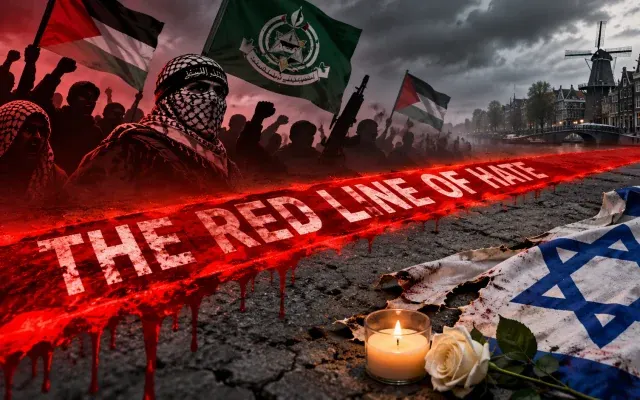
For decades, Israel regarded the Netherlands as one of its most reliable friends in Europe. In the 1970s and 1980s, the Dutch were widely perceived as sympathetic to the Jewish state, supportive of its right to exist, and deeply conscious of the horrors of the Holocaust. The Netherlands had a reputation for tolerance, democracy, freedom, and respect for human rights. To many Israelis, it seemed almost inconceivable that a country associated with Anne Frank, the memory of the Holocaust, and a historically close relationship with Israel could become a place where Jewish citizens increasingly fear displaying their identity and where hostility toward Israel is expressed with such extraordinary intensity. Yet this is precisely the contradiction that demands examination. Was the Netherlands ever as friendly toward Israel as Israelis believed, or was that friendship always more fragile, selective, and superficial than anyone wanted to admit?
I grew up during those decades, and I remember a Netherlands where support for Israel seemed far more natural than it does today. But appearances can be deceiving. A government can maintain excellent diplomatic relations with another country while considerable sections of its population hold entirely different opinions. Political friendship is not necessarily social friendship, and public sympathy can disappear remarkably quickly when international circumstances change. The uncomfortable question is whether the Netherlands genuinely changed its attitude toward Israel or whether hostility that had existed beneath the surface simply became more acceptable to express.
To understand what happened, we must first confront a fundamental distinction. Criticism of an Israeli government is not automatically antisemitism, just as criticism of the Dutch government is not hatred of Dutch people. But when Israel alone is denied the right to exist, when Jews everywhere are held responsible for decisions made in Jerusalem, when Jewish institutions require extraordinary security because of events thousands of kilometres away, or when ancient antisemitic stereotypes are repackaged as political arguments, we are no longer discussing ordinary political criticism. We are witnessing something considerably older and far more dangerous.
The Laws Existed, But Where Was the Protection?
The Netherlands has laws against discrimination, including antisemitic discrimination. Article 137c of the Dutch Criminal Code prohibits certain forms of deliberate public group insult based on religion or ethnicity, while Article 137d addresses incitement to hatred, discrimination, or violence. Other provisions address discriminatory conduct, and crimes motivated by antisemitism can attract more severe punishment. These protections did not suddenly appear after October 7, 2023. The Netherlands has had criminal provisions against discriminatory expressions for decades, and its constitutional commitment to equal treatment is well established. Yet the existence of legislation raises an obvious question. What is the value of a law if the people it is supposed to protect increasingly feel unsafe in their own country?
It would be inaccurate to claim that the Dutch authorities have never acted against antisemitism. There have been investigations, prosecutions, convictions, educational initiatives, and government strategies. But acknowledging these efforts does not mean accepting that they have been sufficient. The difference between having legislation and enforcing it effectively is enormous. A country cannot congratulate itself on its commitment to human rights while Jewish citizens feel compelled to conceal their identity, avoid particular neighbourhoods, or reconsider whether they can safely attend university. Freedom of expression is essential to democracy, but it does not provide unlimited protection for threats, intimidation, or criminal incitement. When authorities fail to distinguish clearly between legitimate protest and unlawful hatred, they risk creating an environment in which extremists become increasingly confident.
The figures are deeply disturbing. According to the Dutch National Coordinator for Combating Antisemitism, police registered 867 antisemitic incidents in 2025, compared with 880 in 2024. The CIDI recorded 281 incidents in 2025, lower than the extraordinary levels of the previous two years but still significantly higher than the years before October 2023. These organisations use different reporting methods, which explains the difference in their figures. Particularly troubling is the problem of reporting fatigue. Some Jewish people have become reluctant to report incidents because they believe nothing meaningful will happen or fear that reporting could make their situation worse. This is not proof that every complaint has been ignored, but it is a devastating indication of declining confidence in the system.
Antisemitism Has Many Faces, But the Target Remains the Same
Antisemitism does not belong exclusively to one political movement, religion, or social class. Historically, religious antisemitism portrayed Jews as enemies of Christianity and used theological accusations to justify persecution. Racial antisemitism subsequently transformed Jewish identity into a supposedly biological characteristic, laying the ideological foundations for some of history’s most horrific crimes. Economic antisemitism promoted the poisonous fantasy that Jews secretly controlled banks, international finance, and global commerce. Conspiracy theories claimed that Jews manipulated governments, newspapers, wars, and entire societies. Holocaust denial and distortion sought to erase, diminish, or exploit the murder of six million Jews.
Today, these older forms coexist with political antisemitism, including hostility that uses Israel as a vehicle for attacking Jews collectively. This does not mean that everyone opposing Zionism or criticising Israel is antisemitic. It means that political language can become a convenient disguise for prejudices that would be recognised immediately if expressed more openly. When Jewish students are confronted over Israeli military operations simply because they are Jewish, when synagogues are targeted in response to events in Gaza, or when people justify violence against Jews by referring to Israel, the distinction is no longer difficult to recognise.
And this brings me to a particularly uncomfortable subject. How did the Netherlands move from being perceived as one of Israel’s closest friends to becoming a country where anti Israel demonstrations attract enormous attention and where Jewish citizens increasingly question their safety?
Part of the answer lies in history. Dutch support for Israel in the 1970s was real. During the Yom Kippur War in 1973, the Netherlands adopted a notably supportive position toward Israel, even risking diplomatic isolation and economic consequences. Dutch territory was used to facilitate military supplies, and the country subsequently faced an Arab oil embargo. Furthermore, between 1967 and 1990, the Dutch embassy in Moscow represented Israeli interests and helped facilitate the emigration of hundreds of thousands of Jews from the Soviet Union. These were not imaginary gestures of friendship. They were substantial political commitments.
But government policy never represented every Dutch citizen. Sympathy for Israel was influenced by the memory of the Holocaust, religious traditions, political alliances, and the image of a small country defending itself against much larger enemies. As the decades passed, the Israeli and Palestinian conflict became increasingly central to public debate, European political attitudes evolved, and Israel was more frequently portrayed through the lens of military power rather than vulnerability. For some people, legitimate concern for “Palestinian” civilians developed into harsh criticism of Israeli policies. For others, older prejudices found a new political vocabulary. These developments should not be confused, but neither should their consequences be ignored.
October 7, 2023, exposed the problem with horrifying clarity. Hamas terrorists murdered approximately 1,200 people in Israel and abducted 251 hostages. Yet even before the full extent of the atrocities had been established, public discussions were already shifting toward explanations and justifications of the attack. The subsequent suffering of civilians in Gaza deserved serious attention, but it could never justify celebrating massacres, excusing hostage taking, or threatening Jewish communities abroad. Nevertheless, the war became a catalyst for antisemitic incidents throughout Europe, including the Netherlands.
I find it particularly disturbing that a country so proud of its Holocaust remembrance continues to struggle with the protection of living Jews. Commemorating murdered Jews is apparently easier than confronting antisemitism among the living. Ceremonies, monuments, speeches, and educational programmes are important, but remembrance without moral consistency becomes dangerously hollow. The lessons of history are not demonstrated by laying wreaths once a year. They are demonstrated by what society tolerates during the remaining 364 days.
There is another uncomfortable reality. Antisemitism emerges from different ideological environments, including the extreme right, certain extreme left movements, religious extremism, and conspiracy communities. It would be dishonest to blame one entire population or religion for this phenomenon. Equally, it would be irresponsible to avoid discussing antisemitism within particular movements because doing so might be politically inconvenient. Every manifestation deserves scrutiny, regardless of the identity, religion, or political affiliation of the perpetrator. Selective outrage is not a serious strategy against hatred.
A Government Strategy Is Not the Same as Safety
In April 2026, the Dutch government acknowledged that antisemitism remained deeply rooted and that Jewish life was under pressure. It announced further measures under its national strategy for combating antisemitism from 2024 to 2030. This demonstrates that the authorities are not literally doing nothing. But it also confirms that the problem is serious enough to demand coordinated national action. The question is no longer whether politicians recognise antisemitism. The question is whether their actions produce measurable improvements in the daily lives of Jewish citizens.
I believe the Netherlands has become far too comfortable confusing tolerance with passivity. Tolerance does not require accepting intimidation. Democracy does not demand that threatening behaviour be excused as political passion. Universities should protect academic debate without permitting Jewish students to be harassed. Police should investigate credible threats regardless of the political context in which they arise. Prosecutors should apply the law consistently, and political leaders should stop treating antisemitism as a problem that becomes urgent only after another shocking incident reaches the headlines.
Israel, meanwhile, should recognise that historical friendship cannot be taken for granted. The Netherlands of 1973 is not the Netherlands of 2026. That does not mean every Dutch citizen has become hostile to Israel, nor does it erase the Dutch people who continue to defend Jewish communities and Israel’s right to exist. But it does mean that sentimental assumptions about old alliances are insufficient. Friendship must be judged by present actions, not merely historical memories.
Perhaps the most painful conclusion is that antisemitism never truly disappeared from European society. It changed its language, adapted to political circumstances, and found new ways to present itself as socially acceptable. The events following October 7 did not create every prejudice now visible. They exposed existing prejudices, intensified others, and provided opportunities for extremists to exploit public anger.
The Netherlands must decide what kind of country it intends to be. A nation that remembers the Holocaust while allowing Jewish citizens to live in fear has failed to understand one of the most important lessons of its own history. A nation that celebrates freedom while tolerating intimidation has misunderstood freedom itself. And a nation that claims to oppose discrimination but struggles to confront antisemitism consistently has a serious problem with its moral credibility.
Israel does not need unquestioning approval from the Netherlands. No democratic country should expect that. What Israel and Jewish communities deserve is something far more fundamental: the consistent application of the principles the Netherlands claims to uphold.
Because the true measure of a society is not how loudly it condemns the antisemitism of the past, but how courageously it confronts the antisemitism of the present.