The Invention of a Narrative: Palestine, History, and Political Revisionism
Few modern conflicts are surrounded by as much manufactured certainty as the Israeli–Palestinian conflict. Among the most aggressively asserted claims today is that “Palestinians are an ancient, indigenous nation whose sovereign state was destroyed by Israel.” This assertion is not merely popular but it is treated as axiomatic. To question it is to invite accusations of racism, denialism, or moral corruption.
Yet when subjected to historical scrutiny, the claim collapses.
History is not determined by hashtags or repetition. It is determined by contemporary sources, political declarations, and institutional behavior at the time events occurred. When those sources contradict modern claims, it is not history that must be adjusted. No, it is the narrative.
One of the most decisive sources in this discussion is Ahmad Shukeiry, the Arab League’s representative to the United Nations in the 1950s and later the founder and first chairman of the Palestine Liberation Organization (PLO).
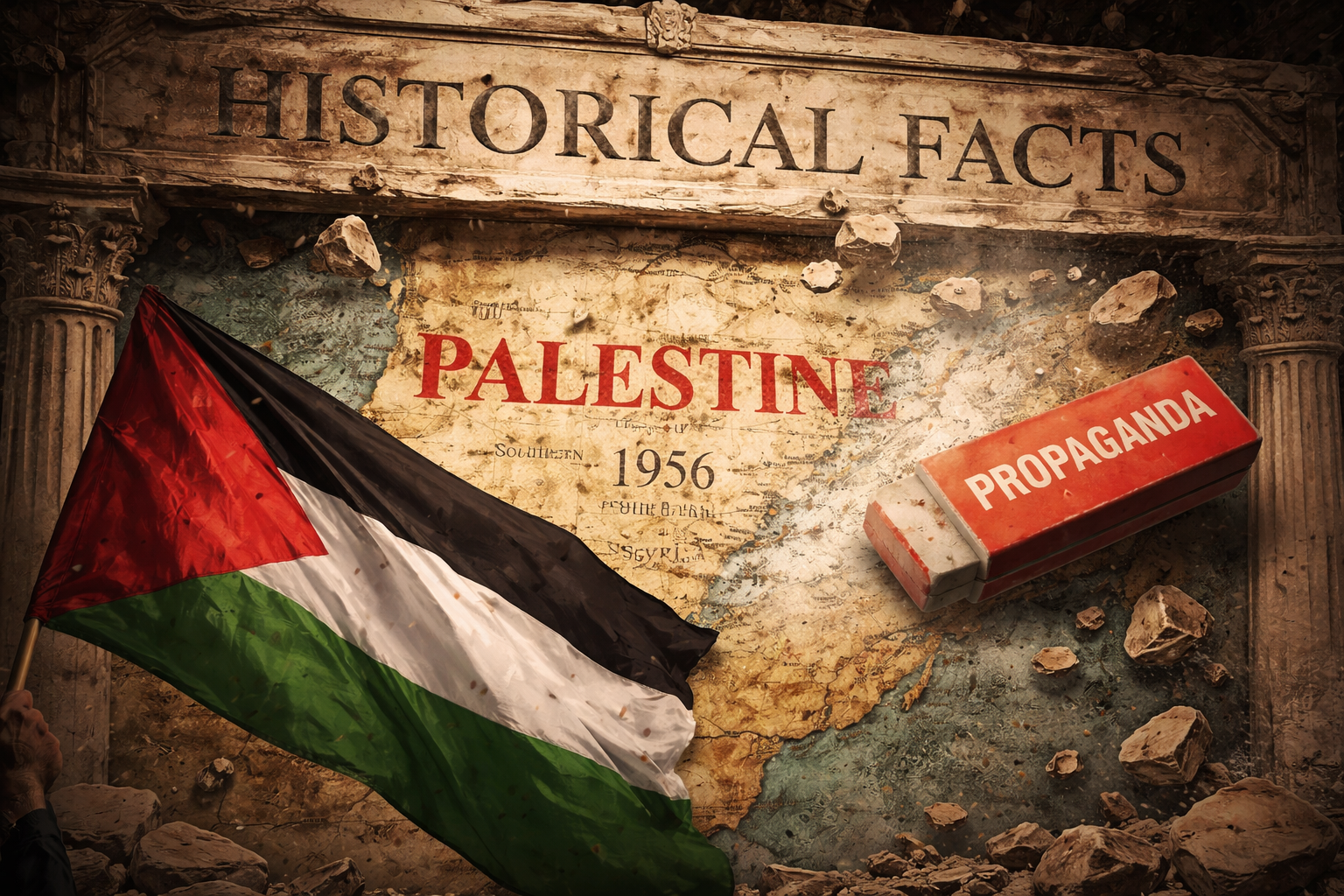
In 1956, speaking at the United Nations, Shukeiry stated plainly:
“It is common knowledge that Palestine is nothing but southern Syria.”
This statement alone destabilizes much of today’s political mythology.
A Statement of Policy, Not a Personal Opinion
Shukeiry was not a marginal figure. He was not a dissident, a rogue speaker, or an uninformed observer. He was the official voice of the Arab League at the United Nations, articulating the consensus position of Arab leadership.
His denial of Palestinian nationhood was neither accidental nor controversial at the time. It reflected the prevailing Arab political understanding:
Palestine was not recognized as a sovereign national entity
Its Arab population was viewed as part of a broader Syrian or pan-Arab identity
The conflict was framed explicitly as Arab states versus Israel and not Palestinians versus Israel
This is not interpretation. It is documented political reality.
If a distinct Palestinian nation had existed “from time immemorial,” it would be historically inexplicable for the Arab League’s UN ambassador to deny its existence, publicly, formally, and without internal objection.
The Inconvenient Chronology of Palestinian Nationalism
Chronology matters. Narratives often fail because they ignore it.
Israel declared independence in 1948. Shukeiry’s statement was made in 1956, eight years later. The PLO was founded only in 1964.
This sequence alone refutes the claim that Palestinian nationalism was the central or defining feature of the conflict from its inception.
Even more revealing is what happened between 1948 and 1967.
During those 19 years:
Judea and Samaria were annexed by Jordan
Gaza was controlled by Egypt
No Palestinian state was established
No Arab League initiative demanded Palestinian sovereignty
No international campaign framed the issue as Palestinian self-determination
If Palestinian independence were the priority now claimed, this period would have been decisive. Instead, it passed with near-total silence.
Why?
Because the conflict was not about Palestinian independence. It was about preventing Jewish sovereignty.
From Military Failure to Narrative Warfare
After repeated Arab military defeats, most decisively in 1967, the strategy shifted.
Unable to eliminate Israel militarily, Arab leadership pursued a political and rhetorical transformation of the conflict. The goal was no longer victory on the battlefield, but delegitimization in international institutions, media, and academia.
This is the moment when Palestinian nationalism was elevated, codified, and internationalized.
The reframing was systematic:
Arab–Israeli conflict → Palestinian liberation struggle
Regional war → Anti-colonial resistance
Rejection of Israel → Accusations of apartheid and genocide
This was not historical discovery. It was political adaptation.
National identities can evolve, that is not controversial. What is controversial is the retroactive claim that such identities were always central, continuous, and sovereign when the historical record says otherwise.
Deconstructing Today’s Dominant Falsehoods
Claim: “Palestine was a sovereign Arab state before Israel.” There is no evidence for this. No state, no sovereignty, no government, no independence. Ottoman administration is not Palestinian statehood. British administration is not Palestinian sovereignty.
Claim: “Palestinians always identified as a distinct nation.” This is directly contradicted by Arab leadership statements, including Shukeiry’s, throughout the mid-20th century.
Claim: “Israel destroyed an existing Palestinian state.” Israel emerged after the Arab rejection of the UN Partition Plan. The war that followed was initiated by Arab states.
Claim: “Palestinian identity predates Jewish presence.” This is historically indefensible. Jewish presence, governance, and civilization in the land precede Arab conquest by millennia.
Why These Facts Are Erased
Shukeiry’s 1956 statement is not forgotten. It is suppressed.
It disrupts:
The claim of eternal Palestinian nationhood
The portrayal of Israel as a colonial intruder
The assertion that Israel destroyed a sovereign people’s state
Modern activism does not engage this statement because it cannot. It contradicts the foundational premise of the contemporary narrative.
Conclusion: History Is Not Optional
This is not an argument against Palestinian rights or dignity. It is an argument against historical falsification.
In 1956, the Arab League’s UN ambassador stated clearly that Palestine was not a separate nation. Eight years later, he founded an organization that claimed the opposite. That contradiction is not a footnote, it is the story.
Peace cannot be built on retroactive myths, moral blackmail, or the erasure of inconvenient facts. Academic integrity demands confrontation with evidence, not submission to narrative pressure.
History does not change because it becomes uncomfortable.
And truth does not disappear because it is politically inconvenient.