Peace Demands Truth, Not Illusions Dialogue
For a brief moment, when President Trump revealed his “Deal of the Century,” a few years ago, the world seemed to hold its breath. Headlines spoke of opportunity. Commentators dared to hope. Perhaps, after decades of bloodshed, terror, and shattered promises, there might finally be a genuine path to peace in the Middle East.
That hope evaporated quickly.
Within hours, the Palestinian leadership launched its familiar rage: shouting, threatening, rejecting any compromise before the ink had even dried. And once again, just as they had done for nearly a century, they said NO.
- 1937 – Peel Commission Partition: NO
- 1939 – White Paper: NO
- 1947 – UN Partition Plan: NO
- 1967 – Khartoum Resolution (“Three No’s”): NO
- 1977 – Peace with Egypt (initially): NO
- 2000 – Camp David Peace Offer: NO
The pattern remains unbroken. Not a single proposal, no matter how generous, has ever been enough for “palestinian” authorities who insist not on coexistence, but on maximal rejectionism.
Meanwhile, Israelis continued to live under fire. On Shabbat’s, rockets launched from Gaza were raining down on southern communities, rockets financed indirectly by an international community that still insists on treating the Palestinians as eternal victims instead of accountable political actors. And like clockwork, much of the world points its accusatory finger not at Hamas, the Iranian-backed terror group firing the rockets, but at Israel, the country defending its citizens.
It made me think deeply: What actually brings peace? If grand gestures by world powers fail, what remains?
A memory of my father resurfaced. During his UNTSO peace duty in 1978–1979, he was responsible for the family reunions of the Druze between Syria and Israel. Once a month, under strict security, families separated by war met again. They talked. They hugged. They remembered one another’s humanity. And for a moment, peace felt real.
That is exactly what has been missing for generations. Palestinian children have grown up in an educational system soaked with hatred, incitement, and lies about Israel and the Jewish people. These messages penetrate deep. When one population is taught that the other is inherently evil, how can any political agreement succeed?
So I began imagining something radically simple, but powerful.
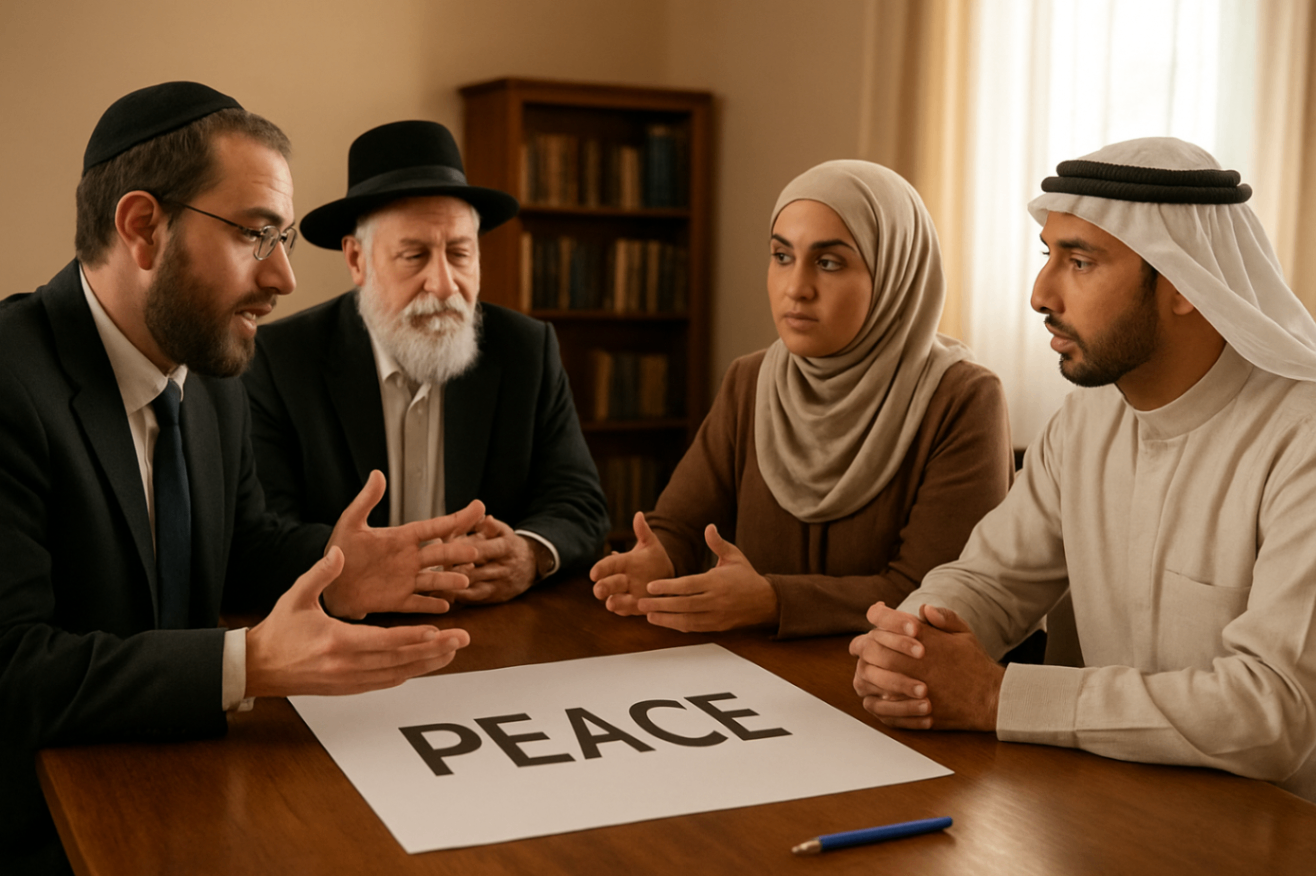
What if Israel selected one Arab village and one Jewish town each month and created structured, safe, supervised family-to-family meetings?
Eight evenings of shared meals. Eight evenings of conversation. Eight evenings where people see each other as parents, neighbors, human beings, not slogans or stereotypes.
Security would be essential: weapon checks, standby guard units, panic buttons for participating families. But with proper protection, a real dialogue could emerge. After one month, the project would move to another pair of communities. Peace may not come top-down, but perhaps it can grow bottom-up.
Because if the political leadership refuses dialogue, ordinary people still can choose it.
Israel has always sought peace, even when surrounded by hostility. Israelis celebrate life, not death. They mourn every fallen soldier as a child of the nation. They protect minorities, uphold democracy, and fight only when forced to. No other country under constant attack shows such restraint.
And yet, we now see a new obstacle emerging, not only Palestinian rejectionism, but global cynicism. The 2025 ceasefire deal, shaped by Trump, once again revealed a tragic truth: when foreign leaders treat the Middle East as a business transaction, history and ethics are pushed aside. If a president accepts hundreds of millions from regimes that sponsor terror and preach extremist ideologies, how can he remain a reliable partner for Israel?
When money dictates policy, peace becomes an illusion.
When dialogue dictates policy, peace becomes possible.
Real peace is not built in conference rooms. It is built at kitchen tables, in shared meals, through honest conversations and slow but steady trust.
The world must stop rewarding those who say “NO” and start empowering those who dare to say “YES.”
Because dialogue, genuine, human dialogue, is the only path that has ever brought lasting peace.