
Operation Opera also known as Operation
Babylon, was a surprise airstrike conducted by the Israeli Air Force on 7 June 1981, which destroyed an
unfinished Iraqi
nuclear reactor located
17 kilometres (11 miles) southeast of Baghdad, Iraq.
The
Israeli operation came a year after the Islamic
Republic of Iran Air Force had caused minor damage to the same nuclear
facility in Operation
Scorch Sword, with
the damage having been subsequently repaired by French technicians. Operation Opera, and related Israeli government statements following it, established
the Begin Doctrine, which explicitly stated the strike
was not an anomaly, but instead "a precedent for every future government
in Israel". Israel's counter-proliferation preventive strike added another dimension to its
existing policy of
deliberate ambiguity,
as it related to the nuclear weapons capability of other states in the region.
In 1976,
Iraq purchased an Osiris-class nuclear reactor from France. While
Iraq and France maintained that the reactor, named Osirak by the
French, was intended for peaceful scientific research, the Israelis viewed
the reactor with suspicion, believing it was designed to produce nuclear
weapons that could escalate the ongoing Arab–Israeli
conflict
On 7
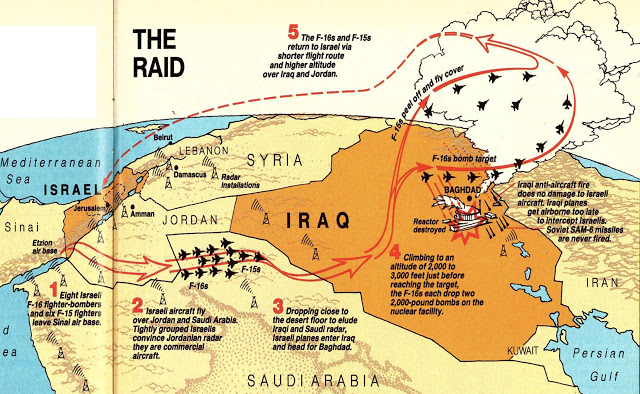
June 1981, a flight of Israeli Air Force F-16A fighter aircraft, with an escort of F-15As, bombed the Osirak reactor
deep inside Iraq. Israel called the
operation an act of self-defense, saying that the reactor had "less than a
month to go" before "it might have become critical." The airstrike reportedly
killed ten Iraqi soldiers and one French civilian. The
attack took place about three weeks before the 1981 Israeli
legislative elections for
the Knesset.
At the time
of its occurrence, the attack was met with sharp international criticism,
including in the United States, and Israel was rebuked by the United
Nations Security Council and General
Assembly in
two separate resolutions. Media reactions were also negative: "Israel's
sneak attack ... was an act of inexcusable and short-sighted aggression", wrote The New York Times, while the Los Angeles Times called it "state-sponsored
terrorism".
The
destruction of Iraq's Osirak reactor has been cited as an example of
a preventive strike in contemporary scholarship
on international law. The efficacy of the attack is
debated by historians, who acknowledge that it brought Iraq back from the brink
of nuclear capability but drove its weapons program underground and
cemented Iraqi president Saddam Hussein's future ambitions for acquiring nuclear
weapons.
The Iraqi Nuclear Program
Iraq had
established a nuclear program sometime in the 1960s, and in the mid-1970s
looked to expand it through the acquisition of a nuclear reactor. After
failing to convince the French Government to sell them a gas cooled graphite moderated plutonium-producing reactor and reprocessing
plant, and likewise
failing to convince the Italian government to sell them a Cirene reactor,
the Iraqi government convinced the French
government to sell them an Osiris-class research reactor. The purchase also included a smaller
accompanying Isis-type reactor, the sale of 72 kilograms of 93% enriched uranium and the training of personnel. The
total cost has been given as $300 million (equivalent to $1.62 billion in
2024).] In November 1975, the countries signed a nuclear cooperation
agreement and in 1976, the sale of the reactor was finalized.
Construction
for the 40-megawatt light-water nuclear reactor began in 1979
at the Al Tuwaitha Nuclear Center near Baghdad. The main reactor was dubbed Osirak (Osiraq) by the French,
blending the name of Iraq with that of the reactor class. Iraq named the main
reactor Tammuz 1 and the smaller Tammuz 2. Tammuz was the Babylonian month when the Ba'ath Party had come to power in 1968.
On 6 April
1979, Israeli agents sabotaged the Osirak reactor awaiting shipment to Iraq
at La Seyne-sur-Mer in France. On 14 June
1980, Mossad agents assassinated Yahya El Mashad, an Egyptian nuclear scientist who headed the
Iraqi nuclear program, in a hotel in Paris. In July 1980, Iraq received
from France a shipment of approximately 12.5 kilograms of highly enriched
uranium fuel to be used in the reactor. The shipment was the first of a planned
six deliveries totalling 72 kilograms. It was reportedly stipulated in the
purchase agreement that no more than two HEU fuel loadings, 24 kilograms,
could be in Iraq at any time.
Iraq and
France claimed that the Iraqi reactor was intended for peaceful scientific
research. Agreements between France and Iraq excluded military use. The
American private intelligence agency STRATFOR wrote in 2007 that the uranium-fueled reactor "was believed
to be on the verge of producing plutonium for a weapons program".
In a
2003 speech, Richard
Wilson, a professor
of physics at Harvard University who visually inspected the
partially damaged reactor in December 1982, said that "to collect enough
plutonium [for a nuclear weapon] using Osirak would've taken decades,
not years". In 2005, Wilson further commented in The Atlantic: "The Osirak reactor that was bombed by
Israel in June 1981 was explicitly designed by the French engineer Yves Girard
to be unsuitable for making bombs. That was obvious to me on my 1982
visit". Elsewhere Wilson has stated that contrary to claims that the
bombing of the Iraqi Osirak reactor delayed Iraq's nuclear bomb program, the
Iraqi nuclear program before 1981 was peaceful, and the Osirak reactor was not
only unsuited to making bombs but was under intensive safeguards.
In an
interview in 2012, Wilson again emphasised: "The Iraqis couldn't have been
developing a nuclear weapon at Osirak. I challenge any scientist in the world
to show me how they could have done so."
Iraq was a
signatory to the Nuclear
Non-Proliferation Treaty, placing its reactors under International
Atomic Energy Agency (IAEA)
safeguards. In October 1981, the Bulletin of
the Atomic Scientists published
excerpts from the testimony of Roger Richter, a former IAEA inspector who
described the weaknesses of the agency's nuclear safeguards to the United States Senate Committee on Foreign Relations. Richter testified that only part
of Iraq's nuclear installation was under safeguard and that the most sensitive
facilities were not even subject to safeguards. IAEA's Director-General Sigvard Eklund issued a rebuttal saying that Richter had
never inspected Osirak and had never been assigned to inspect
facilities in the Middle East. Eklund claimed that the safeguards
procedures were effective and that they were supplemented by precautionary
measures taken by the nuclear suppliers.
Anthony
Fainberg, a physicist at the Brookhaven
National Laboratory,
disputed Richter's claim that a fuel processing program for the manufacturing
of nuclear weapons could have been conducted secretly. Fainberg wrote that
there was barely enough fuel on the site to make one bomb, and that the
presence of hundreds of foreign technicians would have made it impossible for
the Iraqis to take the necessary steps without being discovered.
Strategy
and diplomacy

Menachem Begin, Prime Minister of Israel and in
charge of the operation, disembarks from an aircraft upon his arrival in the
United States, accompanied by Israeli Foreign Minister Moshe Dayan.
In Israel,
discussions on which strategy to adopt in response to the Iraqi reactor
development were taking place as early as Yitzhak Rabin's first term in
office (1974–1977). Reportedly,
planning and training for the operation began during this time. After Menachem Begin became Prime Minister in 1977 the
preparations intensified; Begin authorized the building of a full-scale model
of the Iraqi reactor which Israeli pilots could practice bombing.[ Three Israeli pilots died in accidents while training for the
mission.
Israel's
Foreign Minister Moshe Dayan initiated diplomatic
negotiations with France, the United States and Italy (Israel maintained that
some Italian firms acted as suppliers and sub-contractors) over the matter but
failed to obtain assurances that the reactor program would be halted. In
addition Israel was not able to convince the French governments of Valéry
Giscard d'Estaing and François
Mitterrand to
cease aiding the Iraqi nuclear program. Saddam Hussein consistently maintained that Osirak was
intended for peaceful purposes. Begin considered the diplomatic options
fruitless, and worried that prolonging the decision to attack would lead to a
fatal inability to act in response to the perceived threat. According to
Karl P. Mueller, in the spring of 1979, Begin had reached the conclusion that
an anticipatory attack was necessary.
Anthony Cordesman writes that the Israeli
intelligence agency Mossad conducted a series of clandestine
operations to
halt construction or destroy the reactor. In April 1979, Mossad agents in
France allegedly planted a bomb that destroyed the reactor's first set of core
structures while they were awaiting shipment to Iraq. In June 1980, Mossad
agents are said to have assassinated Yehia El Mashad, an Egyptian atomic scientist working on the
Iraqi nuclear program. Shortly afterward, two other Iraqi engineers
working on the program, Salman Rashid and Abdul Rasul, fell ill and died on trips to
Switzerland and France respectively, with Mossad suspected of having poisoned
them. It has also been claimed that the Mossad bombed several of the French and
Italian companies it suspected of working on the project, and sent threatening
letters to top officials and technicians, causing several French technicians to
resign. Following the bombing in April 1979, France inserted a clause in
its agreement with Iraq saying that French personnel would have to supervise
the Osirak reactor on-site for a period of ten years.
The alleged
assassinations caused widespread panic among Iraqi nuclear scientists. Saddam
Hussein, worried over the effect on the morale of the project's scientists,
awarded cash bonuses and luxury cars to all senior scientists. Meshad's widow
was awarded $300,000 and promised that she and her children would receive a
lifelong pension. Iraqi scientists were given financial bonuses for
international travel, which they had become increasingly fearful of, and
received instructions on how to avoid potential Mossad assassinations.
Iranian attack Operation
Scorch Sword
In an air
attack codenamed Operation
Scorch Sword, Iran
attacked and damaged the site on 30 September 1980, with two F-4 Phantoms, shortly after the outbreak of the Iran–Iraq War. At the onset of the war, Yehoshua Sagi, director of the Israeli Military Intelligence Directorate, publicly urged the Iranians to
bomb the reactor. The attack was the first on a nuclear reactor and only the third on a nuclear facility
in history. It was also the first instance of a preventive attack on a nuclear reactor which aimed to
forestall the development of a nuclear weapon.
Due to last
minute Iranian concerns that the reactor had been already fueled and could
release radioactive
fallout if
hit, they did not attack the actual reactor dome, but the control room,
research/centrifuge facilities, and the adjacent buildings. The targets were
struck and the buildings were damaged, along with the plant cooling mechanisms.
Two other F-4s simultaneously hit Baghdad's main power plant, knocking the
city's electricity out for nearly two days. The Iraqis denied any major damage.
The French and Italian technicians promptly left Iraq, and nearly withdrew from
the project, but some later returned in February 1981 and began to repair the
damage.
Trita Parsi, in the book Treacherous
Alliance: The Secret Dealings of Israel, Iran, and the United States, writes
that a senior Israeli official met with a representative of the Ayatollah Khomeini in France one month prior to
the Israeli attack. The source of the assertion is Ari Ben-Menashe, a former Israeli government employee. At the
alleged meeting, the Iranians explained details of their 1980 attack on the
site, and agreed to let Israeli planes land at an Iranian airfield in Tabriz in the case of an emergency.[57] While the new Iranian government was officially hostile to Israel,
due to both nations having a common enemy (Iraq), and Iranian fears that the
Iraqis would create an atomic bomb to use on them, they clandestinely worked
with Israel to forestall such a development.[56]
Operational
planning
 Scheme of operation
The
distance between Israeli military bases and the reactor site was
significant—over 1,600 km (990 mi; 860 nmi). The Israeli
planes would have to violate Jordanian and/or Saudi airspace in a covert flight over foreign territory, making mid-air refueling unfeasible. The Israelis eventually
concluded that a squadron of heavily fueled and heavily armed F-16As, with a group of F-15As to provide air cover and
fighter support, could perform a surgical strike to eliminate the reactor site without
having to refuel.
The
decision to go through with the operation was hotly contested within Begin's
government. Ariel Sharon, a member of the Security
Cabinet, later said
that he was among those who advocated bombing the reactor. Dayan, Defense
Minister (until late 1980) Ezer Weizman and Deputy Prime Minister Yigael Yadin were among those opposed. According
to Mueller, "the principal difference between the hawks and doves on this
issue lay in their estimation of the likely international political costs of an
air strike". Shai Feldman specifies that "[those opposed] feared
that the operation would derail the fragile Israeli-Egyptian peace process,
fuel Arab anxieties about Israel's profile in the region, and damage
Israel-French relations".] Begin and his supporters, including Sharon, were far less
pessimistic than their opponents about the political fallout. Yehoshua Saguy argued for continued efforts in trying to
find a non-military solution as it would take the Iraqis five to ten years to
produce the material necessary for a nuclear weapon In the end, Begin
chose to order the attack based on a worst-case estimate where a weapon could
be created in one to two years time. According to Ronen Bergman, Mossad director Yitzhak Hofi told Begin in October 1980 that the
Mossad's campaign of assassinations and sabotage could not stop the Iraqi
nuclear program and that the only way to put an end to it was an airstrike.
Prime
Minister Begin defended the timing of the bombing stating that a later attack,
after the reactor had become operational, could cause lethal radioactive
contamination doses
to reach all the way to Baghdad. An analysis by Warren Donnelly of the
United States Congressional
Research Service concluded
that "it would be most unlikely for an attack with conventional bombs upon
the reactor when operating to have caused lethal exposures to radioactivity in
Baghdad, although some people at the reactor site might receive some exposure". This was similarly the conclusion
of Herbert Goldstein of Columbia University using IAEA release factors, the lethal contamination would be confined to a
close proximity to the reactor and small amounts of radiation would be
detectable in Baghdad under the assumption that winds were blowing in that
direction.
In October
1980, Mossad reported to Begin that the Osirak reactor would be
fueled and operational by June 198 1 This assessment was significantly
aided by reconnaissance photos supplied by the United States, specifically
using the KH-11 KENNEN satellite. French technicians
installing the reactor later said it was scheduled to become operational only
by the end of 1981. Nonetheless, in October 1980, the Israeli cabinet
(with Dayan absent) finally voted 10–6 in favor of launching the attack.
Preliminary Israeli/Iranian actions H-3 airstrike
After the
approval for Operation Opera, the Israelis began to plan their mission against
Osirak. The basic procedure for the airstrike had been formulated as early as
1979. However, the Israelis needed photographic intelligence about the
layout of the plant. That task allegedly fell to the Iranians. Rather than
carrying out a follow-up air raid after their September attack, on 30 November
1980, an Iranian F-4 Phantom reconnaissance jet took
pictures of the Osirak reactor. The photographs were allegedly placed in a
top-secret metal container, and certain elements of the Iranian military
delivered them to the Israelis. With these photographs, the Israelis began to
plan out Operation Opera.
A team of
Israeli pilots using A-4 Skyhawk aircraft began practicing over the Mediterranean Sea for the raid. The Israelis shortly
afterwards received their first agreed delivery of F-16 Fighting
Falcon aircraft
(the first batch was originally earmarked for Iran, but because of the Iranian Revolution of 1979, the Israeli Air Force received
theirs ahead of schedule). The new F-16s would be used for the raid. Israeli
F-4 Phantoms also ran reconnaissance missions over areas of southern and
western Iraq. While the Iraqi Air Force was busy fighting the Iranians, on one
occasion, an Iraqi MiG-21 chased an Israeli F-4; the Iraqi jet ran
out of fuel and the pilot was forced to eject. However, in their missions, the Israelis discovered a blind area
on Iraqi radar, on the border with Saudi Arabia. While the Iraqis were aware of
the blind area, they did not remedy the problem because they did not expect a
war with Saudi Arabia.
The Iraqi
Air Force was a potential threat to the Israelis (as the MiG-21 interception
showed) and it somewhat deterred Israel from attacking yet However, Israel
had an advantage in that Iraq was preoccupied fighting Iran. On 4 April 1981,
the Iranian Air Force launched a major attack on Iraq's H-3 airbase in the western part of the country (near
Jordan and Israel). Eight Iranian F-4 Phantoms carried out the long range
bombing mission and struck the airbase.[56][68] Iran claimed that 48 Iraqi aircraft were destroyed, although US
intelligence concluded that 27 aircraft were destroyed and 11 others damaged.[clarification
needed] Among
the aircraft hit were two Tu-22 Blinder and three Tu-16 Badger strategic bombers (which could have been used to
retaliate against Israel in the event of an attack). The attack was a
severe blow to Iraqi airpower, and largely gave Iran air superiority over Iraq.
Israeli reconnaissance planes had been monitoring Iraq during the attack, and
observed that the Iraqi Air Force had been severely degraded and their
retaliatory capacity had been weakened.

F-16A Netz
#243, flown by Colonel Ilan Ramon in
Operation Opera. Here of 140 Squadron "Golden
Eagle" (see tail), but at that time of 110 Squadron "Knights
Of The North" at Ramat David
Airbase.Nose of F-16A #243 showing
the triangular mission marking for the attack, a nuclear reactor silhouette against the Iraqi Air Force emblem.

Attack
Yehuda Zvi Blum, in a speech to the United
Nations Security Council following the attack, claimed that the operation was launched on a
Sunday afternoon under the assumption that workers present on the site,
including foreign experts employed at the reactor, would have left.[11] Notwithstanding this precaution, there were hundreds of French
workers and other nationals at the plant at the time of the raid.
The attack
squadron consisted of eight F-16As, each with two unguided Mark-84 2,000-pound (910 kg) delay-action bombs. A
flight of six F-15As was assigned to the operation
to provide fighter support. The F-16 pilots were Ze'ev Raz , Amos Yadlin, Dobbi Yaffe, Hagai Katz, Amir Nachumi, Iftach Spector, Relik Shafir, and Ilan Ramon. Raz led the attack and was later decorated by
the Chief of Staff for his leadership. Ramon, who was the youngest pilot to
participate in the operation, later became the first Israeli astronaut and died
in the Space
Shuttle Columbia disaster
The
operation started on 7 June 1981, at 15:55 local time (12:55 GMT). The
Israeli planes left Etzion
Airbase, flying
unchallenged in Jordanian and Saudi airspace. To avoid detection, the Israeli pilots conversed in
Saudi-accented Arabic while in Jordanian airspace and told Jordanian air
controllers that they were a Saudi patrol that had gone off course. While
flying over Saudi Arabia, they pretended to be Jordanians, using Jordanian
radio signals and formations. The Israeli planes were so heavily loaded
that the external fuel tanks that had been mounted on the planes were exhausted
in-flight. The tanks were jettisoned over the Saudi desert.
King Hussein of Jordan, vacationing in
the Gulf of Aqaba, witnessed the planes overfly his
yacht, and noticed their Israeli markings. Taking into account the location,
heading, and armament of the jets, Hussein quickly deduced the Iraqi reactor to
be the most probable target. Hussein immediately contacted his government and
ordered a warning to be sent to the Iraqis. However, due to a communication
failure the message was never received and the Israeli planes entered Iraqi
airspace undetected. Upon reaching Iraqi airspace, the squadron split up,
with two of the F-15s forming close escort to the F-16 squadron, and the
remaining F-15s dispersing into Iraqi airspace as a diversion and ready
back-up. The attack squadron descended to 30 m (98 ft) over the Iraqi
desert, attempting to fly under the radar of the Iraqi defences.
At 18:35
local time (14:35 GMT), 20 km (12 mi) from the Osirak reactor
complex, the F-16 formation climbed to 2,100 m (6,900 ft) and went
into a 35-degree dive at 1,100 km/h (680 mph), aimed at the reactor
complex. At 1,100 m (3,600 ft), the F-16s began releasing the Mark 84
bombs in pairs, at 5-second intervals. At least eight of the sixteen
released bombs struck the containment dome of the reactor. It was later
revealed that half an hour before the Israeli planes arrived, a group of Iraqi
soldiers manning anti-aircraft defenses had left their posts for an afternoon
meal, turning off their radars The Israeli planes were still intercepted
by Iraqi defenses but managed to evade the remaining anti-aircraft fire. The
squadron climbed to high altitude and started their return to Israel. The
attack lasted less than two minutes.
International
political reactions
See
also: United Nations Security Council Resolution 487
 I
I
AF F-16A Netz 107 with
Osirak bombing mark.
International
response at the United Nations took two paths. The United
Nations Security Council issued a unanimous and almost immediate response on 19 June 1981,
following eight meetings and statements from Iraq and the International
Atomic Energy Agency.
Security Council Resolution 487 strongly condemned the attack as a "clear
violation of the Charter of the United Nations and the norms of international
conduct" and called on Israel to refrain from such attacks in the future;
the Council recognised the right of Iraq to "establish programmes of
technological and nuclear development" and called for Israel to join Iraq
within the "IAEA safeguards regime" of the Nuclear
Non-Proliferation Treaty. The council also stated its consideration that Iraq was "entitled
to appropriate redress for the destruction it has suffered." The United
States voted for the resolution and suspended the delivery of four F-16
aircraft to Israel, but blocked punitive action by the UN. The suspension
on the delivery of the aircraft was lifted two months later.
The UN General
Assembly followed
the Security Council with Resolution No. 36/27 on 13 November 1981, expressing
deep alarm and condemning Israel over the "premeditated and unprecedented
act of aggression," and demanding that Israel pay prompt and adequate
compensation for the damage and loss of life it had caused. The resolution
also solemnly warned Israel to refrain from taking such measures in the future.
Debate
prior to passage of the UN resolution reflected member states' differing
positions on issues such as nuclear proliferation in the region and the
appropriateness and justifiability of Israel's actions. The Iraqi
representative stated that "the motives behind the Israeli attack were to
cover up Israel's possession of nuclear weapons and, more importantly, the
determination not to allow the Arab nation to acquire scientific or technical
knowledge."[34] Syria requested condemnation not only of Israel for terrorism
against Arab peoples, but also of the United States, "which continue[s] to
provide Israel with instruments of destruction as part of its strategic
alliance."
The
representative of France stated that the sole purpose of the reactor was
scientific research. Agreements between France and Iraq excluded military
use. The United Kingdom said it did not believe Iraq had the capacity to
manufacture fissionable materials for nuclear weapons. The IAEA
Director-General confirmed that inspections of the nuclear research reactors
near Baghdad revealed no non-compliance with the safeguards agreement.
The
IAEA's Board of Governors convened on 9–12 June and condemned
Israel's action. The Board further asked that the prospect of suspending
Israel's privileges and rights of membership be considered at the next General
Conference held by the organization. On 26 September 1981, the IAEA Conference
condemned the attack and voted to suspend all technical assistance to Israel A
draft resolution was introduced to expel Israel from the IAEA, but the
proposition was defeated.The United States argued that the attack was not a
violation of the IAEA Statute and that punitive action against Israel would do
great harm to the IAEA and the non-proliferation regime.
The attack
was strongly criticized around the world, including in the United States. Privately, President Reagan wrote in his journal on the day of the
attack, "I swear I believe Armageddon is near," adding of Begin's
decision, "He should have told us & the French, we could have done
something to remove the threat." Jonathan
Steele, writing
in The Guardian, described the reaction:
The world
was outraged by Israel's raid on 7 June 1981. "Armed attack in such
circumstances cannot be justified. It represents a grave breach of
international law," Margaret Thatcher thundered. Jeane Kirkpatrick, the U.S. ambassador to the UN and as stern a
lecturer as Britain's then prime minister, described it as "shocking"
and compared it to the Soviet invasion of Afghanistan. American newspapers were
as fulsome. "Israel's sneak attack ... was an act of inexcusable and
short-sighted aggression," said the New York Times. The Los
Angeles Times called it "state-sponsored
terrorism".
Aftermath

Osirak reactor site in the aftermath of the attack
Ten Iraqi
soldiers and one French civilian were killed in the attack The civilian
killed was engineer Damien Chaussepied, variously described as 24 or 25 years
old, who was an employee of Air Liquide and the French governmental agency CEA. In 1981, Israel agreed to pay restitution to Chaussepied's family.
Iraq said
it would rebuild the facility and France agreed, in principle, to aid in the
reconstruction. Because of a mix of factors, including the Iran–Iraq War, international pressure and Iraqi payment
problems, negotiations broke down in 1984 and France withdrew from the project. The Osirak facility
remained in its damaged state until the 1991 Persian Gulf War, when it was completely destroyed by
subsequent coalition air strikes by the United States
Air Force, one of
them being the Package Q Strike. During the war, 100 out of 120 members
of the Knesset signed a letter of appreciation to
Menachem Begin, thanking him for ordering the attack on Osirak. In July
1991, Begin, in a rare interview granted to Israeli Army Radio, claimed that the Gulf War, and
especially the Iraqi Scud missile attacks on Israel during that
war, vindicated his decision to bomb the reactor.
In response
to their failures to prevent the Osirak attack (and the earlier H-3
attack), Saddam Hussein ordered the execution of Colonel Fakhri Hussein
Jaber, the head of Iraq's Western Air Defense Zone, and all officers under his
command above the rank of major. In addition, 23 other Iraqi pilots and officers were imprisoned.

Begin at a press conference following the attack on
the reactor, 10 June 1981
The attack
took place approximately three weeks before the Israeli
legislative election of 1981. Opposition leader Shimon Peres criticized the operation as a political
ploy, which did not go over well with the electorate Dan Perry writes that
"the Osirak bombing—and Peres's poor political judgement in
criticizing it—were crucial in turning the tide of what initially had seemed to
be a hopeless election campaign for Likud". Begin responded to Peres's accusation at a Likud rally:
"Jews, you have known me for forty years, since I lived in the Hassidoff
neighborhood of Petah Tikva to fight for the Jewish people (a reference to
Begin's incognito days in the Irgun). Would I send Jewish boys to risk death—or captivity worse than death,
because those barbarians would have tortured our boys horribly—for
elections?" On 30 June, Likud was reelected over Peres's Alignment party, winning by just one
seat in the Knesset.
The US
government had been caught completely off-guard by the attack. A former senior
official in US intelligence told Israeli journalist Ronen Bergman that the failure to detect preparations
for the attack was perceived as a grave intelligence failure within the US
intelligence community, and that it led to a special team within US intelligence being set up
to investigate the failure to detect preparations for an operation of this
magnitude within the Israeli Air Force, military intelligence, the Mossad, and
political system.
In 2009,
the Prime Minister of Iraq Nouri al-Maliki demanded that Israel compensate Iraq for
the destruction of the reactor. An Iraqi official asserted that Iraq's
right to redress is supported by Resolution 487 adopted by the United
Nations Security Council in response to the attack. In early 2010, The Siasat Daily, citing an unnamed Iraqi parliament member,
reported that Iraqi officials had received word from the UN Secretariat that the Iraqi government was entitled to
seek compensation from Israel for damage caused by the attack.
Assessment
Israel
claims that the attack impeded Iraq's nuclear ambitions by at least ten years. In
an interview in 2005, Bill Clinton expressed support for the attack:
"everybody talks about what the Israelis did at Osiraq, in 1981, which, I
think, in retrospect, was a really good thing. You know, it kept Saddam from
developing nuclear power." Louis René Beres wrote in 1995 that "[h]ad
it not been for the brilliant raid at Osiraq, Saddam's forces might have been
equipped with atomic warheads in 1991."
In 2010,
squad leader Ze'ev Raz said of the operation: "There was no doubt in the
mind of the decision makers that we couldn't take a chance. We knew that the
Iraqis could do exactly what we did in Dimona."
As early as
the autumn of 1981, Kenneth Waltz discussed the fallout from the strike:
In striking
Iraq, Israel showed that a preventive strike can be made, something that was
not in doubt. Israel's act and its consequences however, make clear that the
likelihood of useful accomplishment is low. Israel's strike increased the
determination of Arabs to produce nuclear weapons. Arab states that may attempt
to do so will now be all the more secretive and circumspect. Israel's strike,
far from foreclosing Iraq's nuclear future, gained her the support of some
other Arab states in pursuing it. And despite Prime Minister Begin's vow to
strike as often as need be, the risks in doing so would rise with each
occasion.
Charles R. H.
Tripp, in an
interview for the 25th anniversary of the attack, described the bombing
of Osirak as a variation of Israeli military doctrine beginning with
the premiership of David Ben-Gurion, "advocating devastating pre-emptive strikes on Arab enemies."[96] Tripp asserted, "the Osirak attack is an illegal
way to behave—Resolution 487 established that—but it is an understandable way
to behave if you are the Israeli military-security establishment."
Following
the U.S.-led
invasion of Iraq in 2003, American forces captured a number of documents detailing conversations
that Saddam Hussein had with his inner sanctum. In a 1982 conversation Hussein
stated that, "Once Iraq walks out victorious [over Iran], there will not
be any Israel." Of Israel's anti-Iraqi endeavors, Saddam noted,
"Technically, they [the Israelis] are right in all of their attempts to
harm Iraq."
Tom
Moriarty, a military intelligence analyst for the United States
Air Force, wrote in
2004 that Israel had "gambled that the strike would be within Iraq's
threshold of tolerance." Moriarty argues that Iraq, already in the midst
of a war with Iran, would not start a war with Israel at the same time and that
its "threshold of tolerance was higher than normal."
Joseph Cirincione, then director of non-proliferation
at the Carnegie Endowment for International Peace, wrote in 2006:
Israel had
pulled off a remarkable military raid, striking targets with great precision
over long distances. But the bombing set back Israel more than Iraq. It further
harmed Israel's international reputation, later worsened by the ill-fated 1982
invasion of Lebanon, while making Iraq appear a victim of Israeli aggression.
By
contrast, Iraqi researchers have stated that the Iraqi
nuclear program simply
went underground, diversified, and expanded. Khidir Hamza, an Iraqi nuclear scientist, made the
following statement in an interview on CNN's Crossfire in 2003:
Israel—actually,
what Israel [did] is that it got out the immediate danger out of the way. But
it created a much larger danger in the longer range. What happened is that
Saddam ordered us—we were 400 ... scientists and technologists running the
program. And when they bombed that reactor out, we had also invested $400
million. And the French reactor and the associated plans were from Italy. When
they bombed it out we became 7,000 with a $10 billion investment for a secret,
much larger underground program to make bomb material by enriching uranium. We
dropped the reactor out totally, which was the plutonium for making nuclear
weapons, and went directly into enriching uranium. ... They [Israel] estimated
we'd make 7 kg [15 lb] of plutonium a year, which is enough for one bomb.
And they get scared and bombed it out. Actually it was much less than this, and
it would have taken a much longer time. But the program we built later in
secret would make six bombs a year.
Similarly,
the Iraqi nuclear scientist Imad Khadduri wrote in 2003 that the bombing
of Osirak convinced the Iraqi leadership to initiate a full-fledged
nuclear weapons program. United States Secretary of Defense William Perry stated in 1997 that Iraq refocused its
nuclear weapons effort on producing highly enriched uranium after the raid. Its
interest in acquiring plutonium as fissile material for weapons continued, but
at a lower priority.
In the
Duelfer Report, released by the Iraq Survey Group in 2004, it is stated that the Iraqi
nuclear program "expanded considerably" with the purchase of the
French reactor in 1976, and that "Israel's bombing of Iraq's Osirak nuclear
reactor spurred Saddam to build up Iraq's military to confront Israel in the
early 1980s."
Bob Woodward, in the book State of Denial,
writes:
Israeli
intelligence were convinced that their strike in 1981 on the Osirak nuclear
reactor about 10 miles (16 km) outside Baghdad had ended Saddam's program.
Instead [it initiated] covert funding for a nuclear program code-named 'PC3'
involving 5,000 people testing and building ingredients for a nuclear bomb.
Richard K. Betts wrote that "there is no
evidence that Israel's destruction of Osirak delayed Iraq's nuclear weapons
program. The attack may actually have accelerated it." Dan Reiter has repeatedly said that the attack
was a dangerous failure: the bombed reactor had nothing to do with weapons
research, while "the attack may have actually increased Saddam's
commitment to acquiring weapons." In 2011, and basing herself on new
Iraqi sources, Malfrid Braut-Hegghammer said that the attack:
"...triggered a covert nuclear weapons program that did not previously
exist ... a decade later Iraq stood on the threshold of a nuclear weapons capability.
This case suggests that preventive attacks can increase the long-term
proliferation risk posed by the targeted state." Elsewhere, she
wrote:
The
destruction of the Osiraq reactor did not delay the development of a nuclear
weapons option because it [the reactor] was never intended to be part of such
an effort. The French-supplied facility was subject to rigorous safeguards and
designed to ensure that Iraq would not be able to produce weapons-grade
plutonium. An examination of the reactor by Harvard physicist Richard Wilson
after the attack concluded that the facility was not suited for production of
weapons-grade plutonium. As a result, the attack did not reduce the risk that
Iraq would develop nuclear weapons. On the contrary, it brought about a far
more determined and focused effort to acquire nuclear weapons.
Following Desert Storm, Dick Cheney, then the United States Secretary of Defense,
thanked the Israeli mission commander for the "outstanding job he did on
the Iraqi nuclear program in 1981". While many scholars debate the value
of the bombing, Iraq did not possess nuclear weapons at the outbreak of the
Gulf War, and, according to Cheney, the bombing made Desert Storm easier.
The second
use of the Begin Doctrine was Operation
Orchard in
2007, an Israeli airstrike on a purported Syrian nuclear target. Like in Operation Opera, the same types of
aircraft were involved, although their roles were reversed with the F-15Is carrying bombs while the F-16Is provided escort.