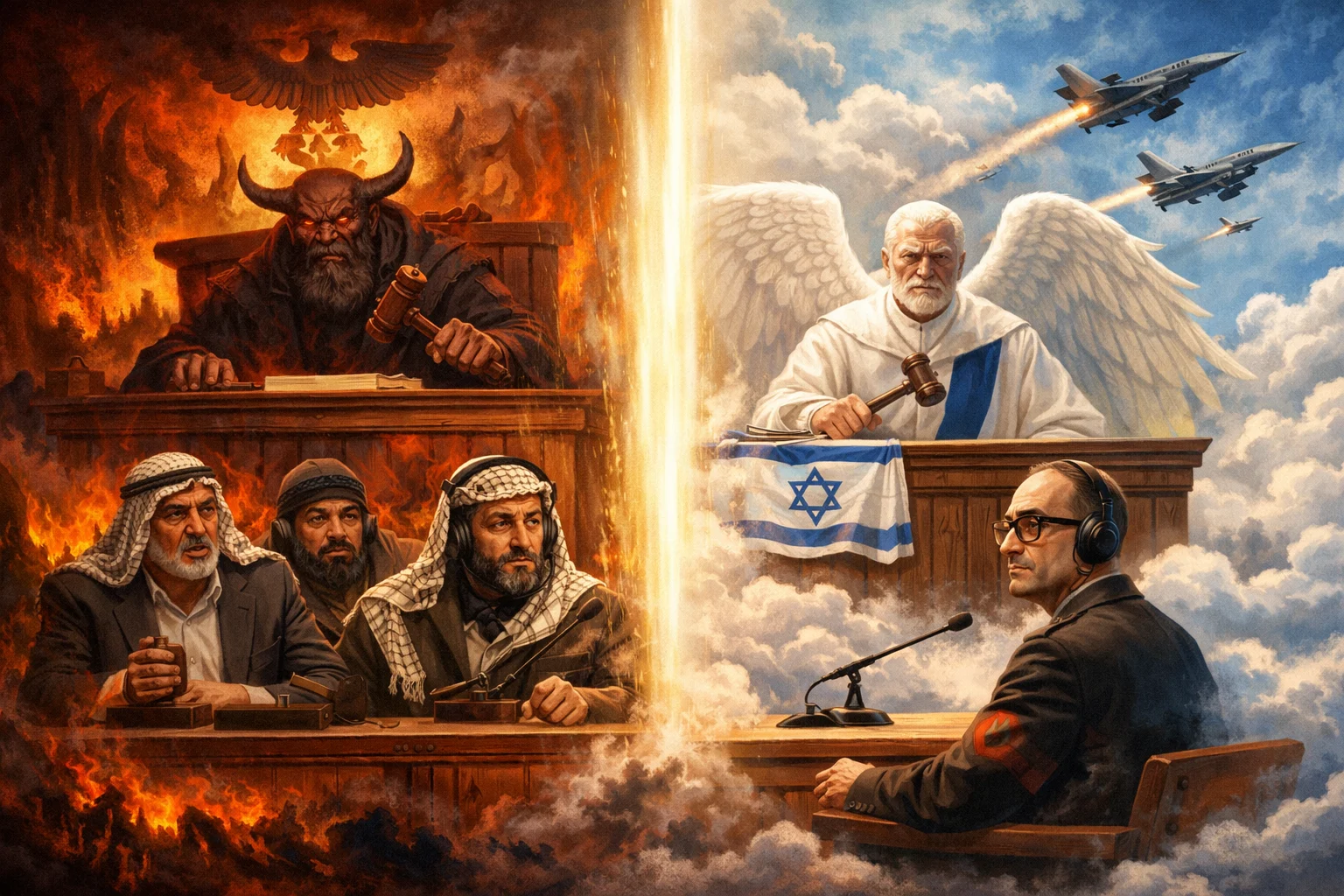
On April 11, 1961, the world was forced to sit still and listen. The trial of Adolf Eichmann began in Jerusalem, and with it came something that had been missing since the end of World War II: accountability that could not be dodged, buried, or diluted.
Eichmann was not a soldier caught in the chaos of war. He was a bureaucrat of death. A planner. A man who turned genocide into logistics. As an SS officer with the rank of Obersturmbannführer, he helped engineer the machinery behind the Final Solution. Trains ran on time because he made sure they did. Human beings were reduced to cargo because he organized it that way. Hundreds of thousands of Jews, especially from Hungary, were sent to their deaths with chilling efficiency.
After the war, he did what many perpetrators tried to do. He disappeared. He fled to Argentina, hid behind a false name, and hoped the world would move on. But history did not forget, and neither did Mossad. His capture in 1960 was not just an intelligence success. It was a statement. There is no safe haven for those who orchestrate mass murder. Not then, not ever.
The trial itself stripped away excuses. Eichmann claimed he was just following orders, a line so hollow it has since become synonymous with moral failure. The court did not accept it. He was found guilty on all counts and sentenced to death. Justice, delayed but not denied.
That moment still echoes today, but the world around it has changed in uncomfortable ways. The battlefield is no longer just physical. It is digital, ideological, and psychological. The enemies are not always in uniforms. The lines are blurred, but the stakes are not.
Modern Israel operates in a different reality. It faces threats from groups like Hamas, organizations that openly call for its destruction. Leaders such as Ismail Haniyeh have been central figures in that struggle. Reports of targeted strikes against such figures are part of a broader strategy: remove those who plan, fund, and direct violence.
This is where the comparison becomes uncomfortable but unavoidable. Eichmann wore a uniform and worked within a state apparatus. Today’s militant leaders operate through networks, proxies, and media channels. But the underlying principle remains the same. If you organize violence against civilians, if you build systems that enable terror, you become a target for justice in whatever form it takes.
That does not mean the methods are clean. They are not. Airstrikes, covert operations, assassinations. These are not courtroom proceedings with neatly presented evidence and measured verdicts. They are messy, controversial, and often tragic. Civilians get caught in the middle. Mistakes happen. And every action fuels another wave of anger, another cycle of retaliation.
But here is the blunt truth: states facing existential threats do not operate in ideal conditions. They operate in survival mode.
What is perhaps more disturbing today is not just the violence on the ground, but the distortion of reality online. Platforms like LinkedIn, which were built for professional discourse, have become breeding grounds for propaganda, misinformation, and at times outright antisemitism. Lies spread faster than facts. Double standards are applied without hesitation. People who would never tolerate hate in one context amplify it in another.
This is not harmless. Words shape perceptions. Perceptions shape policies. And policies can cost lives.
There is a growing sense of frustration among those who see history repeating itself in new forms. Not in identical ways, but in patterns that are impossible to ignore. Dehumanization. Justification of violence. Selective outrage. Silence when it matters most.
Eichmann’s trial was a warning as much as it was a reckoning. It showed what happens when ideology overrides humanity and when ordinary individuals become complicit in extraordinary crimes. It also showed that justice, even decades later, can still arrive.
Today, the question is whether that lesson still holds weight. Will those who incite violence or support extremist ideologies face consequences? Or will they hide behind screens, behind rhetoric, behind the noise of a distracted world?
“Never again” is easy to say. It is much harder to enforce. It requires vigilance, honesty, and a willingness to confront uncomfortable truths. It requires calling out hatred even when it is inconvenient or unpopular.
Justice does not always look the same. Sometimes it is a courtroom in Jerusalem. Sometimes it is an intelligence operation in a foreign country. Sometimes it is simply refusing to stay silent in the face of lies.
But one thing has not changed since 1961. Actions have consequences. And history, no matter how much people try to rewrite it, has a very long memory.