When the World Hesitates, Israel Does Not
For decades, Israel has lived at the intersection of two conflicting global realities: a world that debates, delays, and dithers and a nation that does not have that luxury. When threats rise, Israel does not wait for permission. When genocidal rhetoric grows louder, Israel does not shrug. When existential danger approaches, Israel responds with precision, purpose, and a clarity that too many nations abandoned long ago.
This difference between those who hope for peace and those who prepare to ensure it explains why Israel remains one of the few countries on earth that consistently chooses responsibility over applause. It also explains why Israel’s actions, though often criticized, have repeatedly prevented disasters the world eventually admits it should have worried about sooner.
The Burden of Being First
When most nations face danger, they consult committees, wait for resolutions, or rely on alliances. Israel cannot. The small Jewish state, no bigger than New Jersey, stands in one of the world’s most volatile regions, surrounded by actors who openly declare they wish to eliminate it. Israel’s intelligence services, military leadership, and policymakers understand a truth many Western capitals prefer to ignore: when your enemies promise to kill you, you take them seriously.
This is the foundation of Israel’s defense doctrine. Not aggression, not expansionism, not ideology but the unmistakable requirement to prevent annihilation before it becomes irreversible.
And history has vindicated this doctrine again and again.
The Courage to Act Before It’s Too Late
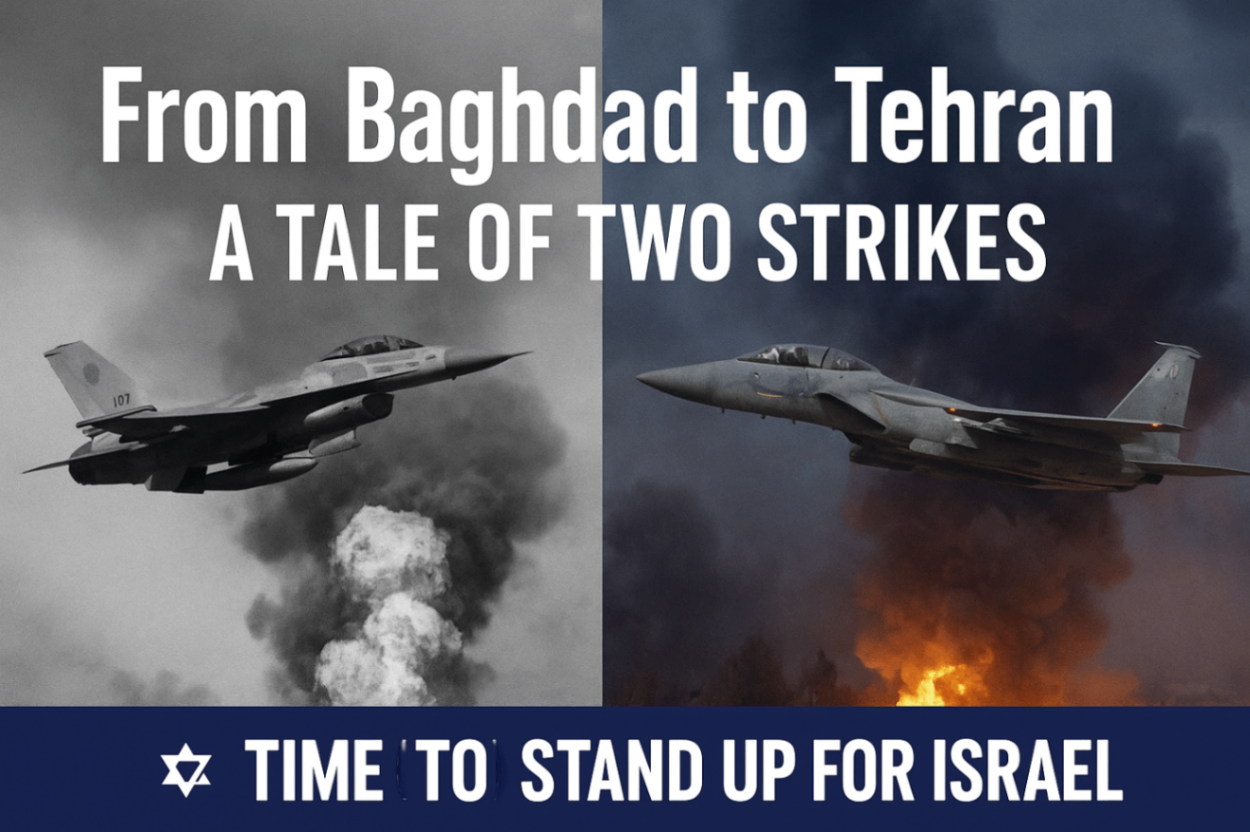
Decades ago, when the world was still trying to decipher Saddam Hussein’s ambitions, Israel already understood them. It was Israel, not the UN, not NATO, not the Arab League, that assessed the danger of the Osirak reactor and concluded that a future nuclear-armed Iraq was not an academic question, but a countdown to potential genocide.
Operation Opera in 1981 was more than a preemptive strike; it was a declaration that Jewish survival would never again depend on the hopes or moral courage of others.
The world condemned the strike. Yet when Saddam invaded Kuwait a decade later, global leaders quietly acknowledged an uncomfortable truth: had Israel not acted, they might have been facing a nuclear tyrant with ambitions far beyond Kuwait City.
History proved Israel right.
And yet, astonishingly, the world repeatedly forgets this lesson.
A New Century, an Old Threat
Today, the central threat does not come from Baghdad but from Tehran, a regime that has funded extremist militias, empowered terrorism from Lebanon to Yemen, and declared openly, repeatedly, and proudly that its goal is the destruction of Israel.
For years, Western governments hoped that negotiations, sanctions, or “restraint” would convince Iran to abandon its nuclear ambitions. They crafted agreements, issued warnings, delivered speeches. Meanwhile, Iran continued to enrich uranium, expand its missile programs, and arm its proxies for war.
While diplomats debated, Israel watched the clock.
When intelligence showed that Iran was approaching the point at which its nuclear program could no longer be stopped without decisive action, Israel, once again, acted. The 2025 coordinated strikes across Iran’s nuclear and military infrastructure were not reckless, impulsive, or politically motivated. They were the logical continuation of a doctrine forged from millennia of Jewish experience.
If the world refuses to enforce red lines, Israel will.
If global institutions allow dangerous regimes to advance, Israel will not.
And if existential threats emerge, Israel will always choose survival over popularity.
The Hypocrisy of Global Criticism
Israel’s defensive actions, whether in 1981, 2007, 2025, or any other year, are consistently met with criticism from governments that face none of Israel’s dangers and share none of its burdens.
It is easy to condemn preemptive action when your borders are quiet.
It is easy to demand endless diplomacy when your cities are not targeted by rockets.
It is easy to speak of proportionality when your enemies are not attempting to develop nuclear weapons while calling for your destruction.
Israel’s detractors enjoy the comfort of distance. Israel lives with the consequences of their wishful thinking.
And the hypocrisy is stunning: the same countries that scold Israel during the crisis later acknowledge, often behind closed doors, that Israel prevented a far greater disaster.
When the world hesitates, Israel decides.
When the world debates, Israel defends.
A Moral Doctrine, Not a Militaristic One
Critics misunderstand Israel’s philosophy. They see airstrikes, intelligence operations, cyber defense, and assume aggression. But Israel does not act to conquer. Israel acts to avoid catastrophe.
The guiding principle is simple:
If there is no Israel, there is no second chance.
For Israelis, this is not theory. It is memory. A memory carved into the DNA of a people who know what happens when the world ignores danger until it is too late. The Jewish state cannot wait for threats to materialize. It cannot gamble on international goodwill. The survival of the world’s only Jewish nation is not something to be delegated to the United Nations.
Nor is Israel’s strength a tool of oppression. It is the shield that makes coexistence possible. It is precisely because Israel is strong that it can offer humanitarian aid, respond with restraint, and maintain democratic norms even under fire.
Strength preserves peace. Weakness invites war.
What the World Should Learn
Israel’s actions carry lessons far beyond the Middle East:
- Moral clarity matters. Calling genocidal regimes “partners for peace” does not make them peaceful.
- Peace must be defended, not wished for. Diplomacy without enforcement is an illusion.
- Prevention is the highest form of defense. A war avoided is better than a war won.
- Small nations can shape global history. Israel, despite its size, has repeatedly prevented regional and global disasters.
- Never again must be operational, not symbolic. It is a commitment that requires action, not hashtags.
The World May Hesitate But Israel Cannot
Israel is courageous in a way the world often forgets how to be. It faces danger with clarity, not denial. It confronts threats before they become catastrophes. And it carries the burden of making decisions others are too afraid to make.
When critics accuse Israel of acting alone, they miss the point.
Israel acts alone because it must.
Israel acts early because it has learned what happens when you act too late.
Israel acts decisively because hesitation is a luxury a surrounded democracy cannot afford.
And when the dust settles, history, as it always does, will reveal the truth:
Israel didn’t destabilize the region.
Israel prevented something far worse.
In a world that forgets lessons, Israel remembers.
In a world that hesitates, Israel protects.
And in a world that doubts, Israel survives.