From the Jordan River to a Global Water Powerhouse
Long before Israel existed as a state, Jewish engineers were already doing what Israel is known for today: solving impossible problems with vision, science, and determination. One of the clearest and least discussed examples is the transformation of the Jordan River into a source of electricity and development decades before 1948.
This is not just a historical footnote. It is proof that Jewish presence in the land was never about exploitation or conquest, but about building, modernizing, and making life possible in a harsh environment.
Engineering Before Sovereignty
In the early 20th century, the region had almost no modern infrastructure. Electricity was rare, water management was primitive, and much of the land was plagued by swamps, malaria, and seasonal flooding. Yet Jewish engineers, many trained in Europe, arrived with a clear understanding: without water control and electrification, there would be no future.
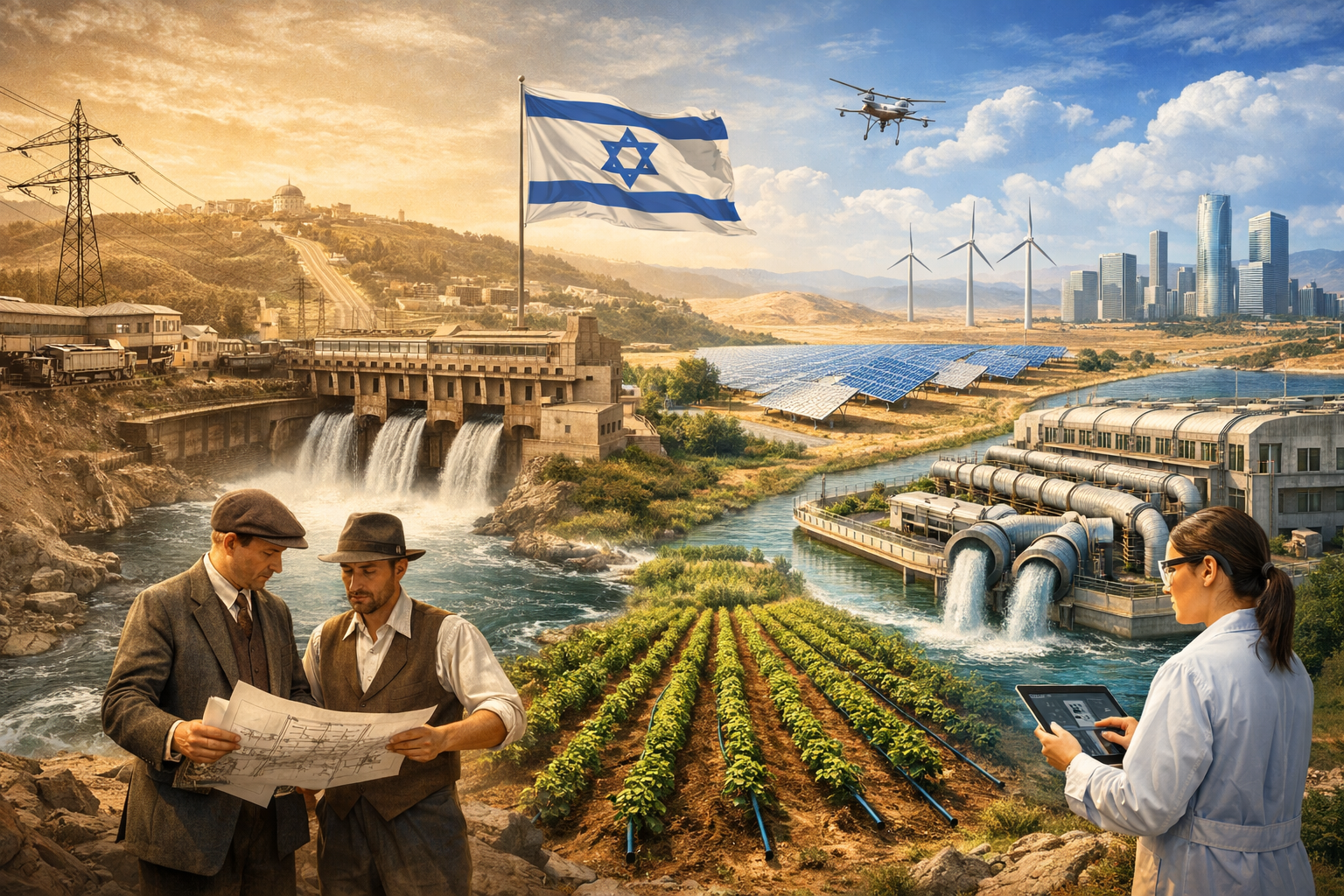
The most important figure was Pinhas Rutenberg, a Jewish engineer who, in 1919, presented a detailed plan to harness the Jordan and Yarmouk Rivers for hydroelectric power. This was revolutionary thinking in a region still dependent on kerosene lamps and animal labor.
In 1926, under the British Mandate, Rutenberg received a legal concession to develop electricity and founded the Palestine Electric Company, the predecessor of today’s Israel Electric Corporation. This was not a Zionist slogan but it was a technical, financial, and engineering undertaking on a massive scale.
The Naharayim Breakthrough
The crowning achievement came in 1932 with the completion of the Naharayim Hydroelectric Power Station, located at the confluence of the Jordan and Yarmouk Rivers.
Jewish engineers:
Designed and built dams, canals, turbines, and generators
Created transmission lines across the country
Built the first large-scale hydroelectric power station in the Middle East
Electricity from Naharayim powered Jewish and Arab cities alike, including Haifa, Tel Aviv, and Jerusalem. It energized ports, factories, hospitals, farms, and water pumps. This electrification laid the foundation for modern agriculture, industry, and urban life, all before Israel existed as a state.
This fact alone dismantles the claim that Jewish development in the land was imposed after 1948. The infrastructure was already there.
Water as a National Mission
Electrification was only part of the story. Jewish engineers and hydrologists also:
Mapped underground aquifers and surface water sources
Drained malaria-infested swamps
Controlled floods and seasonal water loss
Developed early national water planning concepts
These efforts made large areas habitable and productive. The idea that Israel “stole” or “appropriated” water ignores a simple truth: before Jewish engineering, much of this water was unmanaged, wasted, or destructive.
From Survival to Innovation
When Israel declared independence in 1948, it inherited something extraordinary:
A functioning electrical grid
Proven water infrastructure
A culture of engineering solutions
From that point on, Israel did not stop, it accelerated.
Because Israel lacked oil, abundant rivers, or endless rainfall, innovation was not optional. It was existential.
Over the decades, Israel pioneered:
The National Water Carrier, moving water from north to south
Drip irrigation, now used worldwide to reduce water waste
Advanced desalination, producing most of Israel’s drinking water today
Wastewater recycling, with nearly 90% reuse, the highest rate on earth
Smart water grids, using AI and sensors to detect leaks and optimize flow
Renewable energy integration, including solar power in desert conditions
What began with the Jordan River became a global model.
Sharing, Not Hoarding
Another inconvenient truth: Israel does not keep this expertise to itself.
Israeli water and energy technologies are used in:
Africa, to combat drought and famine
Asia, for irrigation and flood control
Europe and North America, for desalination and efficiency
Jordan and the Palestinian Authority, through water-sharing agreements
This is not the behavior of a state built on exclusion. It is the behavior of a nation shaped by necessity and responsibility.
Proof of Jewish love and reponsibiliy for the land
The story of the Jordan River electrification exposes a deeper reality: Zionism was never just political, it was deeply practical. Jewish engineers didn’t arrive with slogans. They arrived with blueprints, turbines, pumps, and long-term plans.
Israel’s modern achievements in water and energy are not accidents. They are the direct continuation of work that began decades before statehood, under far harsher conditions, and with far fewer resources.
From hydroelectric turbines at Naharayim to desalination plants on the Mediterranean coast, Israel’s message has remained the same:
You don’t conquer land by destroying it. You build a future by making it livable.
That truth flows from the Jordan River, then and now.