
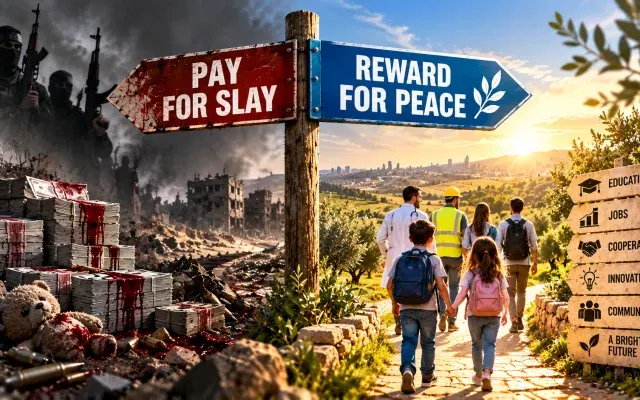
What if we stopped asking how to punish terrorism and started asking how to make peace more rewarding than violence?
For decades, Israel has been confronted with a disturbing reality. While Israeli families bury their loved ones following terrorist attacks, financial payments have been made to imprisoned terrorists and the families of those killed while carrying out attacks. This system, widely known as Pay for Slay, has become one of the most controversial aspects of the Israeli and “Palestinian” conflict. Yet despite years of international criticism, diplomatic pressure and financial sanctions, the underlying problem remains. Violence continues to be glorified, terrorists are celebrated as heroes, and generations of children are exposed to narratives in which killing Israelis can bring honor, recognition and financial benefits.
But what if we reversed that logic completely?
What if saving an Israeli life brought greater recognition than taking one? What if preventing terrorism became more rewarding than participating in it? What if the international community invested as much energy in rewarding peaceful behavior as it currently spends condemning violence?
Perhaps it is time to stop fighting only against the incentives for terrorism and start creating powerful incentives for peace.
Understanding Pay for Slay
The term Pay for Slay refers to a longstanding system of financial benefits associated with the Palestinian Authority, under which payments have been provided to prisoners convicted of security offenses, including terrorism, and to families of those killed or injured in the conflict.
Under the previous prisoner payment arrangements, monthly allowances could increase according to the length of a prison sentence. This created a particularly troubling incentive structure because individuals convicted of the most serious offenses, including murders that resulted in lengthy sentences, could qualify for higher payments.
Consider the implications.
A person convicted of murdering Israeli civilians could receive financial benefits linked to the severity of the sentence. Families of perpetrators killed during attacks could also receive financial support. Although not every recipient was convicted of terrorism, the inclusion of convicted murderers and other attackers made the system morally indefensible.
The Palestinian Authority has defended such payments as social welfare for families affected by imprisonment or death. Critics, including Israel and successive American administrations, argue that providing financial benefits connected to terrorist offenses legitimizes violence and risks encouraging further attacks.
In February 2025, Palestinian Authority President Mahmoud Abbas announced a reform intended to replace the previous prisoner and family payment arrangements with a needs based social welfare system. However, the announcement did not automatically resolve concerns about implementation, transparency or whether financial benefits would continue through alternative channels.
The essential question remains whether public money is distributed according to genuine humanitarian need or whether participation in violence continues to provide financial advantages.
And that distinction matters enormously. Because money is never just money. It communicates priorities. It influences decisions. It can reinforce social expectations and determine which behavior a society chooses to recognize.
When violence becomes associated with financial security, prestige or public admiration, the consequences can extend far beyond the individual perpetrator.
The Real Victims of This System
The obvious victims are the Israelis murdered, injured and traumatized by terrorism. Their families carry the consequences for the rest of their lives. No financial compensation can restore a murdered child, a parent or a spouse.
But there are other victims as well. Ordinary “Palestinian” families who want nothing more than security, employment, education and a future for their children are trapped in an environment where extremist organizations and political leaders have repeatedly exploited suffering for ideological purposes.
A young person who dreams of becoming an engineer, doctor or entrepreneur should never have to compete for social recognition with someone who chooses violence.
A father who works honestly to support his family should receive greater respect than someone who attacks innocent civilians.
A mother who teaches her children coexistence should be celebrated rather than intimidated into silence.
Yet peaceful voices are often overshadowed by those who glorify confrontation.
This is where the international community has failed spectacularly.
For decades, enormous amounts of international assistance have been directed toward “Palestinian” institutions and humanitarian programs. Some of that assistance has provided essential services and saved lives. But international donors have too often failed to establish a convincing strategy for strengthening the social standing, safety and economic opportunities of people who actively reject violence.
We cannot purchase peace simply by transferring money to political institutions.
We must change what society rewards.
Introducing Reward for Peace
Imagine an entirely different system.
Instead of financial benefits being associated with imprisonment for terrorism, create a transparent international program that rewards measurable contributions to peace, cooperation and the protection of human life.
Call it Reward for Peace.
The principle is simple.
If terrorism can bring financial benefits and social recognition, then preventing terrorism, saving lives and building peaceful relationships should bring far greater opportunities.
Not through propaganda. Not through forced political loyalty. Not by demanding that people abandon their national identity or personal beliefs.
But through tangible opportunities connected to constructive behavior.
Imagine a “Palestinian” teacher who develops an educational program promoting coexistence and rejecting antisemitism. Instead of struggling to obtain resources, that teacher receives international funding to expand the program.
Imagine a young entrepreneur from Judea & Samaria who establishes a business employing both Israelis and “Palestinians”. Rather than facing endless political obstacles, the entrepreneur becomes eligible for investment, business mentoring and access to international markets.
Imagine a medical professional who participates in joint emergency response training with Israeli colleagues. Such cooperation could qualify for scholarships, professional exchanges and funding for medical equipment.
Imagine a community leader who successfully organizes dialogue between neighboring Israeli and “Palestinian” communities. That person receives support for projects that create jobs, improve infrastructure and strengthen local security.
These are not fantasies. Cooperation already exists in healthcare, commerce and other areas despite the political conflict.
The challenge is to transform isolated examples into a comprehensive strategy.
What About Preventing Terrorism?
This is perhaps the most sensitive and important part of the proposal.
Imagine someone who becomes aware of an imminent terrorist attack and decides to prevent it.
That decision could save dozens of innocent lives.
Should society not recognize the extraordinary value of such an act?
Of course it should.
But recognition must never expose that individual or their family to retaliation.
A responsible Reward for Peace program could therefore include confidential protection arrangements, secure relocation when necessary, educational opportunities and long term support for individuals who face credible threats because they helped prevent violence.
Such arrangements would need strict independent oversight and should never encourage fabricated accusations, vigilantism or dangerous attempts by civilians to investigate suspected terrorists.
The objective must be protecting human life, not creating a market for informants.
The moral principle remains clear.
Saving a life should never carry a greater personal cost than taking one.
Reward Communities, Not Just Individuals
There is another possibility that deserves serious consideration.
What if entire communities could benefit from sustained peaceful cooperation?
Imagine villages in Judea & Samaria participating voluntarily in programs designed to strengthen economic development, education and coexistence.
Communities that demonstrate successful cooperation could receive priority access to additional development grants, infrastructure investments, vocational training and international business partnerships.
The emphasis should be on measurable achievements such as successful joint projects, participation in nonviolent conflict resolution, educational initiatives and improvements in local economic opportunities.
Importantly, essential humanitarian assistance must never depend on political compliance, and innocent families must never be punished for the actions of terrorists.
Peace cannot be built through collective punishment.
But additional investment can encourage positive initiatives.
A community that establishes a successful Israeli and “Palestinian” agricultural partnership could receive funding to expand production.
A school that introduces credible educational programs against antisemitism and incitement could receive scholarships and international academic partnerships.
A municipality that develops effective cooperation on environmental protection, water management or emergency medical services could gain access to technical expertise and development funding.
The result would be a different form of competition.
Not competition over who demonstrates the greatest hostility toward Israel, but competition over who creates the greatest opportunities for their children.
Change the Meaning of Heroism
Perhaps the greatest transformation must occur in the definition of a hero.
For too long, extremist organizations have presented individuals responsible for murdering Israelis as symbols of resistance.
Their photographs appear on posters. Their names are celebrated. Their actions are incorporated into political narratives that glorify sacrifice through violence.
This culture of glorification must be challenged.
But simply removing posters or condemning slogans will not be enough.
Societies need alternative role models.
Let the doctor who saves Israeli and “Palestinian” children become a hero.
Let the teacher who rejects hatred become a hero.
Let the father who prevents his son from joining a terrorist organization become a hero.
Let the entrepreneur who creates employment across communities become a hero.
Let the young person who refuses to inherit generations of hatred become a hero.
Give these people opportunities, recognition, scholarships and platforms from which their achievements can inspire others.
Make their success visible.
Make their courage meaningful.
Make peaceful achievement something future generations aspire to.
Because children learn not only from what adults tell them, but also from what adults celebrate.
Israel Should Lead, But Not Carry the Burden Alone
Israel has every right and obligation to protect its citizens against terrorism. Nothing in this proposal should weaken that responsibility.
Military preparedness, intelligence cooperation and effective security measures remain essential.
But military strength alone cannot transform the beliefs and aspirations of future generations.
A successful Reward for Peace initiative would require cooperation among Israel, credible international donors, independent organizations, businesses and willing “Palestinian” participants.
The European Union, the United States and Arab countries that have established diplomatic relations with Israel could play important roles.
Financial support should be administered through independently audited programs with transparent eligibility criteria and safeguards against corruption, discrimination and political exploitation.
Success should be measured not by the amount of money distributed, but by the number of sustainable businesses created, educational partnerships established, lives protected and peaceful relationships strengthened.
And one principle must remain nonnegotiable.
No financial incentive should ever excuse terrorism, erase accountability or require Israel to compromise the safety of its citizens.
Rewarding peace is not the same as purchasing forgiveness.
It is an investment in preventing the next tragedy.
The International Community Must Make a Choice
The world has spent decades discussing what Israel should concede, what Israel should change and what Israel should sacrifice in the pursuit of peace.
Far less attention has been devoted to the question of how to create meaningful incentives for peaceful behavior within “Palestinian” society.
That imbalance must change.
Peace requires more than demanding concessions from one side.
It requires a fundamental rejection of the idea that murdering civilians can advance a legitimate political cause.
It requires leaders who teach their populations that coexistence is not surrender, that cooperation is not betrayal and that Jewish self determination does not prevent others from pursuing dignity and prosperity.
Most importantly, it requires the international community to stop confusing financial assistance with meaningful progress.
Money without accountability can sustain dysfunctional institutions.
Money connected to constructive achievements can create opportunities.
The difference is not merely economic.
It is moral.
Turning Evil into Good
I have spent years advocating for Israel, confronting antisemitism and challenging narratives that justify violence against the Jewish state.
And I have learned something important.
Condemning evil is necessary, but condemnation alone does not create good.
We can expose terrorism, challenge propaganda and demand accountability. We absolutely should.
But imagine what could happen if we also invested in building an alternative that offers young people a future worth choosing.
A future in which education brings more opportunity than extremism.
A future in which cooperation brings more recognition than hatred.
A future in which saving lives is celebrated rather than taking them.
We cannot force people to love Israel.
We cannot purchase genuine friendship.
And we certainly cannot eliminate generations of hostility with a financial transaction.
But we can influence the incentives that shape decisions.
We can create opportunities for those who reject violence.
We can protect those who demonstrate moral courage.
And we can show future generations that choosing peace is not a sign of weakness, but a path toward dignity, prosperity and freedom.
Pay for Slay represents everything that is wrong with rewarding violence. Reward for Peace could represent everything that is right with investing in humanity.
The objective is not to reward people simply for refraining from murder. That is a basic obligation of every civilized society.
The objective is to recognize and support those who go further, those who actively build bridges, prevent violence, protect innocent lives and create a future in which terrorism loses its appeal.
Israel has demonstrated extraordinary determination in defending life against those who seek its destruction.
Perhaps the next great challenge is to help create an environment in which more people discover that building a future alongside Israel offers far greater rewards than attempting to destroy it.
Because the ultimate victory over terrorism is not merely defeating those who choose death.
It is creating a future in which choosing life becomes the most powerful decision of all.
And perhaps that is how we finally begin turning evil into good.