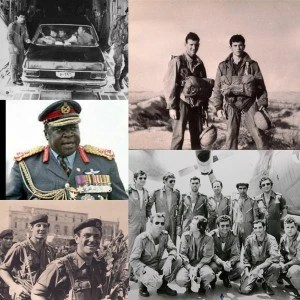
Operation Entebbe took place during the night of July 3 to July 4, 1976, at Entebbe Airport in Uganda. It was a rescue mission carried out by the Israel Defense Forces (IDF) to free Israeli citizens and other Jewish hostages who had been taken captive by German and Palestinian terrorists after a flight from Athens. The terrorists had separated the Jewish hostages from the other passengers based on their ethnicity. The military codename for the operation was Operation Thunderbolt. However, in honor of Jonathan Netanyahu, who was killed in action, the mission was later referred to posthumously as Operation Jonathan. The public and the media commonly use the unofficial name Operation Entebbe. The final death toll was 56 people, including 45 Ugandan soldiers, seven hijackers, three hostages, and Netanyahu. Two hostages were killed during the rescue operation. Another hostage, 75-year-old Dora Bloch, had been taken to a local hospital the day before the mission and was therefore not rescued. She was murdered the following day by Ugandan soldiers. Ugandan dictator Idi Amin suspected neighboring Kenya of assisting Israel in the operation and ordered the killing of hundreds of Kenyans living in Uganda in retaliation.
Lt. Col. (res.) Mor knows what it means to fight for freedom. He was born in Poland and escaped to Israel with his parents and seven siblings during the Nazi regime. He enlisted in the Israel Air Force and passed the rigorous Flight Academy course. During his time as a captain in the IAF, he became a trained navigator. His talent for navigation was put to the test when, on June 27, 1976, Air France Flight 139 was hijacked. This flight, which had originated in Tel Aviv, had a scheduled layover in Athens, Greece, before it was to continue to Paris, France. Shortly after taking off from Athens, four of the new passengers hijacked the flight and demanded the release of hundreds of prisoners worldwide.
The hijackers – Wilfried Böse and Brigitte Kuhlmann of the German Baader-Meinhof militant group, and two Palestinians from the Popular Front for the Liberation of Palestine – directed the hijacked flight to Entebbe Airport in Uganda, where Ugandan soldiers, under the leadership of then-Ugandan President Idi Amin Dada, helped support the hijackers and trap the hostages. Upon arrival, the terrorists immediately separated the Jewish and Israeli hostages from the rest of the captives. “Even now, as I am telling you the process by which the terrorists selected their hostages, it hurts me to say it,” Lt. Col. (res.) Mor said, recounting that “it was a similar selection process the Nazis administered when selecting who would go work and who would be sent to the gas chambers.” Gathering Intelligence With the deadline in motion and little known about the underlying motives of the hijackers, their exact whereabouts in Entebbe Airport, and their plans moving forward, Israel’s government and security officials sought to collect information about the situation as quickly as possible.
“One of the biggest problems we had,” recalled Lt. Col. (res.) Mor, “was that we were operating with minimal clarity throughout the entire mission, as we had no reliable source of information. And, when faced with an ultimatum, time is of the essence.” In the week before the raid, Israel tried a number of political avenues to release the hostages. Faced with little choice, the Israeli government announced that it would enter into negotiations. This provided Israel with just enough time to consolidate a seemingly impossible military rescue operation, as the terrorists issued a new ultimatum for July 4. Gathering intelligence took a few days and, by midday Tuesday, IDF forces were able to gather enough information about the situation to provide them with basic clarity to work desperately on a possible rescue attempt. In the middle of the night on Wednesday,
Lt. Col. (res.) Mor received a house visit from a friend and fellow soldier in the Israel Air Force. “My wife answered the door. My friend told her ‘Norit, I suggest you go to your room and close the door,’” Lt. Col. (res.) Mor recalled. “By 6 the following morning, I was at an exercise with Sayeret Matkal.” From that moment on, every single person who was in some way relevant to the mission was in a period of intensive brainstorming for the best possible rescue scenario to present to Israel’s governing officials. A few options were thrown around until, on July 1st, the mission’s main commander, Brig. Gen. (res.) Dan Shomron (later to become the IDF’s Chief of Staff), presented the rescue plan to Lt. Gen. (res.) Mordechai Gur (then Chief of Staff), Shimon Peres (then Israel’s defense minister) and Yitzhak Rabin (then prime minister) for final authorization to complete the highly secretive rescue mission. One of the aircraft crews that landed at Entebbe poses with their plane after the mission. Ready, Set, Don’t Fire Out of this plane emerged two jeeps and a black Mercedes, practically identical to the car of then-Ugandan president Idi Amin Dada. Lt. Col. Netanyahu’s unit drove slowly and calmly towards the old terminal, appearing as if they were Ugandan forces in familiar vehicles. They were ordered not to shoot before reaching the old terminal and to take the terrorists by surprise. However, one of the IDF soldiers shot at a Ugandan soldier who was heavily armed and close to their vehicle. They were no longer undercover, and their plan was now altered as they had to reach the old terminal as quickly as possible. The second and third Israeli planes arrived six minutes later, carrying reinforcements and troops assigned to help fight the Ugandan forces surrounding the airport. “I had the great honor of being the leading navigator for aircrafts two, three, and four,” Lt. Col. (res.) Mor said proudly. The fourth aircraft – the only aircraft with enough gas to fly to Entebbe and back to Israel, arrived empty, ready to evacuate the hostages and take them home. “The rest of us had no details about the first aircraft and what was going on down there. I was in the second aircraft and, whether the first was successful or not, we had to land at the airport precisely six minutes after them,” Lt. Col. (res.) Mor said. “Luckily, they succeeded and, in six minutes, killed the terrorists and rescued the hostages.” Within 20 minutes of their arrival, IDF soldiers began evacuating the hostages in the fourth aircraft.
“Our mission was accomplished the instant the hostages had left Entebbe,” Lt. Col. (res.) Mor recalled. Everyone was accounted for besides one: Lt. Col. Yonatan Netanyahu, the commander of the first aircraft’s Sayeret Matkal rescue unit, who had been shot and killed while helping hostages return to the aircraft. At least five other soldiers were wounded during the escape, but the soldiers finished evacuating the hostages, loaded Lt. Col. Netanyahu’s body into one of the planes, and left Entebbe Airport only 58 minutes after their arrival. The operation was later named “Operation Yonatan” in honor of its commander and one of Israel’s greatest soldiers. Returning Home On the morning of July 4, 1976, the rescued hostages and their defenders landed safely in Israel, concluding one of the most daring chapters in the history of the IDF. “I did not register it then, as we were still in mission mode,” Lt. Col. (res.) Mor explained, “but we landed at Ben Gurion [Airport in Israel] to a sea of Israelis swarming with pride, elated to welcome us home.” Looking back, Lt. Col. (res.) Mor insists this was one of Israel’s finest moments, as its heroic actions were heard around the world. “It marked one of the best times in Israel’s history in terms of international recognition and respect,” Lt. Col. (res.) Mor stated. Operation Entebbe marked a dramatic victory over international terrorism, but it did not eliminate the danger. Thirty seven years later, as Israel continues to cope with the threat of terror, the rescue at Entebbe serves as a reminder that victory is worth the fight.
The Heroic captain of the plane Michel Bacos (Michel Bacos 3 May 1924 – 26 March 2019) was a French airline pilot. He was the captain of Air France Flight 139 when it was hijacked on 27 June 1976 by terrorists belonging to the German Revolutionary Cells (RZ) and the Palestinian Popular front for the liberation of Palestine- External Operations PFLP-EO). The hijacking was part of an international campaign of Palestinian Terrorism. In 1976, Bacos was awarded the National Order of the Legion of Honour, the highest decoration in France, by President Valery Giscar d’Estaing. The Israeli government awarded Bacos and his crew medals for heroism, for refusing to leave the Jewish passengers behind when the terrorists released their non-Jewish hostages and offered to release Bacos and his crew. In June 2008, Bacos was awarded the B’nai B’rith International “Ménoras d’Or” (Golden Menorah) in Cannes, France. Bacos retired from Air France in 1982,and resided in Nice, France, with his wife. They had seven grandchildren. In 2016, the American Jewish Congress awarded Bacos the organization’s Moral Courage Award. Bacos lived in Nice at the time of his death on 26 March 2019.The Israeli National Anthem, “Hatikva”, was played at his funeral.The Mayorof Nice, Christian Estrosi recognized Bacos, saying: “Michel, bravely refusing to give in to anti-Semitism and barbarism, did honor to France. The love of France and the defense of liberties have marked his destiny.” A street was named after Bacos in Netanya, Israel.