Out-of-the-Box Thinking: What If the Druze of Suwayda Traded Places With Gaza?
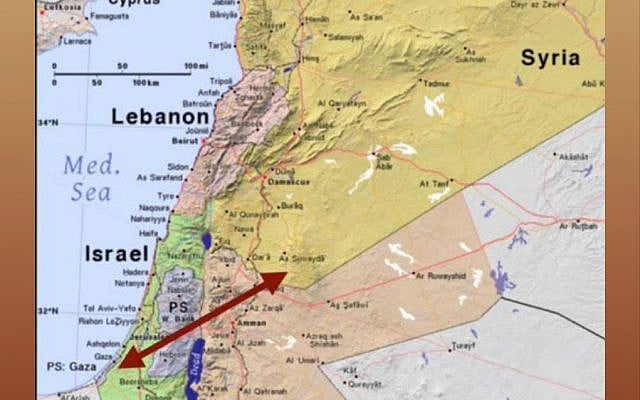
Imagine if Israel and Syria pulled off history’s first population-and-real-estate swap. The Druze of Suwayda, long isolated in the mountains of southern Syria, move to Gaza’s Mediterranean coast. The Palestinians of Gaza, in turn, resettle in Suwayda’s fertile highlands on the Jordanian border. Druze trade isolation for a thriving coastal region. Palestinians trade a blockaded strip for wide-open farmland. Israel gains a stable, non-hostile Gaza, while Syria gains a loyal population that has traditionally leaned toward Damascus.
It sounds wild, maybe even impossible but sometimes thinking out of the box helps us see the bigger picture. And the bigger picture is this: the histories of the Druze and the Palestinians of Gaza are not at all the same. One group has consistently chosen stability, loyalty, and integration when given the chance. The other has chosen rejectionism and violence, even when offered freedom. That contrast says everything about why Gaza is still trapped in cycles of bloodshed and why Israel’s perspective must be understood.
The Druze of Suwayda: Between Isolation and Loyalty
The Druze are a small but fascinating community that emerged in the 11th century, branching off from Ismaili Shi’ism and developing a unique faith blending Islamic, Gnostic, and monotheistic traditions. Secrecy and tight-knit solidarity have been hallmarks of their survival.
Their main homeland became southern Syria’s Jabal al-Druze (modern Suwayda), parts of Lebanon, and northern Israel. Under the Ottomans, the Druze of Suwayda lived in relative autonomy, often resisting central control. In the 1920s, during the French Mandate, the Druze of Suwayda led the famous Great Syrian Revolt under their legendary leader Sultan al-Atrash. They earned a reputation for bravery and independence.
Yet, in modern Syria, the Druze remained a vulnerable minority, just 3–4% of the population. They balanced between autonomy and loyalty to Damascus, never fully trusted, never fully empowered.
In Israel, however, their story took a different turn. When Israel was born in 1948, the Druze made a fateful decision: unlike the Arab Muslim majority, they aligned with the Jewish state. They volunteered to serve in the IDF, fought alongside Jewish soldiers, and earned deep respect. Today, Israeli Druze are doctors, generals, judges, and politicians. They are deeply integrated, fiercely loyal, and proof that minorities can thrive in Israel’s democratic framework.
In short: the Druze of Suwayda remained Syrian but marginalized. The Druze of Israel flourished by allying with the Jewish state.
Gaza: A Tragic Case of Rejection
Now let’s turn to Gaza, a region whose history has been rewritten by propaganda but which is clear when seen through facts.
- Ancient roots: Gaza is mentioned multiple times in the Bible. It was part of the territory of Judah, and Jews lived there in antiquity.
- Ottoman era: Under Ottoman rule, Gaza was a poor, neglected outpost, sparsely populated by Muslims, Christians, and some Jews.
- British Mandate: In 1917, the League of Nations entrusted Britain with all of Israel, Gaza, and Judea-Samaria, explicitly to establish a Jewish national home. There was no mention of a “Palestinian state.”
- 1948 War of Independence: When five Arab armies invaded Israel, Egypt took Gaza. Did Egypt grant Palestinians a state there? No. They locked them into camps, denied them citizenship, and ruled them with an iron fist.
- 1967: Israel captured Gaza during the Six-Day War after Egypt launched aggression. Israel offered peace for recognition. The Arab world answered with the infamous “Three No’s” of Khartoum: no peace, no recognition, no negotiations.
- 1990s Oslo Accords: Israel signed peace deals and transferred authority to the Palestinian Authority. The world hoped this was the start of self-rule and prosperity.
- 2005 Disengagement: In a painful move, Israel withdrew completely from Gaza, uprooting 8,000 Jewish families from Gush Katif. Their farms and greenhouses could have launched Gaza’s economy. Instead, they were looted and destroyed.
- 2007 Hamas Coup: Hamas, backed by Iran, violently expelled the Palestinian Authority and turned Gaza into a terror enclave. Billions in aid poured in. Instead of building schools, hospitals, or jobs, Hamas built rockets and tunnels.
And then came October 7, 2023, when Hamas terrorists massacred 1,200 Israelis, kidnapped civilians, and shattered any illusions of “coexistence” with a regime that glorifies death over life.
So let’s be clear: Gaza is not and never was a “Palestinian state.” It was Ottoman, then Egyptian, then briefly Israeli, then self-governed. When given the chance, its leadership turned it into a base of terror instead of a place of hope.
Two Paths, Two Lessons
Here lies the contrast:
- The Druze, when given the chance, chose loyalty, integration, and peace. In Israel, they prosper. In Syria, they survived through careful pragmatism.
- The Palestinians of Gaza, when given the chance, chose rejection, violence, and terror. Offered peace in 1948, they rejected it. Offered self-rule in the 1990s, they squandered it. Offered complete withdrawal in 2005, they built rocket factories.
One community proved that minorities can find a home in Israel. The other proved that endless victimhood and terror destroy every chance of building a future.
Out-of-the-Box, but Not Out of Reality
Would a Druze/Palestinian population swap ever happen? Probably not. But the thought experiment makes something crystal clear: Israel is not to blame for Gaza’s misery. The blame lies with Hamas, Arab leaders, and decades of rejectionism.
Israel has shown, time and again, that minorities who choose coexistence and loyalty—like the Druze, like Israeli Arabs who integrate into society—can thrive. Gaza’s tragedy is that its leadership chose a different path.
The lesson is simple: peace and prosperity come through partnership with Israel, not war against it.
And that’s not just out-of-the-box thinking. That’s reality.