
After twelve years of advocating for Israel, day and night, almost twenty four hours a day, I have learned one uncomfortable truth. You cannot convince someone who is determined to hate Israel simply by presenting more facts.
You can provide historical documents, archaeological evidence, legal arguments, and eyewitness testimonies. You can explain Jewish history, the origins of Zionism, Israel’s efforts toward peace, and the extraordinary achievements of a small nation facing enormous challenges.
Yet those who have already decided that Israel is evil will often reject everything you present. Facts become propaganda, historical evidence becomes fabrication, and every explanation is dismissed before it is considered.
So why continue? Why devote twelve years of my life to a cause when hatred appears to grow louder and meaningful dialogue increasingly difficult?
Because my advocacy is not primarily intended for those who already support Israel or those determined to oppose it. It is for the billions of people who know very little about the conflict and are still capable of forming an independent opinion.
That is where our greatest opportunity lies.
The Audience We Are Overlooking
Between passionate supporters and determined opponents of Israel exists an enormous population whose understanding of the conflict comes mainly from headlines, emotional images, social media, and political slogans.
Many have never studied Jewish history, visited Israel, or examined the historical background of the conflict. They are not necessarily hostile toward Israel. They simply lack the knowledge needed to evaluate competing narratives.
And that makes them vulnerable to manipulation.
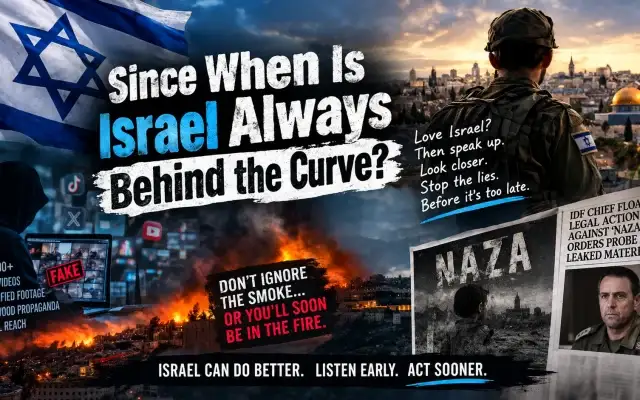
Pro Palestinian information campaigns have often proved remarkably effective at generating emotional engagement. Powerful images, simplified messages, and constant repetition can shape public opinion long before historical context enters the conversation.
Misleading footage, false captions, and selectively presented information can reinforce existing assumptions. Critics sometimes describe staged or misrepresented material as Pallywood, although genuine Palestinian suffering must never be dismissed simply because misinformation also exists.
The challenge is that emotional storytelling frequently reaches people faster than carefully documented facts.
While pro Israel advocates are explaining complex historical realities, emotionally compelling narratives may already have influenced millions.
We cannot solve this problem simply by publishing more of the same material for the same audience.
We must rethink whom we are trying to reach and how.
Our Division Is Weakening Our Message
One of the greatest obstacles facing pro Israel advocacy is our own fragmentation.
We have Jewish organizations, Christian Zionist organizations, secular groups, religious groups, supporters and opponents of Benjamin Netanyahu, advocates of a two state solution, and those who reject that possibility.
These differences are understandable. Israel is a democracy, and disagreement is part of democratic life.
But disagreement becomes destructive when organizations treat one another as rivals rather than partners.
Too often, personal ambitions, ideological disagreements, competition for donations, and the desire for recognition prevent meaningful cooperation.
Meanwhile, anti Israel movements, despite their own internal differences, frequently succeed in mobilizing around shared messages and objectives.
We should learn from that organizational effectiveness without adopting hostility or misinformation.
We do not need to agree on every Israeli government decision to defend Israel’s right to exist, oppose antisemitism, recognize Jewish historical connections to the land, and insist on fair standards.
Unity does not require everyone to think alike. It requires recognizing that our shared purpose is more important than our individual differences.
Why Arguments So Often Fail
There is a psychological reality that advocacy organizations frequently overlook.
People do not develop their beliefs through facts alone. Their opinions are influenced by emotions, social relationships, personal experiences, and the desire to belong.
When hostility toward Israel becomes part of someone’s group identity, changing that opinion may carry a social cost.
Their friends share the same beliefs. Their online communities reinforce them. Disagreement can threaten their sense of belonging.
Confronting such individuals publicly often makes them more defensive. Instead of considering new information, they feel compelled to protect their reputation and demonstrate loyalty to their group.
The conversation becomes a competition rather than an opportunity to learn.
This is why endless arguments on social media rarely produce meaningful change among deeply committed opponents.
We may win an argument without changing a single mind.
And after twelve years, I believe it is time to ask whether our energy could be used more effectively.
Reaching People Through Their Personal Interests
What if we approached individuals through something they genuinely care about rather than immediately confronting them with political arguments?
Imagine someone who strongly criticizes Israel but loves archaeology.
Instead of sending another political article, we give that person a beautifully illustrated book exploring archaeological discoveries in Jerusalem, Judea, and Samaria, also commonly referred to as the West Bank.
Through an existing passion, they encounter ancient Hebrew inscriptions, Jewish coins, historical sites, and evidence of the Jewish people’s longstanding connection to the land.
We have not demanded agreement. We have introduced knowledge through curiosity.
Consider someone who appreciates fine wine. Why not send a bottle of Israeli wine accompanied by a small, beautifully produced booklet about ancient winemaking traditions and modern Israeli vineyards?
Someone interested in medicine could receive a publication about Israeli medical innovations and cooperation between Jewish and Arab healthcare professionals.
A technology enthusiast might discover Israel’s contributions to water conservation, agricultural innovation, cybersecurity, and medical research.
An animal lover could learn about Israeli wildlife conservation. A music enthusiast might explore Israeli musicians representing the country’s remarkable cultural diversity.
The possibilities are almost endless.
Instead of approaching people exclusively through the conflict, we should approach them through their interests, passions, and natural curiosity.
A person who would immediately reject a political argument might willingly read a fascinating book about something they love.
And that book might introduce facts they have never encountered.